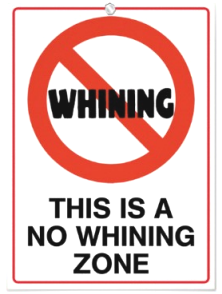
Some cheese with your whine? (dealing with the victim mentality)

As you may have figured out, I have a “thing” about accountability – I happen to believe it’s one of the most important character traits a person can possess.  I even wrote a whole article about it (see?).  So I fully acknowledge that when I address the topic of victim mentality, I have a bit of an agenda.  Okay, disclaimer out of the way.  Let’s do this!

Most of us have been “blessed” with the experience of watching someone play the victim – “It’s not my fault.” “He’s just out to get me.” “That’s not fair.” “I wanted to give you a raise, but they wouldn’t let me.”   The fascinating part about it is that the victim mentality knows no boundaries.  From the fresh-out-of-school entry-level clerk to the tenured CEO, anyone can take refuge in the sanctuary of the victim mentality.  Um…yay?

The tragedy of the victim mentality is that it quickly becomes a way of life for people.  Why?  Because it works.  It allows managers to avoid tough conversations because now it’s someone else’s fault and the employee can’t be mad at them.  It allows employees to avoid taking responsibility because now everything was out of their control and it’s not fair to blame them.   And the rest of us let them get away with it because it’s easier to just say “fine” and secretly resent them than it is to call them on it, all the while moping that you’re the only one who seems to do anything around here…thereby perpetuating the victim mentality.

no_whiningSo in the spirit of personal accountability, here is some guidance on how to overcome victim mentality for the following scenarios in your workplace:

  • If you’re listening to your employee or a peer play the victim: First, try not to roll your eyes.  Were you successful?  Good!  Now you can empathize (but don’t sympathize!).  Acknowledge that from their perspective, you could see it might feel like they were a victim (don’t say it that way – tailor your phrasing to the words they’re using).  Then you might start asking some probing questions, such as, “Did they explain to you why it was important to meet the deadline?” Or perhaps, “So when you read through all the fine print, did it not outline the penalties for early cancellation?”  Basically, you’re helping the other person see that they had some ownership, too.  Don’t be a smartass, though – that doesn’t work out well.
  • If you’re listening to your manager play the victim: Oy…what to do?  This one is tough, no question.  If you have a good relationship with your boss, you might be able to use humor to point out how silly they’re being.  (No, really, this works…as long as you trust each other).  Many times, all you can do is nod politely and say, “wow”.  Once your boss is done complaining, ask an action-oriented question, such as, “So what I can I do to help you move this forward/solve the problem/support you?”  Sometimes that’s enough to snap them out of it and get them in the right mindset attain.  Again – don’t be a smartass.  Just sayin’.
  • If it’s you playing the victim (non-manager role): Stop it.  (Need more?  Sheesh.)  Self-awareness goes a long way towards changing any behavior, so become a little more introspective about your complaining.  What’s your inner monologue say?  Is there a lot of finger-pointing, “they”, or “fairness” creeping in? Ask yourself, “What did I do that contributed to this outcome?” and acknowledge your role in the situation.  If you can’t seem to do that, ask a friend to play devil’s advocate to help you learn from the experience and break your victim habits.  Hopefully, they won’t be a smartass.
  • If you’re playing the victim (manager role): The most common issue I see in this case is from a manager who won’t own the message.  It might be that a policy has rolled out that they don’t entirely agree with, or they didn’t address an employee’s performance until someone else noticed the issue and said to deal with it – whatever it might be, some managers try to soften the blow by siding with the employees against a common enemy (usually “leadership” or the ever-popular “HR”).  Here’s the thing – the moment you use the word “they”, you have completely abdicated your authority and credibility to someone else.  Why should your employees see you as a leader if you let someone else push you around?  My advice is that you learn when to fight (not in front of your employees) and when to support (in front of your employees).  You don’t have to agree with everything you’re asked to roll out; but you need to ensure you are aligned with the company and can send a consistent message.  Learn why a decision was made, and figure out a way to communicate that decision without tipping your hand to either support or discontentment.  Not sure how?  Start listening to upper management roll out new policies.  No, not every policy change is a winner, but your employees are looking to you for cues on how to act.  If you’re a victim, they will be, too.

Will there be times in your life when you actually are a victim?  Yes.  So why not save all that energy for use when the situation calls for it, and not when you forgot to mail in your payment?   The reality is, your inner monologue contributes to your reality – if you think you’re a victim, you ARE a victim.  Wouldn’t you rather be the one running your life?  I know I would.

 If it’s never our fault, we can’t take responsibility for it. If we can’t take responsibility for it, we’ll always be its victim.
– Richard Bach

Got a good technique for overcoming a victim mentality?  Or just have a funny victim story to share?  Post it in the comments!


Defining Success (or how to gamble the right way)

I was watching Storage Wars the other night (don’t judge me) and one of the featured buyers/characters made the comment that the day was a bust because he didn’t get any of the lockers.  And it struck me that this person (“the gambler”) was looking at it from completely the wrong perspective.

For those of you who are unfamiliar with the world of Storage Wars, a brief tutorial – when people don’t pay their fees on a storage locker for a certain amount of time, these lockers are considered abandoned and are offered up for auction.  The bidders are not allowed to enter the locker or touch any contents – they get about 2 minutes to look inside and make a snap decision about bidding.

As you might have guessed, not all of these storage units are “winners”.  Units that look like they are full of high quality boxes have been known to be filled with old newspapers.  Occasionally there is a gem found among the lockers (old baseball cards, jewelry, rare books), but more often than not the bidders may only make $100 or even lose money on the deal.

gamblingwiththedevilSo, back to “the gambler’s” comment that bothered me so much.   Like most businesses, the storage racket would appear to live by the “buy low – sell high” philosophy, only in this situation, the buying is a very chancy proposition, indeed.  In that particular episode, a number of the lockers went for $2,000+ – pretty tight margins for someone who relies on buying other people’s abandoned stuff.  So wouldn’t you think that you might define success as making smart buying decisions and knowing when to NOT buy something?

A lot of leaders think like “the gambler” (and yes, it’s perfectly acceptable to be singing the song to yourself at this point).  They define success as having a finished product, whether it’s a PowerPoint deck, software roll out, or a company-wide reorg – even if one of these is a bad idea.  Or they define success as “winning” a conversation, shouting down the whole room and having the last word – even if it means abandoning the game plan.  Sometimes success means NOT taking action – but you wouldn’t know that if you haven’t taken the time to think about it.

Leadership is a bit of a gamble at times.  You don’t always know how your decisions will turn out.   Good analysis may suggest a course of action, but then you find out the data was inaccurate.  Depending on your hiring process, those candidates may look like a promising storage unit that you bid on, only to find out the fancy storage trunk hid a bunch of mold.  We stay in it, though, for that occasional hidden treasure that experience and research tells us should be a good bet.  The key is defining success the right way and sticking to it.  A few thoughts:

  • If you’re gonna play the game, boy, ya gotta learn to play it right: Have you REALLY defined what success looks like, or are you relying on a flash of insight, a vague pie chart, or a dream you had last night?  Do your homework, conduct some analysis, and define what success means…and stick to it!
  • You gotta know when to hold ‘em: Sometimes things start as clunkers (employees, projects, lunch plans).  But if your plan is sound and you keep the long-term goal in mind (success!), it’s worth waiting it out a little bit.  Don’t give up because you hit one road block.
  • Know when to fold ‘em: Conversely, don’t keep throwing good money after bad.  This really is gambling and typically doesn’t end well for anyone. (Click here for a recent post about knowing when to pull the plug).
  • Never count your money when you’re sitting at the table: Okay, I really just wanted to use all the lyrics, but hear me out.  Don’t assume you’re a success just because you had a good week, just as you shouldn’t assume you failed because you had a bad day.  Stick to the plan and remember your definition of success.  Wait until all the cards on the table before declaring something was a waste of time.

Listen, if everything was a sure bet, it wouldn’t be any fun.  Just be careful that you don’t substitute smart thinking with chasing the “gambler’s high”, remembering that ONE time that your gut was right.  Whether you’re a CEO, an entry-level analyst, or a dude who makes money buying abandoned storage units, your long term prosperity and general well-being relies on your ability to define success in a way that’s right for the business…and remembering it in times of frustration.

And THAT’S an ace that you can keep*.

*With apologies to Kenny Rogers

Ev’ry gambler knows that the secret to survivin’
Is knowin’ what to throw away and knowing what to keep.
‘Cause ev’ry hand’s a winner and ev’ry hand’s a loser,
And the best that you can hope for is to die in your sleep.

Empathy – The Art of Giving a $h*t (or at least acting like you do)

In a recent conversation about the joys of leadership, the subject of whether or not it’s important to be a “people person” came up. Actually, the conversation was more along the lines of, “why are some people so stupid”…but you get the general idea. While acknowledging the frustration of dealing with (allegedly) stupid people, I made the observation that a lot of struggles in leadership can be traced back to a lack of empathy.

kittensNow, before I go on, let me clarify – I am NOT a people person. On the MBTI, my “I” is 30 out of 30 (and would probably be higher if the scale allowed it). Seriously, you people exhaust me. However, I find the way people think and behave fascinating, I love what I do, and I long ago came to grips with the fact that if I wanted to do what I do I would have to interact with people from time to time. This doesn’t mean I enthusiastically embrace warm and fuzzy – it just means I can adjust my preferences in order to be successful. So when I talk about the importance of empathy, rest assured I’m not coming at it from a kittens and rainbows point of view.

Dictionary.com defines the word thusly:

em·pa·thy [em-puh-thee]: noun the intellectual identification with or vicarious experiencing of the feelings, thoughts, or attitudes of another.

How ’bout that? The intellectual identification…. Basically, empathy is all about the intellectual ability to put yourself in the other person’s shoes and see things from their perspective. It doesn’t mean that you have to feel what they feel, give them a hug (HR asks you to avoid that), or even feel emotions about it. It simply means you are not a self-centered jerk all the time.
Hey, it’s not your fault. One of the struggles of being a leader is that you have always been rewarded for being really good at something – either you’re super smart, good at problem solving, one heck of a suck up – whatever it might be, you were the best at it at the time. This consistent reward for know-it-all behavior has uniquely conditioned you to NOT see things from the same perspective as other people. You’re used to making connections faster than those who report to you. You’re supposed to. It’s your job. But it also makes you a little bit of an asshole when you show off, so you have to figure out when it’s appropriate to share your sagacity, and when it’s better to back off and see it from the other person’s perspective.
In my past, I worked for a company whose CEO was very smart and had built the industry practically from scratch. But he had zero empathy…he simply couldn’t figure out why people didn’t prioritize the same way he did, didn’t make decisions the same way he did, or lived the same way he did. This lack of empathy created a leadership model that rewarded people who operated the same way, even to the point of viewing empathy as a weakness. Worse, it bred a “take it or leave it” culture at the company, and not surprisingly a lot of employees decided to leave it. So many amazingly talented people left that company because leadership saw empathy as a “soft” skill rather than another critical thinking tool to reach common ground in discussions.
Empathy is a key component in marketing, sellling, training, coaching, negotiation, conflict management, meetings – any time more than one opinion could be expressed. Unless you can put yourself in another person’s shoes to try and understand what might motivate them to do something, you can’t possibly be successful. Okay, let me amend that – in a world of people who think EXACTLY like you, you would be wildly successful. Know of that world? No? Right, then let’s take a look at ways that you can start using empathy to be a more successful leader:
  • Empathize, don’t sympathize: One of the mistakes leaders make is to confuse the two concepts. Sympathy means you agree with the other person’s feelings, and can get you into trouble once you start down the path of validating their hurt feelings because the bus driver made them wait two seconds before opening the door. Remember, empathy is, at its core, an intellectual act – not necessarily emotional.
  • Use personal experience: Believe it or not, there was a time when you didn’t know how to do something. Remember what it was like when a teacher (or coach, or boss, or older sibling) took the time to break things down in discrete pieces so you could figure it out? Didn’t you figure it out more quickly? Well, your employees are like that, too. They need you to be able to break things down into digestible chunks so they can learn what it is you already know.
  • Shut up and listen: Sometimes leaders get “Ugly American-itis” – when it’s obvious the other person doesn’t understand, the leader just says the same thing louder and more slowly. Shockingly, this doesn’t work. If the other person isn’t on the same page as you, ask them to explain how they see it…and then listen, taking notes if necessary. This gives you the data you need to either support your hypothesis, or to change your mind because you didn’t have all the facts. It also makes the other person feel valued.
  • Find value in diversity: Getting back to my geek roots, Star Trek introduced the TV audience to the concept of IDIC (Infinite Diversity in Infinite Combinations), the basis of Vulcan philosophy. The sheer number of variables in the universe makes it logical that multiple outcomes from multiple scenarios are possible. Therefore, to assume only one point of view is the best answer is illogical. If a culture based entirely on the purging of emotion in favor of logic can embrace the concept of empathy, surely YOU can.
  • Learn the language: Empathy has a vocabulary associated with it. It is inquiry vs. advocacy. It is paraphrasing and mirroring. Do a little reasearch, hang out with people who seem to be good at it, and start using the words. In coaching, we refer to it as “flipping the switch” – using the right dialogue techniques forces you to think differently. (Language informs thought, people – George Orwell was right.)
  • Fake it ’til you make it: I don’t mean be inauthentic. I mean you use the language and techniques of empathy until it feels more natural. If you’re not an empathetic person, it’s going to feel very squishy and uncomfortable at first. Don’t give up! The first time your empathy pays off, you’ll feel that ‘Eureka!’ moment and start to see the value.

Bottom line: Empathy makes you a better leader because it forces you to look at all sides of an issue, consider the impact, and make the best decision based on data. So get over your belief that your job would be so great if it weren’t for the people, and learn how to give a $h!t.