Seven Years In (and Still Surprised)

There’s something almost mythical about the number seven.

Hollywood certainly seems to think so. Seven Years in Tibet, Seven Year Itch, Seven Samurai, The Magnificent Seven, Seven Pounds, Se7en (What’s in the box?!)…okay, that last one got a little dark.

Then there’s our cultural fascination with it. Lucky number seven, the 7 wonders of the ancient world, the seven seas, seventh heaven, the seven deadly sins…sheesh, that keeps coming up. Anyway, seven seems to recur as a number of significance.

I bring this up because last week, I marked seven years with IA.

That may not sound remarkable on its own, but for me, it’s quietly monumental. It’s the longest I’ve ever stayed at a single company and honestly, I can’t quite believe it. Some days it feels like I just started, like I’m still learning the rhythms, still discovering new edges to the work. Other days, it feels like I’ve been here forever – in the best possible way – grounded by history, but never stuck in it.

For most of my career, longevity wasn’t something I was aiming at. I always told people I build, I don’t maintain. I was motivated by learning, by momentum, by the pull toward harder, more interesting problems. When that sense of stretch faded in past roles, I moved on. Not because I’m Gen X and apparently destined to job hop, but out of a desire to keep growing and learning. Staying felt riskier than moving on.

So when I look back at seven years here, the real question isn’t why did I stay? It’s what kind of work makes staying make sense?

My work here at IA sits at the intersection of strategy, design, and transformation. In practice, that means we’re rarely solving the same problem twice. We partner with organizations navigating meaningful change – how they operate, how they decide, how they serve people, how they evolve over time. That kind of work doesn’t settle neatly. It resists templates and tidy endings.

What’s kept the work feeling alive for me is that I’m constantly encountering new systems and new challenges. Each engagement resets the context. I can’t rely on muscle memory when helping clients. I need to listen again, learn again, and adapt again. That exposure to “new” work across different industries, cultures, and moments of change has given me the sense of renewal I used to associate with changing jobs, without losing the grounding that comes from staying in one place.

Just as important as the work are the relationships we build with clients along the way. Transformation only works when there’s trust, and trust takes time. Being able to return to organizations, deepen partnerships, and see how ideas evolve from recommendation to execution adds a layer of meaning that’s hard to replicate. It turns the work from a series of engagements into an ongoing conversation, one where learning flows in both directions. I’ve made several connections that have lasted long after the client engagement ended.

Doing this work alongside the people I work with at IA makes all the difference. I’m lucky to be surrounded by colleagues who are thoughtful, curious, and willing to sit with complexity rather than rush past it. People who ask better questions, challenge assumptions, and care as much about how we work as what we deliver. This helps keep the work demanding, human, and deeply engaging.

Seven years in, I no longer think of staying as the opposite of growth. I see it as a different expression of it, one grounded in continuous learning, meaningful relationships, and work that keeps evolving in genuinely interesting ways.

I’m grateful to be part of work that keeps changing, with people who make that change meaningful. I didn’t expect to find a long-term home this late in my career. But here feels like exactly the right place to be.

When progress stops belonging to all of us

History shows us something important: most technological revolutions eventually became part of the public fabric of life.

The printing press didn’t just lower the cost of books, it broke down walls. Knowledge that once belonged to the elite began reaching merchants, farmers, and ordinary families. Literacy spread, ideas crossed borders, and entire movements (like the Reformation) were made possible because access was no longer locked away.

Consider the telephone. It started as a novelty for businesses and the wealthy, but within decades, phones were hanging on the walls of regular households. Distance shrank. Families stayed connected across miles. A tool once reserved for the few became an expectation for the many.

The same was true with electricity. At first, it powered factories and illuminated the homes of the rich. But within a generation, power lines stretched across cities and towns. Eventually, even rural households could flip a switch and change the rhythm of their lives. Electricity didn’t stay exclusive; it became essential.

And then the internet. The early days were clunky, noisy dial-up connections, but it wasn’t confined to Silicon Valley insiders for long. Schools, libraries, coffee shops, and homes all gained access. The internet didn’t just belong to tech giants; it belonged to anyone with a modem and a little patience for AOL’s screechy login tones.

Each of these revolutions had flaws. They created disruption, inequity, and sometimes exploitation. But over time, they moved outward. They became shared. They became ours.

That’s what makes Artificial Intelligence feel so different.

A revolution that isn’t spreading

Unlike earlier breakthroughs, AI isn’t marching toward universal access. Yes, AI is ubiquitous for end users. Even appliances seem to be “enhanced” with AI. But are consumers all we ever will be? Training today’s most powerful systems requires staggering computing power, mountains of data, and billions of dollars. That’s not something universities, small businesses, or hobbyists can replicate.

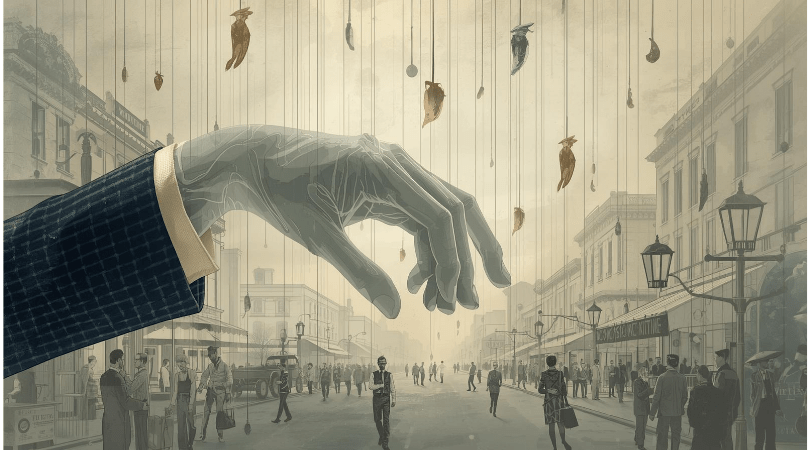
Training today’s AI systems requires computing power and funding that are out of reach for almost everyone. Right now, there are maybe four major players at the forefront: Microsoft (through OpenAI), Google (through DeepMind and Gemini), Anthropic, and Amazon. And if trends continue, that number could shrink to two. AI is concentrating in fewer and fewer hands. And that’s dangerous.

This is not a broad-based revolution. It’s consolidation.

When power and money gather in a few hands, the rest of us don’t just lose out on opportunity. We lose control:

  • A few voices dictate the future. Microsoft’s partnership with OpenAI means one company already wields outsize influence on how AI is integrated into businesses, education, and daily tools. Google’s models are quietly shaping search, advertising, and the flow of online information. Anthropic, funded heavily by Amazon, positions itself as the “safer” alternative, but at the end of the day, it’s still a private company answering to investors.
  • Wealth piles up at the top. OpenAI’s valuation hit tens of billions within a few short years. Google and Microsoft stock prices surged on the promise of AI. Meanwhile, the average worker is being told to “upskill” before their job becomes obsolete. That’s not shared prosperity, it’s extraction.
  • Fragility sets in. If two or three companies control the technology, what happens when one makes a catastrophic mistake? Or decides to cut corners in pursuit of profit? When power is concentrated, failure doesn’t just hurt a company, it destabilizes the system.
  • We lose our sense of ownership. Electricity, books, and phones became part of daily life that people could buy, use, and understand. With AI, we’re not participants, we’re customers at the mercy of a few gatekeepers.

This isn’t just about markets. It’s about the kind of society we’re building.

Why this should worry all of us

It would be easy to say, “This is a leadership problem,” or “It’s up to regulators.” And yes, leaders and policymakers carry a huge share of responsibility. But the truth is, this concentration of AI power impacts all of us.

As citizens, we risk losing democratic influence over how AI evolves. Do we want a handful of unelected executives deciding how the most powerful tools in human history are used?

As workers, we risk being replaced, monitored, or squeezed for efficiency gains that benefit shareholders, not employees.

As consumers, we risk being locked into ecosystems where one company controls the platforms, the data, and the outcomes, and we have no real alternatives.

As communities, we risk technologies being built without local values, cultural diversity, or public good in mind. It is in danger of becoming an echo chamber that regurgitates our own content back to us.

AI isn’t just another business tool. It’s shaping the future of communication, education, healthcare, and governance. And if we’re not paying attention, that future will be built for profit, not people.

And let’s be clear: AI carries enormous potential. It could accelerate medical breakthroughs, personalize education at scale, and help us tackle massive challenges like climate change or global poverty. Used responsibly, it could open new doors for creativity, innovation, and human connection in ways we’re only beginning to imagine. The power of the technology itself isn’t the problem. The problem is who controls it, how it’s developed, and whether its benefits will actually be shared.

We aren’t powerless

The genie is out of bottle. The toothpaste has left the tube. Use whatever idiom that makes you happy, but they all boil down to one thing – AI is here to stay. We need to be intentional about how we want AI to augment, not control, our lives. I’m not the fanciest expert, but some thoughts on how we can get started:

  • Policy and regulation. We know legislation lags innovation but that doesn’t mean we can’t set up some guard rails to save us from ourselves. Transparency and accountability aren’t optional.
  • Support open ecosystems. Open-source AI won’t rival the giants tomorrow, but it creates alternatives. It keeps innovation from being locked behind closed doors. It means educators, nonprofits, and smaller businesses can participate in shaping the field.
  • Treat AI like infrastructure. Just as we fund public roads, schools, and healthcare, we should treat AI as a public good. Imagine national or global initiatives focused not solely on profit, but on solving real-world problems like climate, healthcare, education.
  • Make conscious choices as leaders. Don’t assume “bigger” means “better.” Push vendors for transparency. Invest in alternatives. Reward diversity of thought and innovation, not just scale.
  • Demand accountability as citizens. Ask questions. Vote for representatives who understand technology and its risks – who want the benefits of AI but are wary of false promises. We need more transparency in legislative wheeling and dealing.

What the future holds

Responsibility isn’t just about steering the ship today. It’s about making sure the people who come after us inherit something better. It’s about our legacy. This moment isn’t just a “leadership” test – it’s a societal one.

AI will shape the future whether we like it or not. The only question is whether that future is written with us or for us. If power stays concentrated in the hands of a few, progress will no longer belong to everyone, it will belong to “them.”

We can’t afford to be passive. Leaders need to act. Citizens need to speak up. Workers need to demand accountability. Because if we don’t, we’ll look back one day and realize we handed over the next great revolution without ever insisting it be ours too.

Writing while angry

[Author’s note: it’s been a long time since I’ve written here, so what follows is reactive and immediate. It may also be triggering.]

When I was in high school, I read The Long Walk, a novella by Stephen King, published under his pen name Richard Bachman. It’s a brilliant piece. The gist of the plot is that in a dystopian United States, young men enter a lottery for the chance to be one of 100 boys chosen compete in a contest in which they try to outwalk 99 other boys to win their greatest desire. The reality of the fact that they’re basically committing suicide doesn’t hit until the first few deaths. You see, anyone who drops below 4 mph a certain number of times is killed on the spot. As the walk progresses, the boys awaken to the reality of their deathwish and the social circumstances that got them there. In the end, even the winner is an empty shell, wiped clean of all anger, desire, identity.

In that same collection is a novella called Rage. It’s a very difficult read, given where we are a society. You see, it’s about a school shooting. In it, King explores the social factors that fail teenagers. In the end, it wasn’t the violence that King wanted to examine – it was the pressures that make violence a reality. In the years since the novella’s publication, numerous school shootings have taken place. King asked that the story be pulled from publication in 1999, wrote about why in 2013, and has donated proceeds from that writing to gun control efforts.

Each of these stories depicts a society in which self-destruction is the only path for the protagonists. These stories paint a world in which the downtrodden fight for scraps and compete to the death for a mere chance to live a life that promises more than fighting for the next meal. (For a real in-your-face metaphor, read The Running Man novella – it’s far darker than the movie.) These works are meant to horrify, but they are also meant to shock you into thinking.

Stephen King’s writings came to mind when I heard of yet another school shooting, coming so close after two other shocking domestic terrorist attacks in Buffalo and California. I hesitate even calling them “shocking,” because it is so common anymore. We are drowning in violence. We are buried in helplessness. We are suffocated by inaction.

King’s writings came to mind because we are living in a society that incubates violence. To be clear, I do not exonerate the killers. They are evil. They are horrible. They have destroyed so much. They are monsters.

But they are our monsters.

We celebrate notoriety and grant celebrity to the worst of us. We cry ”thoughts and prayers” while we profit from ensuring the next attack will happen. The news cycle never ends, politicians pad their pockets, and legislative progress halts in the name of grandstanding.

I’m fucking angry about it.

I don’t have patience for it anymore.

And before you dismiss my anger, listen.

I am a gun owner. I have a shotgun and a .22 pistol. I enjoy trap shooting and target shooting. And I would gladly relinquish how I own and use those guns if it meant no one else would feel like violence is the only answer. I am a registered independent, and I would gladly vote for legislation that addresses inequality in society and works to ease the burdens of those who feel like their only chance to leave a legacy is to destroy lives.

In the immortal words of Ted Lasso, we are broken. We have built a system that limits hope. We have exchanged our social contract for control. We have been sold the lie that security means success. We keep voting for people who are owned by lobbyists. We focus on banning books when we are failing our fellow human beings. We are systematically closing off choices for all but a few and as a result, we have people who think that there is only one path.

I don’t know the full answer. We need gun reform. We need social programs. We need pay equity. We need to eliminate white supremacists. We need campaign reform. We need to remember we need each other.

The dead deserve better. Their families deserve better.

If you are also angry, that’s good. Let’s channel that anger into action. Let’s stop pretending there’s nothing we can do. If you believe in prayer, then pray. And when you’re done, roll up your sleeves.

We’ve got work to do.


If you’re struggling with feeling helpless, here are some resources for you to take action:

  • Moms Demand Action: Moms Demand Action is a grassroots movement of Americans fighting for public safety measures that can protect people from gun violence.
  • Sandy Hook Promise: Sandy Hook Promise envisions a future where children are free from shootings and acts of violence in their schools, homes, and communities.
  • Buffalo 5-14 Survivor Fund: In partnership with Tops, the National Compassion Fund has established the Buffalo 5/14 Survivors Fund to provide direct financial assistance to the survivors of the deceased and those directly affected by this tragedy.
  • Mental Health Support: A starting place to find help.
  • Brady Campaign to Prevent Gun Violence: Dedicated to raising transparency about candidate funding and endorsement of gun control.
  • Contact Your Senator: Information on writing or calling your senator demanding action.
  • Contact Your Representative: Information on writing or calling your representative demanding action.
  • VolunteerMatch: If you want to make a difference locally, this site can help you get started.