10 (-ish) things leaders do that make me sad: Part 2

As I said in Part 1, I’m sure there are more than what’s on this list. But come on, I already had to break the post up into two articles because of the length – give me a break!

And now, the thrilling conclusion of my list (in no particular order):

  1. Ignore evidence: Sometimes super smart people can’t see the forest for the trees. Or they already have their mind made up and look for confirmatory “facts”. Or they refuse to admit that a pattern of circumstantial evidence trumps a smoking gun. Whatever it is, it can be very frustrating for a team that perceives its leader as someone who ignores what they see as “obvious” – this is how grumbling starts. Yes, I acknowledge that there is often evidence a leader has that can’t be shared with others. So tell them that. I’m more concerned with a leader who explains away evidence because it’s inconvenient to acknowledge it.
  2. Have trust issues: Ah, trust. That oh-so-important-yet-rarely-mastered element of a highly functioning team. When a leader trusts too much or too little, the balance of the organization can be completely thrown off. I tend to think that trusting too little is a bit more damaging as I’ve seen its impact first hand, but trusting too much can lead to a number of the other behaviors on this list and can also damage a leader’s credibility. Trust is a combination of character and competence – once you’ve figured that out, leaders, you can go from there.
  3. Busad-pandally others / allow bullying: Yes – bullies are often insecure and act out because of fear. I don’t care – they’re still jerks who harm others and kill a culture. If you are a bully, stop it. If you know a bully, stop them. I don’t care how great the results this person might bring to the organization – I can tell you that in the long run, it is NEVER worth it. (SHRM members, check out this article on why bullies thrive at work.)
  4. Think “me first”: One of the more difficult aspects of leadership to wrap one’d mind around is that it’s not about you and your abilities any more – it’s about your team and their results. Some leaders aren’t able to make that leap, and it makes me sad because it robs a team of an opportunity to spread its wings, and it limits a leader’s ability to positively impact a greater part of the organization. It should always be about the team and about the company for leaders. (Oh, and guess what – if you’re an executive, your team is the executive team…not your organization.)
  5. Focus too much on who likes them: The reality is that at any given time, there are dozens of people who don’t like you. In fact, it could be in the hundreds or more, depending on your company’s size and industry. Get over it. USA Today recently shared this fantastic quote from Eleanor Roosevelt – “Do what you feel in your heart to be right – for you’ll be criticized anyway.” You’re never going to get everyone to like you, so focus more on making the right decision and feel confident you can stand by it for the right reasons.
  6. Don’t develop their people: Shame on you. Your people hunger for growth and thirst for knowledge. You’re unwillingness to develop your people is either lazy, petty, or both. I’ve always told leaders that their job is to train their replacement and/or find a way to help their people reach their full potential. If you don’t want to do that, then don’t be a leader. (By the way, read this post by Mike Figliuolo on becoming a talent exporter – great stuff!)
  7. Play favorites: We know…you love all your children equally, blah blah blah. Oh please – we all have a favorite or two. Some employees are special and you want to help develop them. That’s okay. What’s not okay is BLATANT favoritism – especially when it’s unwarranted and/or based on personal friendship. Leaders who blatantly play favorites put the whole organization in jeopardy because the wrong people are sometimes promoted or otherwise rewarded…and the good employees see that and leave. And that makes me sad.

Well, there you have it. My Top Ten (-ish) Leadership Behaviors that make me sad. Agree? Disagree? Think I missed a few? Let me know! Share in the comments or send me a note.

[Sad Panda graphic respectfully grabbed off the internet because I LOVE that South Park episode!!]

10 (-ish) things leaders do that make me sad: Part 1

Okay, this is a list that started out as 10 and then settled somewhere in the vicinity of 14 (I have editing issues), so I apologize for the length. Because it’s so long, I’ve broken it into two separate posts.

There are more of them out there, I’m sure – these are the ones that stand out to me because of the widespread impact they have on an organization.

So here, in no particular order, is the first half of my list:

  1. Fail to acknowledge their impact: Seriously – if you’re a leader, you impact your organization. Pure and simple. No ifs, ands or butts. So when a leader tries to pull the “do as I say, not as I do” crap, it just underscores a certain lack of awareness that leaders need to have to be successful. Don’t be surprised if your team throws each other under the bus when you do the same thing.
  2. Lie: This one’s a pretty obvious no-no, so why do leaders keep doing it? Well, according to research – we ALL lie and cheat…at least a little bit. But some people are LIARS (all caps – I know!) – they misrepresent their skills, their team’s skills, the facts, just about everything. When these lying liars lie, it impacts the business’s ability to make good decisions, destroys trust on all levels, and creates a culture that no one feels good in.
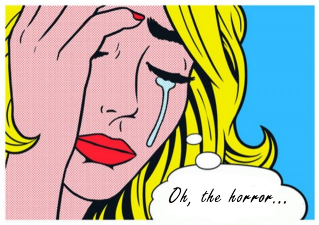
    oh the horror
  3. Avoid conflict: I know. Conflict is icky. People might get upset. Voices might be raised. Eye contact might be made. Here’s the thing – without conflict, there is no debate. With no debate, the wrong decisions might be made because a leader was scared to “rock the boat”. Healthy conflict is ESSENTIAL to innovation and good business. The really annoying bit is that leaders who avoid conflict are often the first ones to say, “I told you so” when something happens that they suspected but didn’t bring up. Boo on them.
  4. Treat “accountability” like a disease: As you know, this is my “thing”. So when I deal with a leader who is unable to embrace accountability, it really puts a little black rain cloud over my head. Lack of accountability comes in many shapes and sizes, but primarily boils down to two big categories – inability to accept accountability for something you did, and inability to hold others accountable for their actions. Both are damaging to the organization. A leader who keeps getting bad outcomes yet doesn’t see how he/she contributed to the situation will forever be blaming outside forces for their issues (unless, of course, it’s a successful outcome – then it’s totally that leader’s skills that did it, the aptly named “self-serving bias”). A leader who doesn’t hold others accountable doesn’t get results, tends to complain about their team a lot, and doesn’t understand why all the A players want to leave.
  5. Talk more than listen: Leaders who listen get amazing results – their employees know they can take anything to their leader and it will be considered. Doesn’t mean it will be implemented, but at least their voice will be heard. Leaders who talk too much are usually GREAT speakers. They are often external processors. All that is well and good, but watch what happens to a team when a leader talks and talks and talks – there’s usually only one voice in meetings, no one is willing to bring things to the leader’s attention, people hesitate when the leader asks for ideas. That’s because people assume the leader’s voice will overrule all others. And that’s not good.
  6. Roll their eyes: Listen, I’m a champion eye-roller. You can hear my eyes rolling from across the country when I think something is ridiculous. And it’s a horrible trait that I’ve worked hard to eliminate. The reality is that eye rolling is the manifestation of contempt – one of the most damaging attitudes. Leaders who roll their eyes are really just treating another person with contempt. They are sending the message that others are inferior to them, that they can’t be bothered to deal with that other person’s issues. It’s often an involuntary movement, but don’t think for a moment the other person didn’t notice.
  7. Gossip: People like gossip. It makes them feel like they are in the “in-crowd” because they have secret information. And even though employees prefer to get their information from their manager, they usually end up getting information through the grapevine, so I get that gossip is a learned habit reinforced by years in the workforce. When leaders gossip, though, it is incredibly damaging. A leader’s words carry weight – speculation and rumor become fact when someone in authority says it. So come on, leaders – show some respect to the absent and stop gossiping.

Want to read more? Continue on to Part 2!

Want to argue my points? Leave a comment.

You da man! (whether you like it or not)

Once upon a time (1993), back when Charles Barkley was known better as a professional basketball player and not an analyst with a bad golf swing, he famously declared that athletes shouldn’t be role models.  Nike even made a commercial about it.  And while many people agreed with the underlying point the Round Mound of Rebound was making, the comment left a bad taste in the mouths of the public because the reality is that it doesn’t matter if you WANT to be a role model – sometimes you just are.

It’s the same for leaders.  You may think you were hired for your business acumen, or your ability to set a vision for the company and produce results.   Okay, you’ve got me there – you were hired for those reasons.  But there is another line in your job description that may or may not be explicitly stated.  As Uncle Ben tells Peter Parker, with great power comes great responsibility.  And that responsibility is  to be a role model to your organization.

superherokid

This idea – “the shadow of the leader” –  has been around for a long time, but was first studied in business organizations in Larry Senn’s 1970 doctoral dissertation (and his company Senn Delaney is still rocking the concept).    Remember when you were a kid and you used to dress up like a super hero?  Employees are kind of like that kid – they emulate the people they look up to, or who have control over them.

Here’s another way to think of it:

Think of a family tradition that has been passed down generation after generation.  It might be a phrase that everyone uses, a certain way you cook something, game night, anything. For example, when I make a pizza, I always cut it into squares.  Why?  Because that’s the way my dad always did it.  There is no real reason to cut a pizza into squares – in fact, some would argue it’s very inefficient.  But that’s how pizza was cut in my house, and so that’s how I cut it.

In your organization, you’re the one cutting the pizza into squares.

The leader of an organization casts a shadow that influences the group culture.  This shadow may be weak or powerful, but it always exists.  Whole organizations often take on aspects of the personality of a strong leader (think Apple, Microsoft, Southwest, Virgin, etc.).  It’s not so much that leaders force their style and values on others, but that employees tend to look upwards for clues as to what is important, how to get ahead in the organization, and how to fit in.

This is the power of the shadow in action – the power to shape and influence the character of an organization.  Do you know what kind of shadow you’re casting?

One of the best things about the shadow of the leader is that you have the power to control it – you can take specific actions that will help you cast the shadow you want in order to create the culture you want.  Below are some questions you can answer to help you be the leader you want people to emulate:

  • What are the elements of your shadow, both strengths (things you like) and challenges (things you dislike)?
  • What values, beliefs, and standards are in place within your organization because of these elements? Is that what you want?
  • What behaviors are you seeing in your employees as a result of these elements? Do you like them?
  • What elements of your shadow come from your desire to emulate a leader you had at one time?  Did you mean to make that choice?

Once you’ve answered those questions, you are ready to create an action plan for change, thereby taking control of your shadow.  Complete these sentences to create your action plan:

  • The elements I want to change in my shadow are…
  • It’s important to change this behavior because…
  • I will monitor my behavior by…
  • I will know I’ve been successful when…

If you don’t like the shape of your shadow, change it.  If you don’t like the shadow of the person above you, step out of it and create your own.  Whatever you do, be mindful of your actions – because (despite what Sir Charles might think) people are copying what you do, whether you like it or not.

We don’t choose to be role models, we are chosen.  Our only choice is whether to be a good role model or a bad one.

– Karl Malone (well said, Karl!)