My Left Ear (a story in two parts): Part 1

Part One: The Story of What Happened

In June 2017, a few days before the national SHRM conference in New Orleans, I noticed that my ears felt kind of clogged, particularly my left ear. I’d had allergies so I wasn’t particularly worried. Then, later in the day, my left ear kind of went dead. As in…couldn’t hear anything at all. I thought my phone was broken because I couldn’t hear the ring tone when I held it up to my ear. Still, I wasn’t worried because I figured it was congestion. I’d just take some Sudafed and use some Swim-Ear to dry it out.

The next morning, I still had no hearing in that ear.

Knowing I was getting on a plane in less than 48 hours (and knowing how PAINFUL it is to fly with a clogged ear), I went to Urgent Care to see what was up. The doctor there took a look up my nose and in my ears and said it was most likely congestion as he didn’t see any infection. Told me to take Sudafed and use nose drops for a couple of days and it would clear up.

Those of you who saw me at SHRM17 knew I couldn’t hear you if you sat on my left side. I suspect a few of you took advantage of that (bless your evil little hearts). By the end of the conference, I was starting to get some hearing back, so I was confident the doctor had been right and I’d be hearing again in no time.
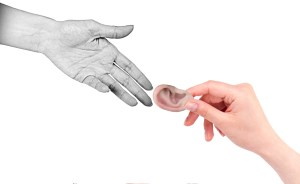
A “lend me your ears” joke. I regret nothing.

Not so much.

Six weeks later, my hearing hadn’t really improved in that ear and I was starting to get tinnitus (not really a ringing – more like what you hear when you hold a seashell to your ear). I went to an ENT (ear-nose-throat) specialist who informed me it wasn’t congestion; rather, I was one of the lucky folks who experience sudden sensorineural hearing loss (SSHL). This was most likely caused by a deep inner ear infection I didn’t even know I had that damaged my cochlea. Even better…it turns out that had the doctor at Urgent Care recognized it, he could have given me steroids that would have given me about a 70% chance of getting my hearing back. As it stood, it was too late to do anything. The ENT said this with such remorse, I had to tell her it was going to be okay.

That first hearing test showed my right ear was fine. But my left ear was down to 75% word recognition.

I was told to give it a few months to see how it stabilized, then get retested. Oh, and I got to get an MRI because in a few cases (not many, but you want to be careful) some people (hardly anyone, but still) turn out to have a benign tumor growing in their ear bones (really, this hardly ever happens, but let’s just be sure).

No tumor. Nothing structurally wrong.

At the time of my second hearing test, I’d developed pulsatile tinnitus (so imagine hearing your heartbeat in your ear REALLY LOUDLY only it sounds squishy). Oh, and my left ear’s word recognition rating went down to around 35% – meaning it can’t really recognize any words at all, and most frequencies are right out.

Because of the pulsatile tinnitus, I was sent to get a CT-scan with contrast because sometimes (not that often, but you want to check) pulsatile tinnitus is caused by a vascular issue, like a growing aneurysm (don’t be worried…but schedule it soon), so it’s good to check these things.

Thankfully, the CT-scan showed no problems. And the technology is wicked cool, but I couldn’t have my eyes open because apparently it would have made them not work anymore. Which is a bummer, because I really wanted to see how it worked. This lack of underlying cause means 1) I’m in the 30% of people for whom there IS no cause of pulsatile tinnitus, and 2) I may never get rid of it. Or it will come and go.

Having been medically cleared of weird ear things, I made an appointment to be fitted for hearing aids.

I’m 43, by the way.

In case you’re wondering, yes – it does kind of suck to be told you have permanent hearing loss. It sucks even more when you did what you’re supposed to do and went to the doctor right away, just to not be given the right treatment. But I’m not mad about that because I was very congested and have had blocked ears my whole life, and the doctor went with the diagnosis that was the most likely scenario (when you hear hooves, think horses, not zebras). It could have had a better outcome, but wasn’t guaranteed. Besides, I can’t do anything about it now, so what’s the point? And my right ear is still at 100%.

I was mostly worried because I’m a singer. And you really need to be able to hear the people around you (and yourself) to be able to sing properly. Luckily, it didn’t impact me TOO much – I just noticed I had to listen differently. I’m sure it impacted my pitch a bit, but no one threw anything at me, so I’m calling it a win.

I do notice that in crowded areas, or in a group discussion, it’s hard to follow anything going on across the way or from my left side. This causes me to pull back in group settings even more than I normally would because it’s just too tiring to try and follow everything that’s being said. I figured if someone REALLY needs me to respond, they’ll repeat themselves.

I’m not writing about hearing aids just yet, because this happened in 2017. Hearing aids are expensive and I need my flex spending account to kick in so I can go buy said hearing aids. I need 2 because just amplifying sound in my left ear would be useless (I’d hear mush LOUDER, which seems pointless). So I will have a receiver in my left ear that will transmit sound from that side to a hearing aid in my right ear, which will interpret the sound as though it’s coming from my left. HOW COOL IS THAT??? Hearing aid technology has come a long way. And I’m hopeful it will help the tinnitus. Basically, tinnitus is a result of your brain freaking out that it can’t hear something from an ear anymore, so it creates fake sound to trick itself into thinking the ear is working. It’s like phantom pain from a missing limb. Our brains are so freaking weird.

Next up: Part Two – What I learned.

Too much crazy

Today, another person I respect and adore decided to take a hiatus from social media. This is something like the third or fourth person (that I know of) in the last 6 months.

There are a lot of reasons people take time off from social media. Some want to spend more time with family. Others realize it’s keeping them from doing what they love (reading books, painting, overthrowing governments, etc.). And one very special person claims quitting Facebook it has helped him learn to move 10 lbs objects with his mind. (He’s totally lying – he’s only managed 4 lbs, and that’s being generous.)

The most common reason I’ve heard lately, however, is that there is just too much crazy.

People can’t seem to be civil anymore. The 24/7 news cycle has turned every little thing into an “event.” And many wake up in dread over what may or may not have been tweeted overnight.

They might have a point. There are numerous studies suggesting that quitting Facebook – even for just one week – has benefits. Middle school students may be particularly susceptible to issues with social media, with online bullying becoming a real danger for kids as young as 10. They’ve even come up with a new term – bullycide – for when a child takes his/her own life because of bullying. It’s heartbreaking.

I’ve contemplated taking a break. I haven’t because most of the people I know I communicate with online (#introvert). But I have cut back. And I find myself avoiding crazy as much as possible – it’s too exhausting. Not everything needs to be an argument, and not every post needs a dissenting opinion.

I think the way people are interacting online right now is a mix of opportunity and motive. Online comments lend anonymity and distance and accountability is almost nonexistent. And as for motive? There are a lot of people out there who have either felt they never had a voice and then found it, or have always had a voice and think everyone needs to hear it.

It’s unfortunate – we’re like kids who broke the expensive toy because we couldn’t respect it. Or because we played with it too much and it fell apart. I worry because I see how we interact online bleeding over into our real world interactions, and it’s getting ugly. I also worry because all the noise can block out all the good that the internet can enable.

I hope the crazy calms down. I hope those who are struggling with memories and feelings that the relentless news cycle brings are able to find peace. I hope we find a way to talk instead of yell.

I hope we keep finding funny cat videos to share online. (Thug Cat is THE BEST.)

I hope we find ways to remind each other that the world is a beautiful place and that people are worth saving.

If you need a break, take it. But please come back.

We need you.


Gratitude – it might be enough

I am attending the WorkHuman conference in Phoenix, AZ this week. This is the third year in a row I’ve had the opportunity to be a part of this conference, and I like it because its focus is less on “how to” and more on “why.” The conference organizers try to find speakers and keynotes who align with the message of rewards, recognition, and living one’s authentic self – a phrase a few years ago I would have snorted at. Actually…I do still kind of snort because the word is overused, but in today’s world of social media with increasing pressure to put on a good public life while struggling in private, I think the message is valid.

In yesterday’s opening session on the big stage, we watched a Q&A with Chaz Bono, a transgendered individual who knew from an early age he didn’t fit the female body he was born into. His story is rather well documented – being the child of celebrities must have compounded the challenges of dealing with these feelings of “different” – and he was open about the challenges he faced with substance abuse. Chaz shared he was 13 years clean and sober, an impressive accomplishment for anyone.

Chaz has refocused his efforts to make a living as an actor (including a secret project he can’t talk about…mysterious!) but continues to use his celebrity to support people (including kids) who are going through the emotions of transitioning and to help them understand they are not alone.

There were a lot of powerful messages in Chaz Bono’s Q&A, but one stood out to me. He was telling the story of going through his journey to sobriety and shared the advice a mentor gave him. The key to sobriety and not relapsing, this person said, was GRATITUDE. Be grateful for what you have, and you won’t dare relapse.

Now, not all of us struggle with substance abuse. But we are human beings who go through life with one burden or another. We may wallow in self pity. We may think life isn’t fair. We may dream about the next big thing without paying attention to what we have RIGHT NOW.

All of this got me thinking…am I grateful? Do I practice gratitude?

If I’m honest with myself, I would say…sort of. I do have a tendency to dwell on things. As an affirmed introvert, I internalize a lot of things, turning it over and over in my mind, wearing out my thoughts like a well-handled piece of paper. This can be an addictive way to live – stress and anxiety can be comforting because there is little accountability to act on things. And it’s easier to be stressed and anxious when you think you don’t deserve what you have.

On the other hand, I do step back from time to time and recognize that I am incredibly fortunate. I have a well-paying job. I have an amazing husband. I live in a beautiful state. I have the flexibility to make daily choices that millions don’t. So I recognize those things and AM grateful.

I just don’t say it out loud very much.

Therefore, my takeaway from Day One of WorkHuman is to be more vocal about my gratitude; to tell those around me I’m grateful for their presence; to vocalize to those who are struggling that sometimes the ability to draw breath is enough to be grateful for today…and we can figure out the rest tomorrow.