Tell me what you want (what you really, really want)

When you were a kid, did you know what you wanted to be when you grew up?

I did. I wanted to be a stunt car driver. Given the way I like to drive, there are some who would argue I haven’t let go of that dream just yet.

Considering that I don’t have “stunt car driver” on my LinkedIn profile, you can assume I embarked on a different career path.

But was it a conscious choice? Did I mean to end up where I did? Do any of us?

Ambivalence

I just finished reading Brigid Schulte’s book Overwhelmed: Work, Love and Play When No One Has The TimeIt has some excellent data to support the notion that American’s are too busy, but that it’s a combination of personal choice, cultural pressure, and business practice that continues to promote our need to one-up each other with our insane schedules.

Wannabe Pic 1 285 x 228In the book Schulte examines the idea of ambivalence – being of two minds. She posits that ambivalence is often at the heart of our feelings of being overwhelmed, that we are really of two minds of what we want that we can’t fully commit to either. Like the time we think it would be really cool to be an SVP of marketing, but then we realize how much travel it would take to get there, and while we really like travel, we’re worried about what our friends might think, and what if we have a significant other who’s not okay with that, and really, isn’t just easier to take the other job and get the paycheck?

Sound a little too familiar?

Choices

Think about your own career. Think about the path you took to get where you are right now. Was it deliberate? Was it all “Forrest Gump-y”? Was it a little of both?

The folks who are happiest in their careers tend to be because they CHOSE to be where they are today. They have defined their own idea of success and have gone after it. And no, it might not be the dream they had when they were a little kid, or even the career they thought they wanted in college. Maybe they had a few jobs along the way that they sort of liked, as well as a few they couldn’t stand.

At some point, though, they came to a crossroads. They could continue down the path they once envisioned but no longer loved, or they could take matters into their own hands and define their own success, and go for it. As a result, they are in the right place at exactly the right time.

And while they might be very busy, they are seldom overwhelmed.

So what?

As both leaders and those being led, it’s important to recognize a crossroad.

As a leader, we can help our employees articulate what success means to them and then help identify whether their current state is equal to that success. If not, we can help them find the right path. Remember, our job as leaders is to help our employees reach their true potential – and sometimes that means moving on.

As an employee, we can help our leaders understand what it is we are trying to accomplish. We can accept the responsibility for our careers and recognize that life isn’t something that happens too us – it’s something in which we are an active participant. If there is friction between how we define success and how our leader defines success, it’s vital that we speak up. Our leaders can’t help us if we don’t admit we need that help.

Define your success

No, I didn’t end up being a stunt driver. Or an astronaut.Or a social studies teacher. Or a mad scientist….yet.

And that’s cool. I’m still figuring it out – like a lot of people. Like you, maybe.

No matter where you stand on the overwhelmed/ambivalent spectrum today, don’t panic.

There’s still time for you to define your success.  There is still time to be an active participant in life.

There is still time to choose.

And if you aren’t sure what you want – what you really, really want – it’s okay.

You’ll figure it out.


Sometimes the wrong choices bring us to the right places.
-Unknown

Connecting the dots (and by dots, I mean people)

Note: This week I am at the annual National SHRM Convention in Las Vegas, NV. And in case you’re wondering if it it’s hot in Las Vegas in July, the answer is HELL YES. The heat…my god, man, THE HEAT.

As we enter the final day of this national gathering of HR folks, the attendees will be thinking about what they really got out of this experience.

  • Were the sessions worth it? Many of them were. Hopefully you chose wisely!
  • Were the keynotes good? Mika Brzezinski was. Her message about knowing your value resonated. And even if you disagreed with her, she made you think about WHY you disagreed.]
  • Were the boxed lunches good? No. 
  • Was the Expo Hall helpful? Depends on your goals. May you connect with many good vendors!
  • Did you have fun at Jennifer Hudson? No one called me for bail money, so you must have balanced it right!

What strikes me about this week as I talk to fellow attendees is how much they talk about different people they’ve met. About the woman working in Iowa as an HR Department of One and how much she has in common with the man in California facing the same challenges. About the folks on the shuttle bus chatting about their day, laughing knowingly about a session as if they were old friends. About the online friends who have been connected for a couple of years who finally got a chance to meet face to face.

I attend SHRM not just because I want to see the sessions, or keynotes, or go to Vegas. (Wait…what?)connect-the-dots

I attend SHRM because I want to connect with the online community who has welcomed me, supported me, mocked me (I’m looking at you, Stollack), and embraced me as one of their own. I am not here in any sort of official blogging/social media capacity and yet I’ve been able to hang with these folks, participate in fantastic conversations, and share my opinions with this fascinating, smart group of people.

Last night at dinner, Jason Lauritsen (yes, I’m name dropping) stopped for a moment and reflected on the growth of this little online family, and how SHRM has become a type of family reunion – a chance to reconnect on a human level with people who have been scattered around the nation.

Jason’s right. SHRM really is about the connections we make. But what’s more important are the connections we SUSTAIN.

My challenge to you as you go back to your homes and to your lives (or to the casinos) is to ensure you sustain the connections you make in life. Help connect people to those who can help each other. And plan ways to keep those connections fresh through face-to-face meetings.

The simple truth is that for all the process and product our companies deal with, it’s the PEOPLE that matter.

Connect. Sustain. Refresh.

It’s that simple.

Ninjas in our midst: in praise of undercover leaders (dispatch from #SHRM15)

Note: This week I am at the Annual National SHRM Convention in Las Vegas, NV. And in case you’re wondering if it it’s hot in Las Vegas in July, the answer is HELL YES. The heat…my god, man, THE HEAT.

Not everyone likes to go to conferences.

There are a lot of people. Vendors looks desperate. There are too many sessions that seem to look the same, and if you have to get on one more shuttle bus, you may burst into tears.

Now multiply that by about 15,000.  Because that’s how many HR professionals have descended upon Las Vegas for the annual SHRM National Convention.

They come for a variety of reasons – some come to get their recertification credits, some to see specific speakers, some to raid the Expo Hall, and yes…some come just because they want a company-sponsored trip to Vegas. (Don’t judge – you’re just mad you didn’t think of it.)

I would argue, however, that the vast majority come to reconnect with others who share their experience, skills, and intereninja2sts. They come because they want to meet the people they’ve connected with over the years. They come because they want to learn from others.

And they come because so many of these HR professionals are LEADERS.

No, they don’t have the fancy title. In fact, many of them don’t even think of themselves as leaders. They are HR folks doing the best they can to help their organizations be successful. And in the process, they prove their leadership.

These folks ask good questions in sessions. They stay behind to challenge the speaker on points made during a session. They engage with their peers on the Expo Floor or while waiting for the shuttle. They ask how the conference is going when riding the elevator down to the lobby each morning. They challenge the thinking of those around them, aren’t afraid to call something bullshit when it is exactly that, yet they don’t tear down – they help build.

This wouldn’t surprise the people who know them, because back in the office, these same HR professionals nudge and influence, support and coerce the employees and leaders working in their organizations. They keep the trains running AND challenge the status quo – all without calling attention to themselves. It’s about the outcomes, silly.

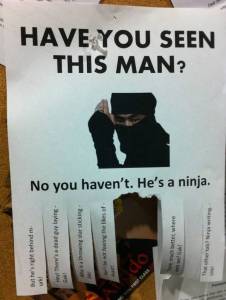
They are leadership ninjas. You don’t even realize they were there – but you feel their effects long after they’re gone. (And some of them are partial to black. No idea why.)

Are you noticing the “ninjas” in your organization? Are you willing to recognize leadership based on actions, not words? Are you able to empower based on behaviors, not title?

Don’t underestimate the power of these covert leaders…because I guarantee there are others in the organization who notice their influence and rely on their leadership capabilities.

When these HR professionals return to their organizations, eager to share what they experienced and itching to try some new things, give them some grace. Leaders DO. Leaders ACT. Leaders TRY. The worst thing you can do is look at them like they’ve grown a second head because these people want to implement something new.

So be quiet. Stand back.

You may be surprised what a ninja can do.