If you don’t like the culture, it’s probably your fault

Once upon a time, I had a chance to work with a vendor with a really cool product that enabled you to measure the culture of your organization (they’re called RoundPegg – look them up, as they are awesome). At one point in the process, we had an option to decide to test the entire company and get a true measure of our culture, or handpick people we felt “represented” our culture. This was kind of a big deal, especially given where I was working at the time.

There was an unspoken concern that the results would tell us nasty things about the culture…things some of us acknowledged and wanted to fix. These were the same things that others chose to view as our “uniqueness”. Basically, we had to decide what reality we were willing to confront. Ultimately the decision was made to pick those who exemplified the aspirational culture and assess them.

I think this was a cop out, and I hope you do, too.

I will always remember the gist of what Natalie (one of the RoundPeggers) said about culture. In essence, she said that culture is made up of everyone and every interaction in the company. If it’s happening at your business, it’s a part of your culture. No amount of stacking the deck, wishing, words, or banners can change this. You have to accept the good, the bad, and the ugly of what you’ll find because only then will you know what you’re dealing with. And only then can you make the choice to change it.

20130507-212315.jpg

Like water eroding sand, every action we take reinforces the path we have chosen. It’s simple neuroscience – the more we reinforce neural pathways, the stronger those connections become and the easier it is to perform those activities we regularly engage in. What paths have been reinforced in your world?

Because culture is made up of the people in the company, each of us has a responsibility to create the culture we want to work in. As employees, we can choose what behaviors we exhibit, being mindful of the impact we’re making. As leaders, we have an obligation to model the behaviors of the culture we want to build.

If the culture where you are isn’t what you want it to be, think about how you’re impacting that culture. Are you reinforcing the positive, or strengthening the negative? Every choice you make contributes your culture. So if you don’t like it, do something about it. Be proactive. Refuse to engage in gossip. Build relationships across functions. Tell a good joke. Host a two-minute dance party.

For goodness’ sake, do something.

But don’t blame anyone else. We’re all in this together.

A company’s culture is often buried so deeply inside rituals, assumptions, attitudes, and values that it becomes transparent to an organization’s members only when, for some reason, it changes.

Rob Goffee (1952–), US writer, consultant, and academic

Leadership training gone wrong (and how to fix it)

Recently, I spent 3 hours of my life sitting in a leadership “workshop”. I use quotes, because it was more like a speech with limited table activities (big room, lots of people, blah blah blah). While the speaker did a good job, the content was nothing anyone hasn’t seen before – a couple of nice concepts sprinkled on a sundae of been there, done that. Ironically, I attended this on the same day my husband (who is more receptive to training than most because of what I do for a living) attended a mandatory training that was less than life-changing.

The confluence of these two sessions got me thinking about the state of leadership development out there. There is a LOT of crap that people are paying good money for that ends up being repackaged versions of successful books from the past. (The session I mentioned earlier wasn’t that bad…but it set off this train of thought…that, and this blog post by Laurie Ruettimann – if you’re not following her, you should be.) The laziness out there really chaps my hide because it perpetuates the myth that leadership training sucks. As a person with a pretty strong background in that arena (leadership dev, not sucking…I think), and as someone who has had to preview way too many awful training programs, I take it personally when someone knowingly puts out mediocre work.

20130424-204818.jpgThe reality is, there are some truly amazing and effective programs out there, and some equally amazing organizations who can help you meet your development goals. The Center for Creative Leadership, Franklin Covey’s Speed of Trust, Crucial Conversations, Disney Institute, Situational Leadership…lots of great stuff. Sadly, few leaders (or L&D groups, apparently) know how to pick a good program. They sign up for whatever sounds good and hope for the best.  And even more depressing is that there are a lot of training professionals trying to pass off sub-standard content as “groundbreaking”.

So in an effort to keep the development pool undiluted by “meh”, and to provide some guidance to those of you looking for a session/workshop/vendor/etc., I submit the following ways to make leadership training more meaningful:

  • Get on with it: I know context is important. But do we really need 45 minutes rehashing what “leadership” is? There’s a good chance everyone who has sought out leadership development already has their own ideas of what leadership is, so take a few minutes to get everyone on the same page as to how you’ll be referring to leadership in the session…AND MOVE ON.
  • What are the objectives? If the session description can’t articulate the expected learning outcomes, you’re in trouble. And if you as a learner can’t articulate your expected learning outcomes, you’re in trouble. And this might just be my soapbox, but don’t trust an objective that uses “understand”. Can you measure “understanding”? Yes? Then say how, and use THAT word instead. Which leads into my next point…
  • Awareness is not actionable: Let me be clear – awareness is a vital component to development and change; however, it is not in and of itself a solution. What are you going to DO with that awareness? Too many trainings spend the bulk of the time on making you aware of stuff, but then gloss over HOW to affect real change. People probably know they need to talk to their team better. So how do they do it? Share some concrete steps, not just high level concepts and pretty pictures.
  • Make sure the learner is a willing participant: Nothing makes me sadder (in a training context) than hastily developed generic mandatory leadership training. It’s out there. I’ve even implemented some (don’t judge me too harshly). Look, I get that this one is tough.  It’s kind of a “lesser of two evils” decision sometimes. So if you have to mandate training to ensure evil managers let their people attend training, mix it up a bit. Do what you can to let the learner pick the topic/session relevant to them. Structure the content in a way that allows the learner to co-create the experience. Be a good enough facilitator to be able to adjust the material to the needs of the audience.
  • Results matter, not your words: This is for the instructional designers out there. As long as the learning objectives are met, does it really matter that the facilitator didn’t say every word you wrote? A good facilitator knows how to get the most put of your material – let them. Work with them to explain your choices, outline non-negotiables, and then let it go. The learners will appreciate it, and you won’t go crazy trying to reign in those diva trainers. 😉 (I say that with great respect – I have had the privilege of working with some amazing facilitators. I’m talking to you, Jim Unger!)
  • DO SOMETHING: Development without supported practice or real world application isn’t development. It’s lip service. Nuff said.

We who believe in the power of leadership development need to hold our fellow practitioners accountable. And we who want our leadership development to make a difference should demand better.

I could go on and on and on (and some of you would say I already have!). As you may have surmised, I’ve got some opinions on this topic and could probably fill a book with them.   But I want to hear from you – what do YOU think leadership development should include? Do you have a horror story we could all learn from? Share in the comments below or send me a note!

Almost anything can become a learning experience if there is enough caring involved.
– Mary MacCracken

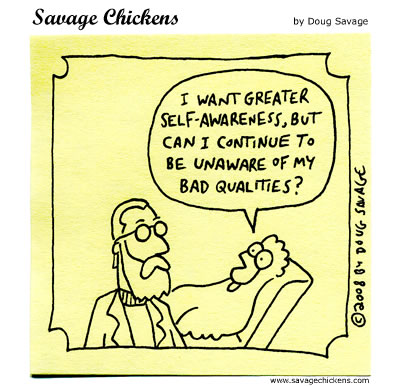
Why should I change? He’s the one that sucks. (The importance of self-awareness)

For fans of Office Space, you probably recognized the immortal words of Michael Bolton when discussing the embarrassment of having the same name as that ‘no talent ass-clown’. It’s a great movie (I used to make it mandatory viewing on my team) and a very funny line…and it illustrates perfectly one of the common pitfalls of leaders everywhere – the lack of self-awareness.

We’ve all seen it. Leaders who lament the shortcomings of their people, loudly stating what those people SHOULD be doing. Well, guess what, Mr./Ms. Thang – you’re probably not doing everything right, either. I read somewhere once that we criticize loudest the things in other that we don’t like in ourselves. It’s not a 1:1 correlation (its not like we dislike an embezzler because we also embezzle); rather, it’s a reminder to think about our OWN behavior.

This talent for self-awareness is a vital component of a successful leader. Granted, it’s more fun to point out the shortcomings of others (schadenfreude, anyone?), but far less constructive. It’s the old trap of, “do as I say and not as I do” – and we all know how we’ll that turns out, right?
A few ideas on how to make self-awareness a regular part of your day:

  • Admit you suck at something: I’ve mentioned many times in this blog that the reason why you’re a leader is because you DON’T suck at a lot of stuff.  But you do suck at something (it’s okay, we all do).  Once you’ve admitted that, you’ll be in a better state of mind to practice self-awareness.
  • Get some help: Okay, self-awareness is all about you (hence the whole “self” thing).  And you will eventually be able to self-monitor and make corrections to your behavior on the fly.  But if you’re new to this sort of thinking, it’s a good idea to have a third party help you through observation, providing feedback, or even challenging your assumptions.
  • Accept it’s going to take time: The whole concept of “he’s the one that sucks” is that you don’t want to make the effort to chickenchange yourself because you know it’s going to be difficult; therefore, the OTHER person should undertake that task.  Tough cookies.  You need to take the time and make adjustments to the only thing you can control –   yourself.
  • Check yourself before you wreck yourself: Every day, take some time to think back on the day’s activities and give yourself a grade.  Did you achieve the outcomes you wanted?  Did you achieve them the way you wanted to?  Figure out what you want to do differently tomorrow and give it a go.
  • Think like G.I. Joe: Self-awareness doesn’t come with a how-to guide.  You might realize you’re doing something stupid…and have no idea how to fix it.  This is where G.I. Joe comes in.  Remember – now you know, and knowing is half the battle.  Go, Joe!!!

So there you go.  While Michael Bolton (the cool one, not the saxophone one) had a fairly good argument to refuse to change, you don’t.  Practice a little self-awareness, improve yourself, and you might be surprised how much better everyone else starts getting, too.

*Check out the awesomeness of Doug Savage’s humor at http://www.savagechickens.com/