What does inspiration look like? A Canadian actor, apparently

The last day of a conference is always a little rough. You’ve seen a lot of sessions and they all start to blur together. At some point you hear, “yada yada yada” and think it’s insight.

And then you see a keynote that stops the conference cold and hits everyone on a gut level.

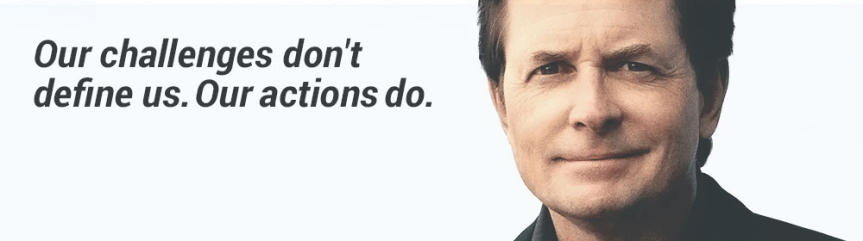
That keynote was Michael J. Fox.

In case you have been living under a rock, Michael J. Fox was THE guy for awhile – Back to the Future, Family Ties, Spin City. What we didn’t know is that in 1991, at the age of 29, he was diagnosed with Parkinson’s Disease and told he would only have about 10 years left to work.

Ten years.

Can you imagine how limiting that must have been? Most of us would have ranted and raved, felt sorry for ourselves, been paralyzed by fear, or some other “end of world” reaction I assume we’ve all imagined at one time or another.

Michael J. Fox went out and starred in Spin City. He continued to act. He wrote 3 best-selling books.

He lives every single day. And he is happy.

On the last day of the Work Human conference in Orlando, there was a lot of anticipation to see him speak. Recent reports were that his disease was progressing quickly. Would he be okay onstage? Would he speak at all?

Lucky for us, he did speak. You could tell the disease had progressed. His speech was a little slurred, you saw the tremors. But you also saw the glint in his eye, the quick wit, the humor – the PERSON. He never shied away from talking about Parkinson’s and how it impacted his life and the lives of those around him. He talked about the challenges of hearing his time to work was limited. He shared the frustrations of not having early detection for Parkinson’s (by the time he had the tremor that led him to the doctor, 80% of his dopamine-producing cells were already dead).

But most of all, he shared the joy he finds in life.
MainHeroSpaceBanner-v1915-v2

He shared it by the way he talked about his family – his parents, his wife, his 4 children. He shared it in the way he focused on what he CAN do, not what he can’t. There were people who cried throughout his entire talk because despite the fact you could see the disease had affected him physically, you saw he chose to see the disease progression as a gift – it gave him focus, honesty and clarity.

I can’t possibly capture the impact Michael J. Fox had on the audience. Nor can I capture all the incredible quotes. Here is a taste of what the crowd experienced:

  • On his father: “My father was in the military. When you had a problem, he was the first person you wanted to call and the last person you wanted to talk to.”
  • On hearing the doctor tell him he had 10 years left to work: “It was after 10 years that I finally got good. Parkinson’s stripped away all the tricks and forced me to be honest.”
  • On his disease: “I accept things. That doesn’t mean I’m resigned to them, but I can accept them them as they are and move on.”
  • On caregivers of those living with disabilities: “There are no rules for people with a disease or disability – let them define their own life and what they can do.”
  • On his foundation: “We are the leading private funder of Parkinson’s research.”
  • On delaying disclosing his diagnosis: “How can the audience laugh at me if they know I’m sick?”
  • On the future: “You can’t project what’s going to happen in the future. You just have to see how it goes.”

I’ve always cringed when someone comes up to me and says, “Happiness is a choice!” Mostly because it’s accompanied by a big giant smile and is usually preceded by a statement akin to, “It looks like someone has a case of the Mondays.” But when Michael J. Fox says he made the choice to not let this define him and to fill his days with life, I totally believe it.

This keynote made the conference for me. It’s one thing for people to tell you to choose happiness.

It’s another thing entirely to see someone who did it.

This is what inspiration looks like. A 54-year-old Canadian who loves to walk outside and feel the dew on his feet and spend time with his family.

Who knew?


If you’re interested in learning more about the Michael J. Fox Foundation or if you want to donate to fund research, visit https://www.michaeljfox.org/

Learning a new way to work

I’ve always been drawn to challenges. I build, I don’t maintain. I like to push, rock the boat, innovate, break down silos. I’ve worked at organizations that were built that way. I’ve also worked for organizations that weren’t built that way…but needed a kick in the butt anyway.

If I don’t have interesting work to do, I get bored. And when work is interesting, I like to keep working until it’s done. I’m online all the time, I check email all the time, and I never seem to be able to turn off my brain.

Sound familiar?

While it can be a very fun way to work, it’s also a pretty tiring way to work, and leads to high levels of burnout. Those who worked through the 2008 economic downturn know that while headcount was slashed, work expectations never changed. And as the economy recovered a bit, those job were never replaced – businesses figured they could continue working “lean,” thereby helping the bottom line.

But at what cost?

Engagement is still extremely low and don’t appear to be going up any time soon.. And according the Bersin by Deloitte: “Employees are overwhelmed with technology, applications, and a constant flood of information.” Employees are overwhelmed and it shows. While the rise of the gig economy has been overstated, there are more people who are looking to scale back, take a break, or start a new, low-stress career.

We can do better.workhuman

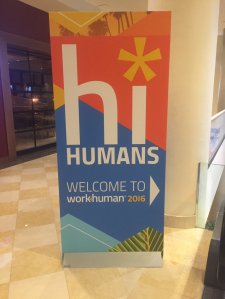
This is why I’m in Orlando, FL this week, attending the WorkHuman conference sponsored by Globoforce. WorkHuman is based on the premise that there has to be a balance between work and life, between happiness and career, and that businesses can create an environment that encourage a healthier approach to work. It’s about helping employees set boundaries and avoid the stress of trying to be “on” all the time.

The conference has sessions on mindfulness, optimism, recognition and will feature CHROs sharing how they are trying to create the “human workplace.”

This is so not how I’ve approached work in the past. I’ve been the one in the back row snorting at the idea of “mindfulness” and “happiness” and other such topics. But resilience is something that resonates with me – and we are starting to learn more about how things like optimism and positivity (mixed with realism) help build resilience.

So I’m here to learn. To hear the research behind these topics and take what makes sense back to my workplace and try to be part of the solution and not the problem.

Not all of what is shared at this conference will resonate with me. I reserve the right to snort from time to time. (After all, I’m the skeptic.) But last year’s conference was pretty darn good and I got a lot out of it. I’m excited to be here.

You’ll see a lot of me on social media the next few days. In fact, there are a lot of great people here to learn new things and share what they’re learning with folks who can’t be here. Track the conference on Twitter under #WorkHuman.

Doing the “correct” thing isn’t always right

Recently I read a story about a restaurant manager who received complaints about a mother and her autistic child. Policy would have dictated that he move the duo to another part of the restaurant, away from the other patrons who were being disturbed. But after one question from the mother, he decided not to. He told them to have an awesome day. He high fived the child. He went back to work.

In his words: Sometimes doing the right thing does not make everyone happy; just the people who need it the most.

Good for you, Tony Posnanski. You rock. You recognized the needs of this mother who had been through this before but just wanted a normal experience with her child. That’s what we call managerial courage – you didn’t hide behind a policy or the bottom line. You assessed the situation and made a judgement call.

justice

This is what leadership looks like. It looks like a person who is aware of policy and procedures. Who listens to the needs of ALL customers. Who assesses things on a case-by-case basis, makes an “executive” decision and stands by it.

We need more leaders like that.

Policies and procedures have their place, but they’re no match for the human touch. People need to reach out to people and engage with them on a one-to-one basis. As my friend Steve Browne often says, you have to meet people where they are. And sometimes that means breaking policy and doing something that just makes sense.

Lord forbid we do something that makes sense.

We all have something in our handbook that HAS to be there because we think we can’t trust employees and managers to make the right decision in the moment. Sometimes it’s dress code. Sometimes it’s bereavement leave. Imagine a world where we let it slide that an employee is in a pair of jeans because there’s 2 feet of snow out but they still busted their butt to be in the office that day. Or we let an employee take bereavement leave for a dear family friend who was like a parent, but gosh darn it, that relationship isn’t listed as covered in the policy.

So as you go about your day-to-day at work, don’t be so quick to say “no,” or “we aren’t allowed to do that.” Think about the person you’re dealing with – the PERSON – and respond in kind. After all, policies and procedures keep us sane, keep us legal, keep us on the right side of compliance.

But our empathy and adaptability makes us human.


Think we need more humanity in the workplace? Join me at the WorkHuman 2016 Conference in Orlando, May 9-11, 2016. To register, go to  and use promo code WH16MF300 for $300 off.