Everyone needs a Jerry

Early in my HR career, I worked for a large Fortune 200 organization that sold pay TV.  We were geographically dispersed – call centers, field technicians, and a big ol’ headquarters filling two rather large office buildings.

The culture at this place was…I’ll say challenging. It didn’t win a lot of fans, that’s for sure. But the company knew exactly who it was and didn’t try to pretend to be something else, which I appreciated. And many days, most people really liked their job – awesome people to work with, cool projects, access to leadership, super fast career development.
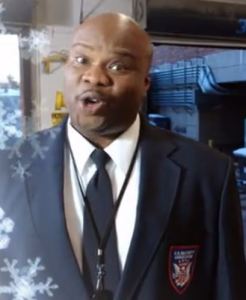
From a Christmas video the company shot. OF COURSE you needed Jerry singing!

There were some days, though…I mean, seriously. Walking into the building was physically difficult. For a lot of people. You’d see their footsteps slowing down, the smile disappearing from their face, their shoulders slumping. It was going to be a grind.

Then you walked through the door and at the front desk was Jerry. And you couldn’t help but smile.

Jerry was one of the main front desk security guards whose job it was to greet visitors, hand out security passes, and generally make sure the folks walking into the building were supposed to be there. But Jerry always took it a step further. He would stand at the desk saying, “Good mornin’. good mornin’, good mornin'” to every person walking in. He’d ask you about your weekend. He’d tell you to have an “awesome, awesome” day. (Always awesome. Twice.)

Jerry was the best.

He saw his job as more than “just a” security guard. He saw himself as an ambassador of the organization. He loved his job and he wanted to make sure you loved it, too. And even if you didn’t, he made sure you had at least one smile that day. Visitors to the building loved him. Regular visitors would worry if he wasn’t at the front desk because he was on break (“Did something happen to Jerry?”). Everyone loved Jerry. Even our sometimes-not-the-most-personable CEO. Jerry could make ANYONE smile.

The CEO recognized Jerry’s worth to the organization because he honored him with a very prestigious award at an all hands meeting, broadcast to all our facilities. This award was typically given to people who had made the company a lot of money, or created a new product, or some other business-y reason. Jerry got it for being himself and helping others.

Everyone needs a Jerry – whether it’s in your organization or in your life. A Jerry helps you set the right tone for your day, or helps bring you out of a gloom on your way home. A Jerry is the face of your company who makes people feel welcomed and valued. A Jerry is this janitor, giving high fives to students as they walk in the door.

Jerry was definitely one of my favorite things about working at that organization. On my last day, when I handed him my badge, he gave a huge hug and said good luck. And a few years later, when I went back to the building to meet with some former co-workers…he recognized me and gave me another hug and said it was great to see me. Who wouldn’t want a Jerry????

As far as I know, Jerry is still being Jerry. I didn’t write this because something sad happened to him or anything. I was just reminded of him when I saw the story about the janitor high fiving students, and I thought, “How cool would that be to get that walking into work every day? Oh wait…Jerry did that.” And thus I wrote about him.

I hope you have a Jerry. And, more importantly, I hope you can be someone’s Jerry.

Because a Jerry is awesome, awesome.

 

Broadway musicals and the lessons of succession planning

Recently, the producers of Dear Evan Hansen announced that its Tony Award-winning lead, a ridiculously talented Ben Platt, would be vacating the role on November 19. Platt originated the role through read-throughs, workshops, previews, and finally, a year on Broadway.

The show is a runaway hit, pulling in $1.5M a week and already providing its investors with a complete return on their investment (in a very short period of time for a small theatre on Broadway). While the show seems like it will be fine with a new lead, its continued success is uncertain and there has been no announcement of who will be taking over the lead.

For another show on Broadway, the continued success is known – it will not have any. Natasha, Pierre and The Great Comet of 1812 (heretofore known as The Great Comet because that name is just WAY too long) was nominated for 12 Tony Awards (3 more than the big winner Dear Evan Hansen). It starred Josh Groban, he of velvety-voice-with-little-inflection-but-everyone-loves-him fame. It was a rousing good time. It got a huge boost from the Tonys performance.

And then Josh Groban left the show.

Okieriete “Oak” Onaodowa (who originated Hercules Mulligan/James Madison in Hamilton) took over the role. People loved him, he had a wonderful debut. And about 3 weeks into his run, rumors started flying that Mandy Patinkin (Broadway royalty/Inigo Montoya) would take over the role. It was officially announced. And the backlash was loud and accusatory because Oak is black, Mandy is white, and the callousness of the move was jarring. Turns out, Mandy was horrified at what happened, and refused to take the role because of what happened to Oak – Mandy had been told Oak was cool with it…and Oak did not appear to be cool with it. Mandy’s out. Oak refuses to go back.

And now the show is closing less than a year after it opened because they have no “name” lead and advance sales plummeted.

So why would I spend nearly 400 words on the drama of a Broadway show’s missteps?

Because that could be your organization.

If you have talented, charismatic, AMAZING leaders in your organization and you haven’t planned for what happens when they leave, you could be The Great Comet.

Don’t be The Great Comet.

Because I’m an unabashed theatre nerd and have decided to run this metaphor into the ground, here are some lessons about succession planning you can learn from Broadway:

  • It’s not the actor, it’s the show:  If you rely on one person’s performance for your company’s success, you will fail. Make sure the team’s/unit’s/company’s work and systems are strong enough to stand on its own, regardless of who is in charge. You want that leader to enhance, not overtake, the work that is already being done. Hamilton, the cultural juggernaut that will probably play forever and ever, is able to survive cast changes all the time – because the book, music and staging is just SO DAMN GOOD. New cast members join in service to the show, and while you see their spin in the performance, it’s not about them. It’s about the outcome of the show.
  • Acknowledge that the original star can never REALLY be replaced and adapt: Having seen Ben Platt perform live, I am fairly confident that NO ONE will ever play that role to that level ever again. It is astounding. That doesn’t mean the next person will not be good. It just means they won’t be Ben. If they’re smart, they’ll try to find someone who can create the role in their own image, and adapt the show to that person’s strengths. Your company should do the same thing. If the last leader was well loved and well liked, acknowledge that. Then give them the opportunity to build and move on in their own image without changing the script.
  • Consider staggering your exits: If you know you have a cohort of leaders who might be leaving around the same time – whether it’s retirement or a spin-off or something else – you might negotiate with them to stagger their leaving (assuming you like their style). This will allow you to have stability throughout the transition, helping onboard the new leaders while providing consistency for the organization. Hamilton used this approach. Lin Manuel Miranda (Hamilton) announced he was leaving. Then Leslie Odom, Jr. (Burr) left (apparently to do Nationwide commercials). Then others in the lead roles left. But never all at once. It helped preserve the spirit of the show and passed on the cast’s culture to the next actors to join. That could work for you.
  • Have a long-term plan: Everyone leaves a company – whether they quit, get fired, or die. It’s the role of a leader to prep his/her replacement and plan that exit from the day they join. Lin Manuel Miranda has a group of trusted performers that he knows he can turn to take over roles. Javier Munoz was Lin’s understudy and replacement for In the Heights, and the same thing happened in Hamilton. Smooth transition. Who is YOUR Javier Munoz?
  • Don’t put all your eggs in one basket: One of the biggest myths in succession planning is that you pick ONE person to be your replacement and you’re done. This is known as “pre-selection” and will bite you in the ass. You want to be sure that person can actually do the job, so you want to make sure you’re developing them. But even more pressing is the fact that someone who is high-potential enough to be identified as your successor may not want to wait in your shadow until you leave – they could jump to another opportunity. On Broadway, many understudies are working on originating one role while backing up another (like with Dear Evan Hansen’s Colton Ryan). There is no guarantee they’ll be around to take over full time. Or life gets in the way – Javier Munoz has had two health issues (thankfully, he’s okay). The point is, identify a potential pool of successors and develop their skills. It gives the company more options at the time of transition.
  • Communicate appropriately: That whole Mandy/Oak thing? Totally could have been avoided if all the right players met at one point to talk long-term goals, communication strategy, and impact to Oak. People get nervous when their boss changes. Having a good communication plan can help alleviate that. Additionally, if you DO have multiple people who could potentially take the job, think about how you let those who did NOT get the position know. What feedback can you give? What career options can you share? And…are you prepared for the reality that they may leave because of it? Whatever the case might be, the last thing you want to do is have a communication issue that results in NO ONE taking the role.

There you have it – lessons from Broadway on how you might approach succession planning within your organization.

See? The arts DO apply to the “real world.” (Support the arts!!!)

Why I cringe when people say “hire for fit”

Companies are constantly looking for differentiators. In the first tech bubble, it was all about stock options and perks like kegs in the breakroom. In the second tech bubble, it’s been all about….stock options and kegs in the breakroom. Huh. I thought we’d come further than that. Moving on…

What you hear about more and more now, though, is “culture.” Culture is the great differentiator. It will make or break your company! It will make you productive! It will cure cancer! (Okay, I made that last one up.)

Listen, I’m a big fan of being intentional about the culture you’re allowing to develop in your workplace. It DOES impact the way people work, their ability to be successful, and how your customers view you. Whether or not you personally like Southwest Airlines (and I love them, so there), you can’t argue with their success in a tough industry. And they attribute it to their “culture” – from how they operate, to how they hire, to how they make, spend, and save money.

It’s the “how they hire” piece that I think people screw up all the time. (And I’m not the only one who thinks that!)

Too many companies who are concerned about their culture focus on hiring as the way to “fix it.” They think that by hiring the “right people,” they’ll magically get the culture they’re looking for. They focus on pre-hire assessments like personality tests and quirky questions and conversations about “passion.” And the next time the employee survey results come back, employees still say they don’t like the culture and turnover proves it.

At this point…I’m over “hire for fit.” Don’t get me wrong – I think it’s important that an employee aligns with core elements of the organization whether it’s the work they do, the people they work with, the values experienced, or what the company represents. But I think we’re going at it wrong. And here’s why:

ILLUSION #1 : Hiring for fit = a cure for all our ills: Every organization I’ve ever worked at that struggles with a “challenging culture” focuses on hiring as the fix. Why? Because it’s the easiest process to change. You add a couple of assessments, change some interview questions, and voila! All done.  

REALITY:  Hiring’s not your problem: Culture consists of EVERYTHING within your workplace, not just the people. It’s your systems, your processes, your location, your parking habits, the industry, your policies, your leadership practices, the behaviors of managers, communication….get the point. If you’ve got issues with your culture, it’s going to take more than just hiring people who SEEM to be part of the culture you want. You have to be willing to dissect the WAY you work. If you’re not wiling to do that, all those “new culture” people you hired are going to leave as soon as they can.

ILLUSION #2: Culture is about attitude, so we’ll ask about that: After all, we want to make sure people share our “values” so let’s make sure the questions are all about how they feel and what they like and dislike. That way we’ll know that they’re the right person to match our culture.

REALITY: Culture is about activity, not attitude: When you read about how Southwest (and other strong “culture” organizations – like Disney) hire people, you’ll see that they focus on BEHAVIORS, not feelings. That’s because behaviors are measurable and you can see how they impact work. Disney records how candidates interact with others, how they treat the receptionist, their inherent curiosity when sitting in a room…all behaviors. Southwest asks candidates how they handled a tough customer situation, looking for examples of the actions taken and the results of those actions. If you want a “culture fit” hire, find people who embody the culture through action, not words.

ILLUSION #3: Our managers are skilled enough to decide if someone is a good fit: We gave them a set of questions and told them to follow the law, they should be fine. Besides, these people have been here FOREVER and totally know what a good hire would look like.

REALITY: At best, they’re guessing. At worst, they’re using “not a fit” as an excuse for discrimination: If you don’t require interview training and calibration before a person is allowed to interview candidates, you have little to no assurance they know what they’re doing. Even then, you’ve got unconscious bias that no amount of training can overcome. By allowing “not a fit” to become the reason a qualified, promising candidate doesn’t get hired, you’re making it okay for managers to make snap judgments. If you can say “not a fit because of x,y,z examples of behaviors,” you’ve got a better chance. Also…DO YOU EVEN REALLY KNOW WHAT YOUR CULTURE IS? Probably not. You think you know. But unless you’ve done a valid assessment, you’re just describing what YOU think the culture is. 

ILLUSION #4: Same is good: Companies believe that if everything acts the same, thinks the same, and looks the same, then the culture will be fabulous and the company will be 100% successful.

REALITY: Diversity is good: You need diversity of backgrounds, thought, experience, age, race, gender…all of it. It breeds innovation. It pushes the company forward. It helps reduce that unconscious bias that gets us into trouble. It’s not the friction that’s the problem – it’s how you function with friction that’s hurting you. Include and celebrate differences and learn to leverage that friction in a way that’s beneficial to the organization.

In a perfect world, I would want companies to share openly enough of who they are and how they operate so that potential candidates can make the educated choice about whether or not they might be a “fit.” There are also tools out there that can help identify alignment with company values/behaviors in such a way that both allows the candidate to decide if they want to proceed AND helps the hiring manager identify questions that will get at the heart of whether full alignment is good or if the team needs that friction.

So please….stop acting like all  you really need to do is “hire for fit.” There are bigger issues at stake. Tackle those and then MAYBE you can start hiring for fit.

Maybe.