When things go wrong, will your people do right?

Today was the kind of day that business travelers tell horror stories about.

I’m speaking at two conference this week (MNSHRM and WISHRM), and today was the first day of a week of travel. It was supposed to be easy. I had just gotten my TSA Pre-Check, so security wasn’t a problem. And I was flying Southwest Airlines with a good boarding position (A 31 – not too shabby).

How hard could it be?

My husband dropped me off at the airport one hour and forty minutes before my flight was scheduled to take off. I figured I’d drop off the bag, breeze through security and grab a little breakfast.

And then I encountered this:

line_southwest

A line to end all lines. And it was even worse inside.

Turns out, Southwest had a massive computer system outage today. They couldn’t print boarding passes from many of the service desks. They couldn’t print baggage claim tickets.

They had to do EVERYTHING by hand – check in, boarding, manifest clearing – everything.

And you know what? They did it with a smile.

The skycaps worked quickly. They had their process down and did what they could to keep the mood light. (I got through that ridiculous line in 35 minutes.)

The boarding gate agent was funny and handled the craziness with some humor.

The flight crew acknowledge the challenges, kept the passengers informed, and did what they could to ensure everyone on the flight made it – even when security was backed up (seriously…get TSA pre-check).

It wasn’t just in my hometown where the employees did what they could to make the best of a terrible situation. Check out these employees in Las Vegas, handing out cold drinks to folks stuck in the hot sun:
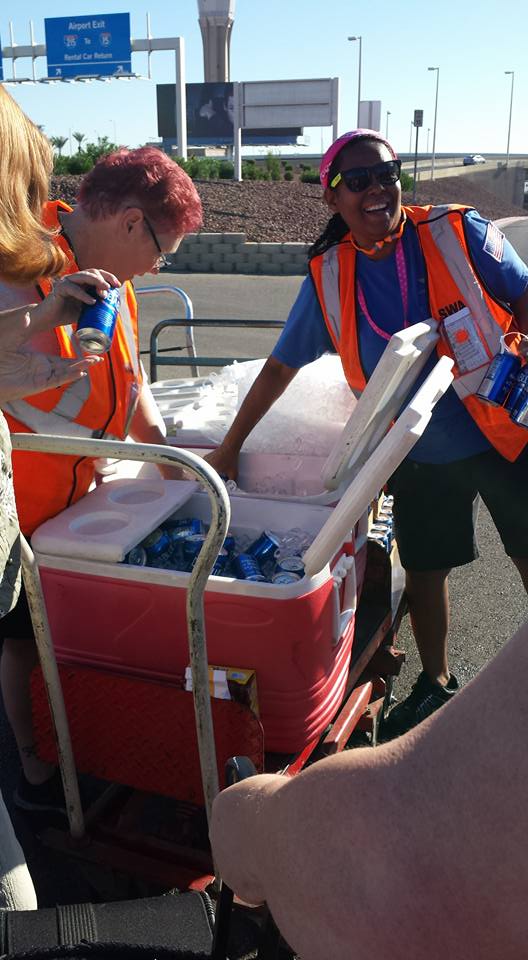
SW_2

Was everyone happy? Of course not. It was stressful for everyone involved. Not everyone saw exemplary service from Southwest employees, but overall, they have handled the ongoing problems pretty well.

In the event of this kind of crisis, how would YOUR employees perform? And what can you do to best ensure you’re ready to respond?

  1. Have a plan: The Southwest employees weren’t using sticky notes to process baggage. They had printed tags designed for manual checking. The gate agent had a protocol to process mobile and paper passes without computer access. If you don’t have a Plan B for your business process, you’ll have even more problems.
  2. Hire the right people: Southwest is very explicit about their culture and expectations for their employees – but they also make a pledge to do right by their people. (The “To Our Employees” clause…) By taking time to find the right people to carry out your organization’s work, you increase the likelihood that they will be able to respond to a challenge the way you want them to.
  3. Balance process with humanity: I can’t imagine the level of complexity Southwest faced with this system outage. Between the sheer number of passengers, Homeland Security requirements, and airport regulations, they could have chosen to approach this with a very command-and-control approach. Instead, I saw employees empowered to make decisions. I read examples of employees given the freedom to hand out cold drinks. I saw a flight crew take time to alleviate a passenger’s concern about a connecting flight when we took off late. Are you willing to let go in times of pressure and put the trust in your people to do the right thing?

They say that adversity does not build character, it reveals it.

What character will your people reveal?

[Disclaimer: I’m sure a LOT of people had a horrible travel day today, and many of them are annoyed and frustrated still. My experience may not be the same as others. If you had a bad start to your day, I really hope it got better!]

Slow or fast, we’re all in the same race (lessons from the driver’s seat)

No, this isn’t going to be an introspective look at the fleeting immediacy of life. I mean, that’s a real thing and you should really think deep profound thoughts about it, but I’m not in the mood.

I’m in the mood to talk about driving.

As readers of this blog know, I always wanted to be a stunt car driver. I don’t really remember why that was something I wanted to do. It just looked like a lot of fun, and the drivers were badass.

I’m not a stunt car driver (yet), but I have gotten a chance to live like one for a few hours. It’s called autocross – and if you’ve never gotten to do it, I highly recommend it. It’s so choiceIMG_2998

Basically, autocross is a giant parking lot or other paved area with a course laid out in cones. It might be a hairpin turn, followed by a slalom, followed by a 90-degree turn, etc. You get a series of runs throughout the day, each one timed. If you hit a cone, you get a time penalty. If you miss a “gate” or go off-course, you officially get a DNF (did not finish), but unofficially you still get to drive the rest of the course like a baller.

This was the second such event I’ve had a chance to do and, like a lot of people in my line of work, I couldn’t help but notice some similarities to the workplace.

Someone else may lay out the course, but you choose how you attack it.
In autocross, like a lot of jobs, there are a series of obstacles/tasks you have to tackle. The cool thing is that we get to choose the way to get through them. In autocross, you see people who go as fast as they can, slamming on their brakes to course correct, and sometimes it’s not pretty. Ultimately, though, they learn from their mistakes and do better next time. Some people start very slowly and tentatively, afraid to make mistakes, learning the course. And as their confidence grows, they get faster and better. Your job is the same way. You can go fast and furious, or go slow and cautious. Each approach teaches different lessons, and the “driver” (employee) can either choose to learn from them and improve, or get the lesser result.

Most mistakes are minor. Don’t freak out. Keep going.
If you hit a cone in autocross, you get a 2 second penalty. And people might give you a hard time. If you miss a gate or something, a corner worker makes a big X with their arms and you get a DNF for the run…but you get to keep driving and you learned something. Most work mistakes are similar. Did you send out an email with a minor typo? Okay, you goofed up. Own it and learn from it. Did you forget to staple ALL the packets? Nobody died. Don’t be afraid to make minor mistakes. (And if you’re a leader, realize your people will make them!) The important thing is to learn from it.

Some mistakes ARE a big deal. Recognize when it could happen.
In these types of driving events, you don’t drive all that fast. But cars do sometimes spin out and go flying off the course. If you’re working a corner, you need to be alert and position yourself in a place that will minimize your risk of getting hit. Not all jobs are life and death, but SOME ARE. Inattention can and does get people killed. Whether you’re the person doing the dangerous activity, or the support person watching that activity, be alert and do what you can to ensure safety protocol is followed. We all want to get to the finish line in one piece.

People doing the same thing at the same time have SOMETHING in common. Work with that.
People who do autocross events have all different types of cars and come from a variety of backgrounds. In a generic social setting, it’s doubtful that any of them would hang out. But put them in this situation and suddenly they are best friends, trading driving tips and encouraging each other to improve each run. Your coworkers may not be people you’d choose to socialize with. In fact, people are socializing with coworkers less and less these days. And it may be impacting our work experience. So while you don’t have to be a best friend or anything, it’s okay to loosen up and talk like people now and then.

Have a good time.
You’re driving a car through a crazy course. OF COURSE YOU’RE GOING TO HAVE FUN. Granted, work isn’t going to be a super fun autocross event every day. But hopefully parts of it are. And if it isn’t, try to find ways to make it a good time. You’re there for too many hours in your life.

Whatever you do – in your “real” life or your “work” life – it’s important to remember that while we all have different approaches, we are all still just trying to finish the race.

Start strong, stay strong, and finish strong by always remembering why you’re doing it in the first place.
– Ralph Marston

Snark is the New Cool…and that may not be cool

One of the things you may not know about me is that I’m a bit of a musical theater nerd.  What this really means is I tend to be a singing snob.  Yeah…I’m one of those people.  It doesn’t mean I think I can do it better than other singers, I just get annoyed when singing isn’t done correctly. (Note to teachers of young singers – STOP MAKING THEM SING OUT OF THEIR NOSES!!!!!  Thank you.)

So when a live broadcast of The Sound of Music was announced with Carrie Underwood, I wasn’t terribly excited.  Nothing against her voice – I’m just not a country fan and I think sometimes she can be a little wooden in her performance.  And I love Julie Andrews.  Therefore, I chose not to watch.

That doesn’t mean I didn’t read a bunch of the comments made on social media on the interwebs.  Seriously, y’all got creative.  And some of you were funny.  And a little mean.

snark1

I was listening to Seth Speaks on my satellite radio (On Broadway channel – enjoy!) and Laura Benanti was a guest (she played the Baroness on the NBC broadcast, and starred as Maria in the Broadway revival…and she is amazing).  She was sharing some backstage stories and such, and Seth asked her what she thought about the comments made against Carrie.  And Laura threw down on the haters.

“Snark,” Laura says, “is the new cool.”   She pointed out that here was a person with the courage to try something she’d never done before…live…in front of 18 million people.  Instead of applauding her for it, and celebrating the fact that a major network took a chance to bring a new, younger audience to Broadway and music, the Twitter-verse used it as a chance to show off how clever it is.

No snark?
This stuck with me.  I love snark.  I enjoy the heck out of reading it, and I tend to engage heavily in the dishing out of said snark, too.  But Laura has a point – snark can get in the way of what you’re really trying to accomplish.  It can shut down people’s willingness to take a chance.  It can break down the feeling of “team”.  A lot of people who give snark can’t take it, so then you get a whiny snarker.  And while snark might be funny or make you look clever, is it adding anything of value to fix the perceived issue?  In short, snark can be extremely damaging.

What to do?
I’m not going to advocate going snark-free.  A little snark is like good satire – it points out that the emperor has no clothes and uses humor and shock to heighten awareness about a situation.  Matt Charney’s Snark Attack blog  is great!  So is Television Without Pity (spare the snark, spoil the network).  That snark IS cool.  And funny.  And thought-provoking. And change driving.

So if you consider yourself a snark aficionado (and who doesn’t, amiright?), use the next 30 days to pay attention to how and when you use it.  If your intent is pure and you’re working towards a greater good, snark away.  And a little snarkiness amongst friends can be fun!  But if you’re employing snark to put someone else down because it makes you feel better about yourself and you think it makes you look clever, stop it. You’re just being an asshole.