What does inspiration look like? A Canadian actor, apparently

The last day of a conference is always a little rough. You’ve seen a lot of sessions and they all start to blur together. At some point you hear, “yada yada yada” and think it’s insight.

And then you see a keynote that stops the conference cold and hits everyone on a gut level.

That keynote was Michael J. Fox.

In case you have been living under a rock, Michael J. Fox was THE guy for awhile – Back to the Future, Family Ties, Spin City. What we didn’t know is that in 1991, at the age of 29, he was diagnosed with Parkinson’s Disease and told he would only have about 10 years left to work.

Ten years.

Can you imagine how limiting that must have been? Most of us would have ranted and raved, felt sorry for ourselves, been paralyzed by fear, or some other “end of world” reaction I assume we’ve all imagined at one time or another.

Michael J. Fox went out and starred in Spin City. He continued to act. He wrote 3 best-selling books.

He lives every single day. And he is happy.

On the last day of the Work Human conference in Orlando, there was a lot of anticipation to see him speak. Recent reports were that his disease was progressing quickly. Would he be okay onstage? Would he speak at all?

Lucky for us, he did speak. You could tell the disease had progressed. His speech was a little slurred, you saw the tremors. But you also saw the glint in his eye, the quick wit, the humor – the PERSON. He never shied away from talking about Parkinson’s and how it impacted his life and the lives of those around him. He talked about the challenges of hearing his time to work was limited. He shared the frustrations of not having early detection for Parkinson’s (by the time he had the tremor that led him to the doctor, 80% of his dopamine-producing cells were already dead).

But most of all, he shared the joy he finds in life.
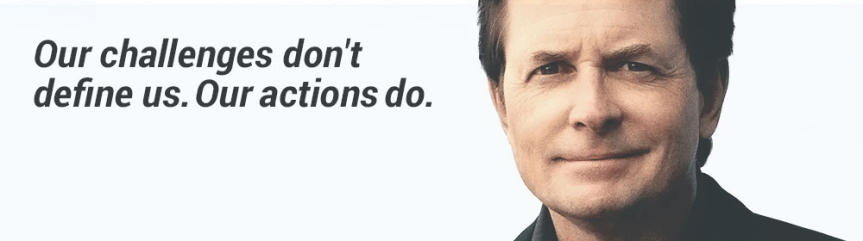
MainHeroSpaceBanner-v1915-v2

He shared it by the way he talked about his family – his parents, his wife, his 4 children. He shared it in the way he focused on what he CAN do, not what he can’t. There were people who cried throughout his entire talk because despite the fact you could see the disease had affected him physically, you saw he chose to see the disease progression as a gift – it gave him focus, honesty and clarity.

I can’t possibly capture the impact Michael J. Fox had on the audience. Nor can I capture all the incredible quotes. Here is a taste of what the crowd experienced:

  • On his father: “My father was in the military. When you had a problem, he was the first person you wanted to call and the last person you wanted to talk to.”
  • On hearing the doctor tell him he had 10 years left to work: “It was after 10 years that I finally got good. Parkinson’s stripped away all the tricks and forced me to be honest.”
  • On his disease: “I accept things. That doesn’t mean I’m resigned to them, but I can accept them them as they are and move on.”
  • On caregivers of those living with disabilities: “There are no rules for people with a disease or disability – let them define their own life and what they can do.”
  • On his foundation: “We are the leading private funder of Parkinson’s research.”
  • On delaying disclosing his diagnosis: “How can the audience laugh at me if they know I’m sick?”
  • On the future: “You can’t project what’s going to happen in the future. You just have to see how it goes.”

I’ve always cringed when someone comes up to me and says, “Happiness is a choice!” Mostly because it’s accompanied by a big giant smile and is usually preceded by a statement akin to, “It looks like someone has a case of the Mondays.” But when Michael J. Fox says he made the choice to not let this define him and to fill his days with life, I totally believe it.

This keynote made the conference for me. It’s one thing for people to tell you to choose happiness.

It’s another thing entirely to see someone who did it.

This is what inspiration looks like. A 54-year-old Canadian who loves to walk outside and feel the dew on his feet and spend time with his family.

Who knew?


If you’re interested in learning more about the Michael J. Fox Foundation or if you want to donate to fund research, visit https://www.michaeljfox.org/

A skeptic’s view of happiness at work

The Intro Bit

If you know me, follow me on social media, or just make up a fake backstory about me (please make me a pirate), you probably realize that while I like to laugh and have fun, I’m not a particularly “up” person.

What I mean by that is I am not a Pollyanna who looks on the bright side of things and always believes things are all going to work out. I tend towards realism with a dose of cynicism. (And a side of eyeroll for good measure.)

So when the whole “happiness” thing started hitting the internet, I was skeptical.  It sounded like just another way of talking about work without having to have any data or research behind it beyond a Cosmo quiz. And deep down, I suspected Pharrell had something to do with it.

Therefore, I did what every good skeptic does. I researched it so I could debunk it.

The Sorta Science-y Bit

Here’s the thing – while some of the “science” out there is a little sketchy (or…a LOT sketchy), there is some really compelling evidence that happiness at work makes a difference to the success of an organization. The iOpener Institute has developed a happiness measure and released some findings in the Wall Street Journal – happy employees stay twice as long, are more likely to help their colleagues, are less likely to be absent, and are more efficient. (For more info, read this white paper.)

Basically, happy employees perceive themselves to be more connected to their organization and are therefore more likely to stay on task and are more likely to choose to be engaged at work than non-happy employees.I_want_to_believe5

The Skeptical Bit

While certain research points to some strong correlation between happiness and connection to business, there is no predictive model between happiness and business performance indicators.

Also, happiness sounds suspiciously like “satisfaction” to me – and you can have satisfied employees who are completely happy to do as little as possible at work. In fact, some research even suggests that job satisfaction has a NEGATIVE impact on productivity. So I’m curious to see more about additional research into this area.

The ‘Here’s How to Make it Work’ Bit

While still preliminary, there’s enough out there to point to definite benefits to supporting happiness at work. As leaders and HR professionals, you are in the perfect position to help employees make the choice to be happy, thereby gaining some positive outcomes for the workplace.  As employees, no matter what your role, you have the power to decide about your own happiness at work.

Some things to keep in mind as you embark on the journey to Work Happyland:

  • Happiness is unique to each person: One of the reasons a predictive model is so hard to find is because “happy” means different things to different people. Watching this video of a tiny horse trotting makes me ridiculously happy. Other people prefer NASCAR. So you have to be willing to adapt to the needs of your team and organization.
  • The pressure to be happy can bum you out: One psychological experiment reported by the Harvard Business Review suggests that the increased expectation of employees to build an “upbeat” workplace can lead to resentment – having the opposite effect on the workplace. Don’t force your people to smile all the time. Create environments where happiness can happen organically.
  • Sometimes, it’s okay to work angry: Some people are more focused, able to detect deception, and negotiate WAY better when they have a little edge. Keep in mind that sometimes happiness can hurt productivity and quality, so don’t be worried if someone isn’t giddy all the time.
  • Help folks set boundaries: We continue to blend work and life more and more – and it’s stressing people out. By making it okay for your employees to leave home at home and work at work, you give them permission to save their best selves for when they need it most.

The research in this area is still emerging, so I am keeping my eyes and ears open as we learn more about happiness at work. I also reserve my right to roll my eyes every now and then if you try to tell me it’s a standalone metric, or if you try to be all obnoxious about it.

On the other hand, my inner skeptic wants to be believe. After all, we spend A LOT of time at work. So why not at least try to make it a happy place to be?


Want to join me in learning more about happiness and other good stuff in the workplace? Come to the WorkHuman 2016 Conference in Orlando, May 9-11, 2016. To register, go to  and use promo code WH16MF300 for $300 off.  THAT should make you happy!


Leadership takes time (Lessons from the Super Bowl)

I know, I know…yet another post about football players and what we can learn from them in moments of great stress. But it’s such a rich topic, people. I mean, really.

I’ve actually already written some posts about how players respond after a big moment – some do well (Peyton Manning), some not so well (Richard Sherman). So when I saw the post-Super Bowl press conference with Cam Newton (or “presser,” as they say in the biz), I figured I’d leave it alone. There are plenty of people out there who will weigh in on his behavior. Besides, I have work to do.

But then I read some of the comments and tweets from his peers and from sports reporters. Reaction is kind of all over the place, with a majority of people landing in the, “We get you’re upset, but you need to be a leader” camp.

People will contrast Peyton Manning’s performance in post-loss interviews with Cam Newton. They’ll point out that Peyton is always gracious, that he always makes time for the press, that he waits to congratulate his opponents. And to some extent, that’s fair.

But Peyton has been around the league for a long time, not just as a player, but as the son of a quarterback who played for a pretty terrible franchise. He learned over time the importance of humility, of dealing with the press, of using reporters’ first names, and of managing his image. In short, Peyton has learned the lessons of leadership. He did not spring from the forehead of Zeus with perfect leadership behaviors (despite what some would have you believe). He has made mistakes, learned from them, and moved on. cam

Having seen the footage, I do think Cam Newton was pretty unprofessional. He was an outspoken player throughout the year, gregarious and emotive, unashamed of how he celebrates. And he suffered a crushing disappointment – so he shouldn’t have been surprised by the onslaught of questions. If you’re chatty when you’re winning, the press expects you to be chatty when you lose. It shouldn’t be a surprise to him. He’s been called out for his “pouting” (for lack of a better word) in previous years when the team lost. This year, he was much better…because his team hadn’t really lost. As soon as he was faced with adversity, the smile was gone and he his frustration was apparent.

Despite this, I think Cam will be okay.

Cam is young. He did not grow up in a football family. He is an emotional player who hasn’t learned the art of equanimity with the press. That is not, however, everything that he is. He gives footballs to kids. He volunteers at elementary schools. He came back from a horrific car accident that could have killed him to be the NFL MVP.

I guess I just hope that this one moment does not end up defining him as a LEADER. Leadership takes time. Leadership takes repetition. Leadership takes mentoring.

Think about your own leadership growth. Can you really say you’ve never messed up? Multiple times? The only difference between your leadership growth and Can Newton’s is that he’s getting paid a LOT of money…and has the added pressure of learning in public in a 24/7 news cycle.

I think the seeds for Cam Newton are there. And he has support.

When asked about the presser, Peyton Manning had this to say:

“I’ll tell ya’, Cam couldn’t have been nicer to me.He was extremely humble, congratulated me, wished me the best. I told him just congratulations on his outstanding season, and just what a great future he has ahead of him. He’ll be back in that game, I can promise you.

Only time will tell if Peyton is right. But we should give Cam Newton that benefit of time. Rome wasn’t built in a day…and neither is leadership.