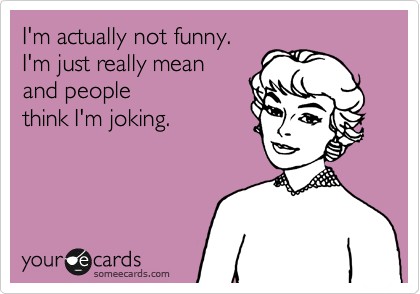
Snark is the New Cool…and that may not be cool

One of the things you may not know about me is that I’m a bit of a musical theater nerd.  What this really means is I tend to be a singing snob.  Yeah…I’m one of those people.  It doesn’t mean I think I can do it better than other singers, I just get annoyed when singing isn’t done correctly. (Note to teachers of young singers – STOP MAKING THEM SING OUT OF THEIR NOSES!!!!!  Thank you.)

So when a live broadcast of The Sound of Music was announced with Carrie Underwood, I wasn’t terribly excited.  Nothing against her voice – I’m just not a country fan and I think sometimes she can be a little wooden in her performance.  And I love Julie Andrews.  Therefore, I chose not to watch.

That doesn’t mean I didn’t read a bunch of the comments made on social media on the interwebs.  Seriously, y’all got creative.  And some of you were funny.  And a little mean.

snark1

I was listening to Seth Speaks on my satellite radio (On Broadway channel – enjoy!) and Laura Benanti was a guest (she played the Baroness on the NBC broadcast, and starred as Maria in the Broadway revival…and she is amazing).  She was sharing some backstage stories and such, and Seth asked her what she thought about the comments made against Carrie.  And Laura threw down on the haters.

“Snark,” Laura says, “is the new cool.”   She pointed out that here was a person with the courage to try something she’d never done before…live…in front of 18 million people.  Instead of applauding her for it, and celebrating the fact that a major network took a chance to bring a new, younger audience to Broadway and music, the Twitter-verse used it as a chance to show off how clever it is.

No snark?
This stuck with me.  I love snark.  I enjoy the heck out of reading it, and I tend to engage heavily in the dishing out of said snark, too.  But Laura has a point – snark can get in the way of what you’re really trying to accomplish.  It can shut down people’s willingness to take a chance.  It can break down the feeling of “team”.  A lot of people who give snark can’t take it, so then you get a whiny snarker.  And while snark might be funny or make you look clever, is it adding anything of value to fix the perceived issue?  In short, snark can be extremely damaging.

What to do?
I’m not going to advocate going snark-free.  A little snark is like good satire – it points out that the emperor has no clothes and uses humor and shock to heighten awareness about a situation.  Matt Charney’s Snark Attack blog  is great!  So is Television Without Pity (spare the snark, spoil the network).  That snark IS cool.  And funny.  And thought-provoking. And change driving.

So if you consider yourself a snark aficionado (and who doesn’t, amiright?), use the next 30 days to pay attention to how and when you use it.  If your intent is pure and you’re working towards a greater good, snark away.  And a little snarkiness amongst friends can be fun!  But if you’re employing snark to put someone else down because it makes you feel better about yourself and you think it makes you look clever, stop it. You’re just being an asshole.

You have to use your MIND (stay open to learning)

At a recent event in Cincinnati (shout out, DisruptHR!), a group of us went out to dinner and, as often happens at these types of gatherings, the conversation ranged all over the place – from discussing the state of local businesses to arguing whether or not I was morally obligated to share any of my dinner.  (The answer was no.)

In general, I didn’t really have a stake in any of the conversations going on (other than the dinner sharing), but suddenly I found myself stepping on a rather large soap box and had to be coaxed down…and it was all about whether or not kids should learn cursive in schools.

Surely you’ve read about it – cursive has been removed from the Common Core because of computers and all that cool tech stuff.  What a waste of time!  After all, these kids are in third grade…there is so much more that they should be learning.  Like how to eat paste.  Why would we possibly want kid to learn something new?

OfficeSpace_038Pyxurz

And there’s the crux of my soapbox.  Never mind that there is research that indicates cursive supports brain development.  What bothers me is that there are people out there who are PROUD that they have encouraged 2nd and 3rd graders to reject learning something.

Okay, fine…hardly any of us writes anymore, let alone write in cursive.  My cursive has been a hybrid of print and cursive for years.  But think about the process of learning cursive – it requires discipline, perseverance, patience, even a little artistic flair.  Are any of those things that we wouldn’t want kids to learn?

So…what does this have to do with leadership?  I think too many people in the business world are guilty of the equivalent of refusing to learn cursive because they think they don’t need it.  Development?  Bah!  I know everything you could possibly teach me!  I don’t need that – it’s a waste of time!

Learning is a lifelong practice…with emphasis on the word practice.  Your brain is begging you to keep creating new neural pathways to keep it young.  By being open to learning, you keep your brain primed to take in and process new information.  You shut that down, what good are you to your business?

Here are a few thoughts on how to keep yourself open to learning:

  • Avoid the urge to dismiss: Sometimes new things sound stupid.  And useless.  And a waste of time.  Find out if that’s true before you dismiss it entirely.
  • Embrace the challenge: Sometimes new things sound hard, so we want to avoid them by saying they’re stupid.  See the benefit in learning something new.
  • Find the nugget: Sometimes new things are kind of useless.  I bet you can find something in there you can use.  Maybe it’s a way to reframe your attitude.  Maybe it’s the process you underwent to learn it.  Maybe it’s simply the fact that you kept your mind open.

Always, always, ALWAYS be open to learning new things.  It’s how you stay relevant…and it’s how the world becomes a better place.

Live as if you were to die tomorrow.  Learn as if you were to live forever.
– Mahatma Gandhi

“Other duties as assigned” (why it’s a good way to work)

I had a streak of bad luck at one point in my career.  Three of the companies I worked for either went out of business or closed the office of where I was working.  I was the William H Macy of business.  I could have been hired as a cooler for competitors.

After the third company went down and the job went away, I wanted to take a little bit of a mental break and just do some temp work until I figured out what was next.  So I was assigned to a small company to do data entry.  About a week into that, I started asking questions.  Why were the forms all hand-written?  What about a web form? Wait, you don’t have a web site?  Well, why not? And who the heck is managing the network?  And shouldn’t you have a single point of contact for general questions?

All of that question-asking led to a full-time position building the company’s web presence and setting some communication infrastructure that’s still in place today.

I share this story not because I want to brag about my mad skillz and the fact that I landed on my feet.  I share it to illustrate that I landed on my feet as a result of asking questions that were outside of my assigned responsibilities.taking out the trash

All too often, I hear employees use the phrase, “It’s not in my job description.”  Or I encounter managers who want a copy of the job description to prove to an employee that there is a task or behavior that they should be doing.  And it sticks in my craw a bit because I find it SO limiting…and it’s so indicative of where a company’s culture currently is.  Employees who think they aren’t responsible for the success of the company will limit themselves to the specifics of their job.  Managers who can’t explain how an employee’s actions contribute to the overall success of an organization rely on job descriptions to “prove it”.  It handicaps both parties…and hinders the business.

There’s a reason that other duties as assigned is included in job descriptions – because there are times when the unexpected happens and the business needs its employees to step up and do some things that are outside of their normal day-to-day.  No business can promise exactly what your daily routine will look like (maybe some manufacturing jobs can get close, but there are still variables).  The company needs some flexibility to succeed in an ever-changing business environment.

Other duties as assigned should be the way you approach your job every single day.  Yes, there are actual job responsibilities you need to complete (duh).  But this phrase is a license for innovation!  You are responsible for adding value – if you can add value outside of your ‘job box’, you will be successful.  For those of you who complain you’re getting burned out or want more development, here’s the phrase for inspiration.  Look around you and find a problem to solve.  If you’re always complaining that one department doesn’t seem to talk to another, call a meeting with the offending parties and see what you can do to help.  Maybe it’s not “technically” your job…but if you see a way to add value by doing it, by all means – do it!

Now, there is some risk inherent in performing other duties all willy-nilly, so here are a couple of suggestions on how you might do it successfully:

  • Tie your other duties to a business need: It’s harder to fault an employee when you’re helping the business achieve its goals.
  • Target pain points: The others will thank you.
  • Don’t make it all about you: Sometimes the problem/pain point you’re solving benefits you…but what would benefit others?
  • Let people know what you’re doing: No one likes an end-around.  Keep your manager up to speed on what you’re doing and why.

So when you’re tempted to grumble or make fun of other duties as assigned, change your mindset.  You may just land on your feet.

Got an example of a time when an “other duties as assigned” mindset helped you?  Share in the comments!

If you’re not stubborn, you’ll give up on experiments too soon. And if you’re not flexible, you’ll pound your head against the wall and you won’t see a different solution to a problem you’re trying to solve.
― Jeff Bezos