The way we win matters

What’s that? ANOTHER movie reference in a blog post? Hell yes. Buckle up, buttercup. Let’s do this.

It’s no secret that I love science fiction (and science fantasy, where I firmly place Star Wars, but that’s a discussion for another time). I started reading Ray Bradbury and Harlan Ellison at a very young age. Which explains a lot, really. What I appreciate about the genre is that it is such a mirror of who we are as a society – and who we want to be. Some sci-fi is post-apocalyptic and depressing, some is unnaturally cheerful and optimistic. (You can probably guess what kind I tend to watch.) All of it acts as a social commentary for the time in which it was made.

One story I experienced first as a movie and then as a book is Ender’s Game. Regardless of what you think of the book’s author, the story and world building is brilliant and engaging. Years ago, Earth was invaded by an alien species and barely survived. Since then, society has been obsessed with preparing for the next attack, training children to be the leaders of the battle because their brains can process the multitude of data faster.

Ender, so-called because he is a third child in a society that limits most families to two, is unique among his peers. He is the perfect combination of aggression and compassion, believing that the best way to defeat his enemy is to love them, because only then do you understand them. When confronted by bullies at his school, he gravely injures the toughest boy – an apparent over-reaction to the situation. When questioned why later, he replies that he wasn’t fighting to win that battle – he was fighting to win all future battles, too. (Seriously, go watch the movie and read the book – so good.)JALWS Letterhead I

One line in particular has stuck with me. [SPOILERS AHEAD] Near the end of the story, Ender and his unit have been undergoing simulation after simulation to defeat the Formics (insect-like aliens). In the final simulation, they risk nearly everything to defeat the entire race of Formics. Ender sacrifices thousands of (he thinks) simulated lives to achieve victory. Following the simulation, the adults cheer…it turns out, the simulation was the real battle. Colonel Graff (played by Harrison Ford) explains they didn’t tell Ender because they didn’t want him to hesitate…that they needed him to do what was necessary. Graff insists Ender will be remembered a hero. “We won,” Graff proclaims. “That’s all the matters.” Ender fires back, “No. The way we win matters.

This line says so much. It embodies so much of our humanity…or lack of it.

How many times have leaders claimed winning is the only option? How many organizations sacrifice values, integrity, dignity because they tell themselves the ends justify the means? Win at all costs. No holds barred. You have to play the game to win the game.

How many times do people regret that approach? In the long term, I hope it’s all of them. Because you give up something vital when you tell yourself that it doesn’t matter how you won. In the short term, it might seem like the smart play, but ultimately, history judges us all. It exposes the lies we tell ourselves and lays bare our mistakes.

Right now, American society is at a crossroads. We have an administration that values “winning” and loyalty over all else. We have a majority party in Congress that is willing to “win” no matter what the cost. We have organizations that are choosing to align themselves with a president who has been accused of sexual assault, and then turn around and speak about the dangers of #metoo. We live in a world where the number of  impressions and Twitter followers appear to be more important than values and critical thinking.

Is this what winning looks like?

I’d like to believe we’ll right this ship; that we’ll realize that attention isn’t the same as regard. That small “victories” are meaningless if we lose the larger battle. That sacrificing what we believe for the sake of a photo op means more than a slight PR hit. The decisions we make moving forward as leaders – as human beings – say more about us than short term gains. Are we willing to admit that sometimes the right thing to do IS the hard thing to do? Do we have the courage to turn down what looks good in favor of what IS good? Are we willing to speak up when our leaders can’t? Or won’t?

I hope so.

THE WAY WE WIN MATTERS.


It’s been a tough week…

Lots happened this week.

Many people are reeling.

Here’s a picture of a kitten in a car.

Take care of yourselves, everyone.

Image source: https://t.umblr.com/redirect?z=https%3A%2F%2Fift.tt%2F2K9x30g&t=MGU5YzhlYTk0ZGU3OTQ4Zjc4NzdlMWZhYTc4NjYwZDI5MDEwZjZkMix2MVJveUtOcw%3D%3D&b=t%3AQKKfTOI5PrkrZQJgkSxZJw&p=http%3A%2F%2Fgoodstuffhappenedtoday.tumblr.com%2Fpost%2F175179773514%2Fawwww-cute-cats-first-ride-source

The “problem” is not the problem

I apologize to those of you out there looking for a return to the leadership content I often post here. This post is fairly HR-centric…although there are definitely leadership underpinnings, because doesn’t everything have leadership underpinnings? That’s just a fancy way of saying I want to share some thoughts that may or may not pertain to you. Also, the title comes from a quote from Captain Jack Sparrow in the Pirates of the Caribbean: “The problem isn’t the problem. The problem is your attitude about the problem.”

So here we go.


The online HR community has been growing, which is a good thing. In the early days, there was a handful of HR pros out on social media, blogging, tweeting, doing their thing. That number has grown exponentially, resulting in a wider network for people to connect with others who are doing the same work and facing the same problems. There are more bloggers, more tweeters, more voices out in the universe sharing their thoughts. Not everyone agrees with everyone else, and I think that’s a good thing. Healthy conflict drives innovation. Let’s do it.

Then there was a hashtag.

When the #HRTribe hashtag first appeared, some people loved it, some people were indifferent, and some people were really bothered by it. In the early days, though, it wasn’t really talked about openly. It was sort of a “meh, whatever” situation. Hashtags come and go, no skin off anyone’s nose.

A little time goes by and some folks begin to voice their discomfort with the term. The reasons are varied – the idea of the need for any label at all is a bit off-putting; there’s an “us vs them” exclusionary mentality growing; the word “tribe” itself holds a specific meaning and is being misused in this context. Like I said…a lot of variety in those reasons.

For the record, I’m not a huge fan of the term. I’m hovering somewhere between uncomfortable with the word “tribe” and “why do you need a label” in my reaction to it. I’m not militant about it. I just don’t use the hashtag. Early on in the growth of it, I suggested that if people really wanted to make it “inclusive,” maybe they should stop tagging specific folks on Twitter because it was sending a different message than was intended. That seemed to be good. I moved on, once gain – not using the hashtag, but not getting all up in arms about it, either.

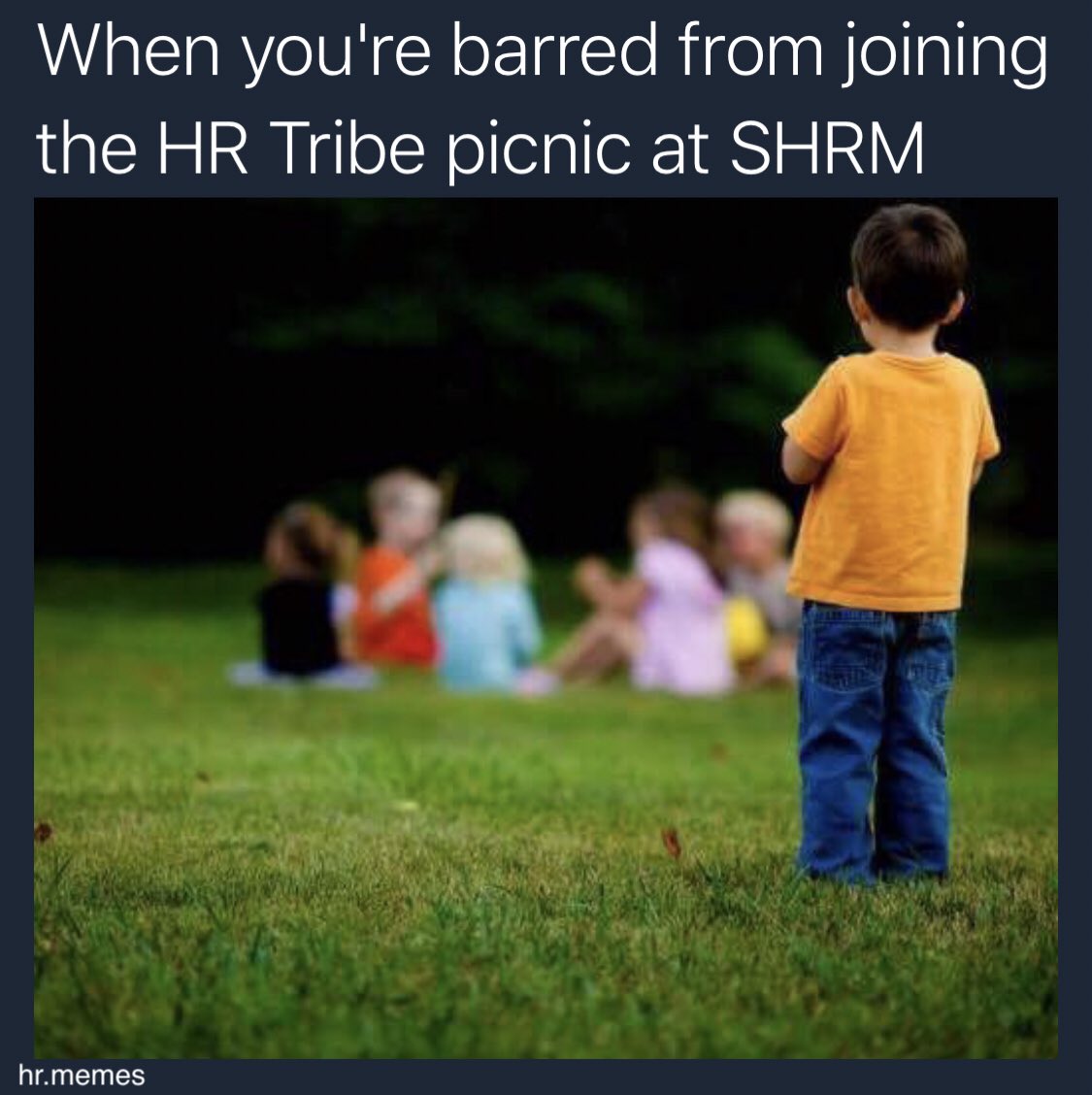
But then hrmemes (a satirical instagram/twitter account, by the way – sort of like The Onion) posted a fairly funny image about the #HRTribe stuff:

(Seriously – this is funny.)

The resulting discussion on Facebook was…enlightening. Suddenly, people who had stayed quiet about the issue started speaking out, and frankly, I was surprised at the number of folks who shared they had felt excluded because of the hashtag. That they felt like there was a wall put up between them and those who would use it. And that they were somewhat afraid to speak out because they didn’t want to “stir the pot.”

Huh.

Look, I’m okay with people wanting to feel like they are part of a community. If a hashtag helps you feel connected, great. Godspeed. #blessed. Whatever.

But there are things I’ve seen and heard that bother me. And it’s primarily around how those who are pro-hashtag are responding to those who have said they don’t like it.

This is what I said on the Facebook discussion, and I stand by it:

Here’s an observation from seeing the discussion on HR Tribe usage across all social media platforms. I keep seeing those who like the term dismiss the experiences or views of those who dislike the term. When specific examples of exclusion are given, they tend to be dismissed because the intent isn’t exclusionary. 

I get that.

And yet, here we are, a bunch of HR professionals who are supposed to listen to people’s stories and meet them where they are in their experiences…telling them they’re wrong. 

I’m bothered by that.

Regardless of how you feel about the use of the term, it’s the reaction of those around it that is starting to rub me wrong. Replace “I felt excluded” with “I felt harassed” and suddenly it takes on a different flavor, doesn’t it? 

No…HR Tribe is NOT an earth-shattering thing that we should lose our collective shit over. But maybe the way we’re talking about it should be.

Notice the focus – it’s not on the hashtag. It’s on the way we are talking about the hashtag.

I am disappointed that there are HR professionals dismissing the concerns of their peers in a manner that is disrespectful. I am bothered that some are HR professionals trying to convince someone who has shared their discomfort that it’s the other person’s fault that they misread the intention and that if they just tried it they would like it. I am seriously rolling my eyes when I see HR professionals reacting passive aggressively or rudely when someone has shared that they feel excluded because of the term.

How people are talking about this reflects how they would handle any controversial topic in the workplace. We are supposed to be a group of people that employees can go to and share their concerns. If someone came to you and said, “Ted from Accounting is making me feel uncomfortable,” should the response be, “Oh, Ted doesn’t mean anything by it. He’s just a friendly guy. You just misunderstood what he was doing”? I would hope not. And PLEASE don’t come at me and argue that a meme isn’t the same as harassment – yeah, I know. But it’s not a giant leap in logic, either.

Frankly, I’m shocked at the amount of passion and emotion around this thing. Some people have really doubled-down on their viewpoint. It’s a freaking hashtag. Yet it apparently has triggered some discussions that need to happen.

To be clear, there have been a number of people who love the hashtag who have said, “I get what you’re saying. Thanks for sharing. I’m still going to use it, but I will be more aware of how it makes people feel.” I love that. There are people listening, reflecting, and then making a conscious choice for a specific reason. There are also a number of people who have reached out and said, “I am glad someone said it. The tribe thing has bothered me for a long time but I didn’t want to say anything.” I love that, too. It means people want to have the conversation.

If we are going to be a profession that claims we can be a safe space for employees to bring forward their #metoo moments, or anything else that breaks the law, then we need to prove it. As Dominique Rodgers said during a Twitter conversation: If a group of kind, educated professionals can’t have this slightly awkward conversation, our nation has no hope for the much bigger awkward conversations that need to happen. Please don’t retreat. We value all perspectives. Promise.