When things go wrong, will your people do right?

Today was the kind of day that business travelers tell horror stories about.

I’m speaking at two conference this week (MNSHRM and WISHRM), and today was the first day of a week of travel. It was supposed to be easy. I had just gotten my TSA Pre-Check, so security wasn’t a problem. And I was flying Southwest Airlines with a good boarding position (A 31 – not too shabby).

How hard could it be?

My husband dropped me off at the airport one hour and forty minutes before my flight was scheduled to take off. I figured I’d drop off the bag, breeze through security and grab a little breakfast.

And then I encountered this:

line_southwest

A line to end all lines. And it was even worse inside.

Turns out, Southwest had a massive computer system outage today. They couldn’t print boarding passes from many of the service desks. They couldn’t print baggage claim tickets.

They had to do EVERYTHING by hand – check in, boarding, manifest clearing – everything.

And you know what? They did it with a smile.

The skycaps worked quickly. They had their process down and did what they could to keep the mood light. (I got through that ridiculous line in 35 minutes.)

The boarding gate agent was funny and handled the craziness with some humor.

The flight crew acknowledge the challenges, kept the passengers informed, and did what they could to ensure everyone on the flight made it – even when security was backed up (seriously…get TSA pre-check).

It wasn’t just in my hometown where the employees did what they could to make the best of a terrible situation. Check out these employees in Las Vegas, handing out cold drinks to folks stuck in the hot sun:
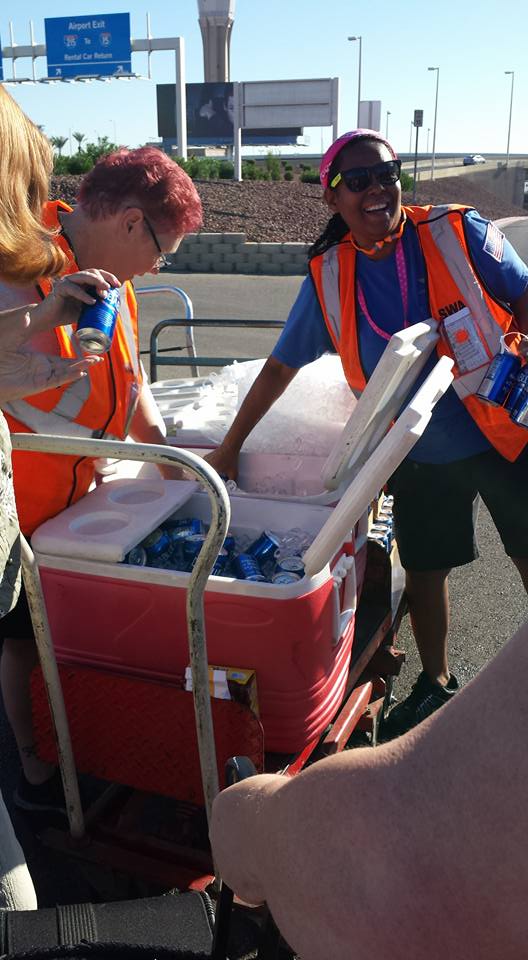
SW_2

Was everyone happy? Of course not. It was stressful for everyone involved. Not everyone saw exemplary service from Southwest employees, but overall, they have handled the ongoing problems pretty well.

In the event of this kind of crisis, how would YOUR employees perform? And what can you do to best ensure you’re ready to respond?

  1. Have a plan: The Southwest employees weren’t using sticky notes to process baggage. They had printed tags designed for manual checking. The gate agent had a protocol to process mobile and paper passes without computer access. If you don’t have a Plan B for your business process, you’ll have even more problems.
  2. Hire the right people: Southwest is very explicit about their culture and expectations for their employees – but they also make a pledge to do right by their people. (The “To Our Employees” clause…) By taking time to find the right people to carry out your organization’s work, you increase the likelihood that they will be able to respond to a challenge the way you want them to.
  3. Balance process with humanity: I can’t imagine the level of complexity Southwest faced with this system outage. Between the sheer number of passengers, Homeland Security requirements, and airport regulations, they could have chosen to approach this with a very command-and-control approach. Instead, I saw employees empowered to make decisions. I read examples of employees given the freedom to hand out cold drinks. I saw a flight crew take time to alleviate a passenger’s concern about a connecting flight when we took off late. Are you willing to let go in times of pressure and put the trust in your people to do the right thing?

They say that adversity does not build character, it reveals it.

What character will your people reveal?

[Disclaimer: I’m sure a LOT of people had a horrible travel day today, and many of them are annoyed and frustrated still. My experience may not be the same as others. If you had a bad start to your day, I really hope it got better!]


Self-fulfilling prophecies and the danger of labels

Read through the following scenario and pay attention to how you interpret it:

An employee, Shaun, shows up very late on a Friday morning. Shaun typically isn’t a morning person and has been a couple of minutes late once or twice in the past – but never like this. He is bleary-eyed, disheveled, and appears to be having trouble concentrating. He is in his early 20s, the same as a group in the office that likes to go out and party on Thursday nights. When you ask Shaun what’s going on, he is evasive, fumbling for answers that would make you happy. 

A week ago, you had a similar incident occur in which the employee actually had a hangover and had accidentally deleted an important spreadsheet and was trying to cover it up. And there have been a lot of system issues lately that you believe are caused by your employees not knowing what they’re doing and creating extra records that don’t need to be there.

Know how you’d react? It wouldn’t be surprising if you assumed Shaun is just like the other employees of his generation. After all, you’ve read all about their work-life balance YOLO lifestyle. You’re in the know. Time to act – right?

But there’s more to the story:

When pressed, Shaun tells you that he knew that the system slowdown was affecting everyone’s productivity, and he decided to stay late on Thursday to remove the extraneous records that were slowing down the system. It took longer than he thought it would, and he didn’t want to get in trouble for not telling you.

Dang it – your label failed you.

The Power of Labels

In 1968, third grade Iowa schoolteacher Jane Elliott wanted to teach her students about the work of Dr. Martin Luther King and the dangers of racism – the worst kind of labeling. How do you get children to understand such a high level concept? By letting them experience LABELS. She started the day by explaining that blue-eyed children are smarter, prettier, and all around better than brown eyed children. After lunch, she changed it and and explained it turns out that brown-eyed children are smarter and better.

The speed with which these children accepted the roles into which they were assigned – aggressor and victim – is terrifying. It is even more terrifying when you consider that Jane Elliott was completely transparent about what she was doing with the children. She explained it’s an exercise. She explains what she wanted them to learn. And yet, the labels were SO strong, the children’s performance in learning exercises went DOWN when they were the “dumb” group. [Watch A Class Divided for the entire documentary. It’s amazing and well worth your time.]

label-maker1

So why do I bring this up?

Because labels are powerful – and we use them ALL THE TIME.

We talk about generations (Do you know how to recruit Millennials? Are you ready for the ennui of Gen X? Do you care what Generation Z will do???). We talk about high potentials. We talk about “difficult people.” We talk about A Players, B Players, engineers, IT, HR, “leaders”, “followers” – all of them labels. And each of these labels comes with preconceived notions about the person who has that label can and cannot do.

Listen, I get that labels can help. We have to categorize things in order to process the amount of information we encounter every day. But we also have to be aware of the impact our labels have.

Words Matter

As a leader, the labels you place on your employees are especially powerful, and are most often given within the first day of meeting a person. A “promising employee” or “hard worker” tends to get more benefit of the doubt than a “slow worker” or “troublemaker.” It’s even worse when an executive labels an employee they’ve met once. I’ve known an employee who carried the label of not being terribly smart because on her very first day, an executive asked her a question about a process she didn’t know the answer to. ON HER FIRST DAY. This employee was very smart, and very capable – and every talent discussion we had to combat the baggage of a label given after a 5 minute interaction.

Sadly, the leader’s reaction to an employee based on a label is nowhere near as dangerous as the employee’s reaction to the label the leader applied. Just like the children in A Class Divided, employees who have been labeled high potential often perform better (or fade under the pressure of expectation), while “difficult” employees make more errors, because others interpret their actions differently – or because the employees themselves believe they are the label you’ve given them*.

The same goes for employees labeling leaders. “She’s mean” or “He’s a pushover” colors the behavior of leaders because it shades the way others perceive the leader. With the prevalence of 360s in today’s business world, these labels gain more and more power, impacting the leader’s self-confidence – or potentially reinforcing BAD behavior – as each cycle of feedback simply reinforces the self-fulfilling prophecy.

Think

Labels are going to be with us for a long time. They helped us survive as we evolved (this berry = good, sharp pointy teeth = bad). They allow us to thin-slice data. Unfortunately, they also allow employees and leaders alike to be lazy – to apply labels rather than get to know the people they interact with.

Leaders, when you go back to your teams take an honest look the expectations that you hold for each of your employees. Employees, take a hard look at the way you talk about your leader.  And ask yourself, am I responding to a person?

Or to a label?

[*For more on the power of suggestion and stereotypes, read Dan Ariely’s work.]

Be careful what you wish for…your voice WILL be heard

As employees, we have a list of grievances – or demands, if you prefer – that we carry in our heart and in our head at all times.

  • No one ever asks me what I think.
  • I never get to work on the big projects.
  • The executives don’t even know who I am!
  • My boss is constantly checking on me. Just leave me alone and let me do my job.

Sound familiar?

Complaining is the lifeblood of the American worker.  If we didn’t have work to complain about, we’d be forced to deal with something else. Like our unhealthy addiction to Laffy Taffy (don’t judge me).

So let’s say you had the opportunity to speak up. And I’m talking about a leadership team who really wants to hear your feedback and input (not some snarky attempt to check off the “listen to your people” box).green_soapbox

Someone finally asks you what you think.  Someone looks to you for some big ideas. Someone gives you free reign to propose a solution to all the problems you’ve been pointing out for so long.

Are you ready to respond? Because you may only get one shot at this.

It can hurt your credibility when you’re not able to rise to the occasion. Responding from a place of emotion rather than giving specific examples of what has happened that negatively impacts the organization, the focus is no longer on the issues – it’s squarely on you. And if you don’t respond AT ALL, you risk never being asked for your opinion again.

No one is looking for a perfectly formed 12 point plan to address the issues.  Your leaders are just asking you to articulate your concerns in a way that shows you have thought about the problem…you know, beyond how much it impacts you personally. Leaders KNOW it impact you. That’s why you keep bringing it up. So what are you gonna do about it?

If you want a voice and have a say in formulating a solution to the issues your team faces, try the following:

  • Self-monitor: Take note of how often you complain and how you might be perceived by others. What others might agree with in the beginning might become background noise in the long run.
  • Listen to others: Issues may not impact others the same way they impact you. And others may lend perspective that you don’t have.  So hush up and see what they have to say.
  • Stick to the facts: Emotions can run high, particularly if a group feels like no one has been listening to them up to this point.  Leaders tend to shut down the instant employees argue emotion rather than factual impact.
  • Be honest without being mean: Leaders want candor. They don’t want anger. Don’t let the message be lost in the way you deliver it. Attack the issue, not the person. You CAN be respectful and be frank.
  • Be solution-focused: We all vent. A lot. It’s pretty easy to point out all the things that are wrong. Leaders ask for your opinion because they want to hear from the people on the front-lines. Use your day-to-day knowledge to suggest solutions no one in leadership would think of.

So the next time you complain that no one ever listens to you, don’t be surprised if leadership starts asking for your opinion.

Will you be ready?