Too much crazy

Today, another person I respect and adore decided to take a hiatus from social media. This is something like the third or fourth person (that I know of) in the last 6 months.

There are a lot of reasons people take time off from social media. Some want to spend more time with family. Others realize it’s keeping them from doing what they love (reading books, painting, overthrowing governments, etc.). And one very special person claims quitting Facebook it has helped him learn to move 10 lbs objects with his mind. (He’s totally lying – he’s only managed 4 lbs, and that’s being generous.)

The most common reason I’ve heard lately, however, is that there is just too much crazy.

People can’t seem to be civil anymore. The 24/7 news cycle has turned every little thing into an “event.” And many wake up in dread over what may or may not have been tweeted overnight.

They might have a point. There are numerous studies suggesting that quitting Facebook – even for just one week – has benefits. Middle school students may be particularly susceptible to issues with social media, with online bullying becoming a real danger for kids as young as 10. They’ve even come up with a new term – bullycide – for when a child takes his/her own life because of bullying. It’s heartbreaking.

I’ve contemplated taking a break. I haven’t because most of the people I know I communicate with online (#introvert). But I have cut back. And I find myself avoiding crazy as much as possible – it’s too exhausting. Not everything needs to be an argument, and not every post needs a dissenting opinion.

I think the way people are interacting online right now is a mix of opportunity and motive. Online comments lend anonymity and distance and accountability is almost nonexistent. And as for motive? There are a lot of people out there who have either felt they never had a voice and then found it, or have always had a voice and think everyone needs to hear it.

It’s unfortunate – we’re like kids who broke the expensive toy because we couldn’t respect it. Or because we played with it too much and it fell apart. I worry because I see how we interact online bleeding over into our real world interactions, and it’s getting ugly. I also worry because all the noise can block out all the good that the internet can enable.

I hope the crazy calms down. I hope those who are struggling with memories and feelings that the relentless news cycle brings are able to find peace. I hope we find a way to talk instead of yell.

I hope we keep finding funny cat videos to share online. (Thug Cat is THE BEST.)

I hope we find ways to remind each other that the world is a beautiful place and that people are worth saving.

If you need a break, take it. But please come back.

We need you.
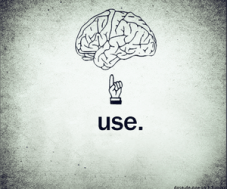
 

Use Your Brain #SHRM17

[This post first appeared on the SHRM Blog on June 20, 2017]

I’ve had the opportunity to go to a lot of different conferences, and I see a lot of keynote speakers who are considered experts in their fields. They are successful because enough people think enough of what they’re saying makes sense and support it. They’re also successful because they are engaging speakers who connect with their audience and make everything sound brilliant.

The thing is…you’re not required to agree 100% with what these speakers are saying. Some of them cite research. Some of them share what they’ve done that worked. Some of them just share what they think SHOULD work. Are all valid ways to share an idea.  All can either be right or wrong.

Whether it’s Laszlo Bock’s suggestion that hiring managers not have the final say of a hire, or Patrick Lencioni’s suggestion that if you REALLY want to know if a person is a good hire you should take them shopping, it’s up to you as to whether or not that suggestion makes a lick of sense.

I go into every session with the attitude that I am going to learn something, because nothing bothers me more than a conference attendee who claims they didn’t learn anything. I may not agree with the speaker, but I bet I learned something about WHY I didn’t agree with them. That speaker’s point of view triggered an internal reflection – “Does that make sense? No, that doesn’t make sense. Why doesn’t it make sense?” By questioning another’s point of view, I’m forced to critically consider my point of view.

Notice the words I’m using – “reflection,” “critically consider.” I’m doing this on purpose because there’s a difference between thoughtful disagreement and a kneejerk reaction against something new.

So as you finish up your conference sessions, or plan future conference attendance, I ask that you use your brain. Listen to what the speakers are saying – not necessarily how they are saying. Then decide whether or not you agree with it. Only then will you be ready to apply what you were exposed to at #SHRM17.

Don’t you dare forget…a session with Kat Cole

[This post first appeared on the SHRM Blog on June 19, 2017]

Today saw the beginning of #SHRM17 in New Orleans, where 18,000 HR pros have descended upon the city for learning, fun, and reconnecting with old friends.

The shenanigans kicked off early in the morning with pre-conference workshops, but the sessions began in earnest after lunch, with concurrent sessions and SmartStage speakers. But the main event REALLY kicks off late in the afternoon, with the appearance of Juana Hart and our first keynote of the conference.

You have probably heard of Kat Cole – she worked at Hooters and learned the operations side of the business when the cook disappeared. Her hard work and inherent business sense led to her recommendation to be sent to Australia to launch restaurants there.  She became a Vice President at 26, and then moved over to Cinnabon to become President of the company at the age of 33. Her story is remarkable. She is remarkable.

Ms. Cole’s keynote was impressive – no slides, no teleprompter, just a woman telling her story and the lessons learned along the way. There were so many inspiring tales in the keynote. I have no doubt my fellow SHRM bloggers will cover many of them. There was one in particular, however, that stood out to me.

She had just finished sharing a major mistake she made early on at Cinnabon, and shared how that mistake led to lasting success. And then, she talked about how her mom keeps her grounded. Every day on her birthday, Ms. Cole’s mother sends her a card with the following reminder: Don’t you dare forget where you came from, but don’t ever let it solely define you.

This hit me on a personal level. Everyone carries the memories of where they come from with the through life. These experiences shape who we are and how we approach adversity. Some choose to overcome them and never look back. Others wallow in those experiences, using them as an excuse to stay stuck. Ms. Cole’s message from her mother is striking because it illustrates the power of remembering what got you through adversity, and then using it to move forward.

When we refuse to look back at who we were in the past, we fail to acknowledge the lessons we learned on that path. We don’t honor the person who made it through the wilderness. We pretend it didn’t exist. But that’s not really the case, is it? That person is always looking over our shoulder, whispering in our ear, holding us back or pushing us forward. It would be disingenuous to believe we aren’t still holding on to a part of the past, even as we look towards the future.

So why focus so much on this aspect – especially when it comes within the context of Human Resources? There are two reasons – one external, the other internal.

First, the external – we need to remember that each of the employees and leaders we work with are bringing their pasts to work. We have an opportunity to be that voice that says, “Yes, you ARE that person who dealt with a not-so-great past. But that doesn’t have to be who you are forever.” We can help these people move forward by reminding them of their strengths and working with leadership to recognize when humility and courage come together to make real change.

Second, the internal – HR needs to listen to that advice. For too long, we have wallowed in the belief that we have no influence. That no one will let us do anything. That we have fought like hell to get where we are today and it just doesn’t seem like it’s that far at all. And yet…look at how far we have come. We are no longer “personnel.” We have the ear of our CEOs. We may still struggle at times, but CHRO is a position that actually EXISTS in business – and it didn’t always. We have struggled and we will continue to struggle…but we have so much potential.

So my advice to you, #SHRM17 HR professionals – don’t forget where you came from….but DON’T YOU DARE let that solely define you.

Be more. Do more. Dare more.