Expanding horizons

This is my plea that everyone – employees and leaders alike – learns how to think outside of themselves.

That they look beyond their personal role to see how they impact the world around them.

That they try to improve the processes they work within.

That they reach out to those they work with to offer support when needed.

That they reach out to those they work with to offer a kick in the butt when needed.

That they step back and think about how the offhanded comment they made in a crowded room might have been interpreted.

Earth_GlobeThat they realize that they made a positive difference in the lives of the people they interact with.

That they see their value in the world and know it spreads beyond those who see them every day.

That they recognize their power to influence…and use their power for good.

That they learn how to say “no” so that others say, “I understand.”

That they win with humility.

That they lose with grace.

That they never lose their love of learning – or that they discover it in the first place.

That they remember that every single person they interact with is going through something in their lives that others don’t know.

That they see the potential of the team, organization, and community that they are a part of – and want to help everyone reach that potential.

That they want to build, not destroy.

That they learn that success comes in many forms.

It is my hope that everyone – employees and leaders alike – realize it’s not all about them.

It’s about us.

How open-minded are you….REALLY?

If I were to ask this question of a random sampling of leaders and employees, how do you think they’d answer?

Most likely, everyone would present themselves as an open-minded, thoughtful human being, unswayed by their bias. (Except for that weird guy from the third floor. But he’s probably a sociopath.)

The reality is that people don’t like to think of themselves as closed-minded, or at the very least, they know better than to admit it. That’s because companies work like hell to hammer home the fact that inclusion, respect, diversity, love, peace, unicorns and rainbows are an integral part of a successful workplace. And it IS important to be inclusive and respectful.

But deep down, we all kind of suck at it.

I don’t mean we’re all assholes and racists or anything. I just mean that we fool ourselves into thinking we’ve got control over our natural biases. And not just the big ones (gender, race, age, etc.) – I’m talking about white-collar, blue-collar, where you went to school, the shoes you wear, what music you listen to…that kind of stuff. Even the most well-intentioned, self-aware person has inherent biases. [For an eye-opening revelation about your own biases, take the Project Implicit test from Harvard. It’s free. And a little spooky.]

All those little biases add up to a pretty significant impact on our decision-making.

Don’t believe me? Look at your hiring practices. Many organizations have some sort of diversity initiative in place – whether it’s monitoring and reporting, or a specific process to ensure a certain candidate pool mix. Hopefully, these programs ARE making a difference for your organization on a macrolevel.

Now look at the teams around you. Look at YOUR team.

Is everyone just a little too…the same?

Do you all like the same things? Have similar backgrounds? Make decisions the same way?

Did you even realize it when you hired them?

BOOM. That’s bias in action, baby.

If you want to be closer to the level of open-mindedness you claim to have, you have to be aware you’re not perfect and be proactive in your approach to make a difference. Here are a few things you can try, either as a leader or an employee:

  • Hiring practices: When hiring, consider taking off names, addresses and school names off the resume. Just look at whether the person meets the required education level and has the right experience. (Bias exists for peers just as much as hiring managers!)
  • Job design: Question whether the education level you’re requiring for a job even makes sense. A college degree does not magically make you a better employee and mean you can do the job. I’m not saying it’s NOT a good thing, but question your implicit assumption it’s required for success.
  • Teams: Challenge your need to like everyone you work with. I mean, it’s nice and all…but a lot of times we like people because they’re just like us. Same can be boring and stifle innovation. Build and/or join a team with people who will challenge your thinking.
  • Silos: Go learn more about the people who do work that is wildly different from yours. If you’re in a corporate office, do some ridealongs with the field folks. If you’re in the field, shadow the corporate people. Understanding of the unknown helps breaks down bias and assumptions.
  • Ideas: What happens who you propose an idea and someone questions it? Do you defend it to the death? Do you think the other person is an idiot because they don’t agree? Do you assume they don’t like it because they don’t have your background? All of the above? To be truly open-minded, you have to be open to the fact that you DON’T know everything…even about the topic you’re supposedly THE expert in. Listen and learn.

These are just a few ideas on how you can set up an environment that encourages open-mindedness through behavior, not intention.

Give one or two of them a shot. After all, you’re open-minded….

Right?

When things go wrong, will your people do right?

Today was the kind of day that business travelers tell horror stories about.

I’m speaking at two conference this week (MNSHRM and WISHRM), and today was the first day of a week of travel. It was supposed to be easy. I had just gotten my TSA Pre-Check, so security wasn’t a problem. And I was flying Southwest Airlines with a good boarding position (A 31 – not too shabby).

How hard could it be?

My husband dropped me off at the airport one hour and forty minutes before my flight was scheduled to take off. I figured I’d drop off the bag, breeze through security and grab a little breakfast.

And then I encountered this:

line_southwest

A line to end all lines. And it was even worse inside.

Turns out, Southwest had a massive computer system outage today. They couldn’t print boarding passes from many of the service desks. They couldn’t print baggage claim tickets.

They had to do EVERYTHING by hand – check in, boarding, manifest clearing – everything.

And you know what? They did it with a smile.

The skycaps worked quickly. They had their process down and did what they could to keep the mood light. (I got through that ridiculous line in 35 minutes.)

The boarding gate agent was funny and handled the craziness with some humor.

The flight crew acknowledge the challenges, kept the passengers informed, and did what they could to ensure everyone on the flight made it – even when security was backed up (seriously…get TSA pre-check).

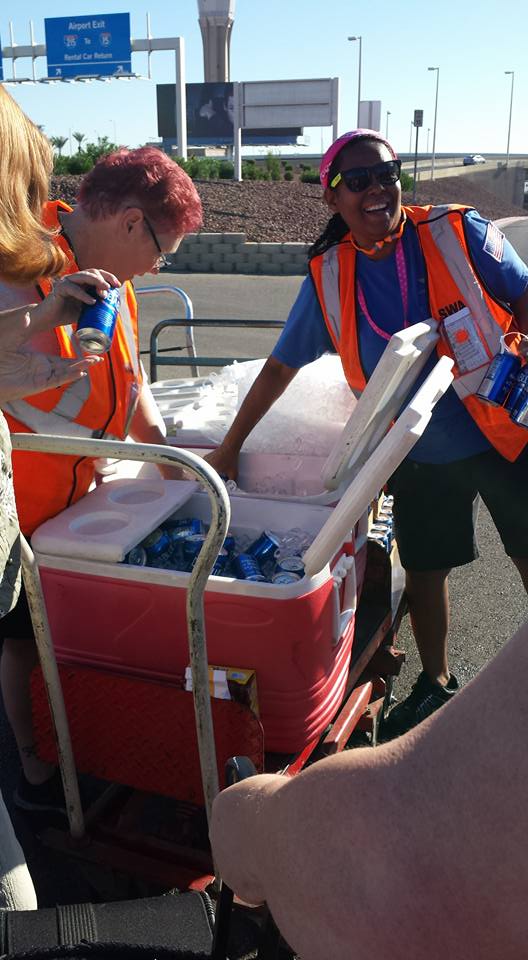
It wasn’t just in my hometown where the employees did what they could to make the best of a terrible situation. Check out these employees in Las Vegas, handing out cold drinks to folks stuck in the hot sun:

SW_2

Was everyone happy? Of course not. It was stressful for everyone involved. Not everyone saw exemplary service from Southwest employees, but overall, they have handled the ongoing problems pretty well.

In the event of this kind of crisis, how would YOUR employees perform? And what can you do to best ensure you’re ready to respond?

  1. Have a plan: The Southwest employees weren’t using sticky notes to process baggage. They had printed tags designed for manual checking. The gate agent had a protocol to process mobile and paper passes without computer access. If you don’t have a Plan B for your business process, you’ll have even more problems.
  2. Hire the right people: Southwest is very explicit about their culture and expectations for their employees – but they also make a pledge to do right by their people. (The “To Our Employees” clause…) By taking time to find the right people to carry out your organization’s work, you increase the likelihood that they will be able to respond to a challenge the way you want them to.
  3. Balance process with humanity: I can’t imagine the level of complexity Southwest faced with this system outage. Between the sheer number of passengers, Homeland Security requirements, and airport regulations, they could have chosen to approach this with a very command-and-control approach. Instead, I saw employees empowered to make decisions. I read examples of employees given the freedom to hand out cold drinks. I saw a flight crew take time to alleviate a passenger’s concern about a connecting flight when we took off late. Are you willing to let go in times of pressure and put the trust in your people to do the right thing?

They say that adversity does not build character, it reveals it.

What character will your people reveal?

[Disclaimer: I’m sure a LOT of people had a horrible travel day today, and many of them are annoyed and frustrated still. My experience may not be the same as others. If you had a bad start to your day, I really hope it got better!]