Missed opportunities, or what if you spent $4M and no one cared?

[Editor’s Note: Due to the horrible performance by this author’s team, the game itself shall not be discussed.  I mean, seriously – what the heck was that?!]

Every year, the Super Bowl audience breaks down to two camps – those who care about the game and those who care about the commercials.  Ever since Apple’s ‘1984’ ad aired, the Super Bowl has risen in prominence as THE place for companies to make a marketing impact.  With the increase of on demand entertainment, live sporting events on the level of the Super Bowl offer one of the few places where millions of eyes will be watching at the same time.  And given the mythical status some Super Bowl ads attain, this is one of the few times that people WANT to watch the commercials. So you would think companies would do their best to make the most of this moment.

Sadly, this year’s crop fell short.  In fact, recent years have revealed some lackluster attempts to get our attention.  We long for the days of EDS’s “herding cats” or the CareerBuilder chimps. Instead, we get a Maserati ad that everyone hoped was a horror movie trailer and others that made Joe Namath’s coat the highlight of the evening. [Ed. Note: The Budweiser Puppy/Clydesdale ad was still awesome.  Because….puppy.  Duh.]  Not exactly everyone’s idea of $4M well spent.

missed_opportunities

We’ve all had situations in which we had a great opportunity to make a positive impression…and fell flat on our face.  Or worse, made no impression at all.  By examining the possible mistakes made by this year’s Super Bowl ad companies, it’s possible you can avoid a similar problem when provided a high visibility stage upon which to make a statement:

  • Playing it safe:  A lot of the ads toyed with audacity, but couldn’t quite get there.  That $4M price tag might have kept companies from wanting to go too far out of the norm.  As a result, there was a lack of creativity.  And I’m not the only one who thought so.
    What it means to you: When you get a chance to play on the big stage, decide whether or not you want to swing for the fences.  If you’re going to take a risk, take a real risk.  A jazz instructor I knew once said, “If you’re going to make a mistake, make a mistake of passion.”
  • Not managing the message: If you followed the Twitter feed for Super Bowl ads, you saw a wide range of negative comments – some deserved (and funny), some bizarre and intolerant. As a result, the ad’s message was lost in the aftermath.
    What it means to you: It’s not possible to anticipate all reactions to the content, but it’s good to have a backup plan. When you take your moment in the sun, consider the audience, the possible response, and how you’ll handle any backlash.
  • Losing sight of the goal: This one can also be thought of as “Letting the size of the stage dictate your message”.  Bud Light, who has had some winners in the past, decided to feature a regular guy who doesn’t know he’s in a commercial – and not just any commercial, a Super Bowl Commercial.  So you ended up with Don Cheadle and a llama, and Arnold Schwarzenegger in inappropriate shorts.  And how is this about beer? Or even about the Bud brand?
    What this means to you: Just because you’re in a high visibility situation, it doesn’t mean you should forget why you’re there.  Whatever message you want to send, keep the core of that message.  What do you want people to remember – you and your message, or the fact that you had a dancing bear introduce you?

Chances are, your stage isn’t as big as what we saw on Sunday.  But every single time you have a chance to make an impression, you should think of it as your personal Super Bowl.  Seize the opportunity to tell your story, share your message, and be memorable – in a GOOD way.  Don’t spend the social equivalent of $4M just so people can say, “meh.”

 Do you have a story about how a time you made an impression on the big stage?  Share in the comments?
Are you serving ‘leadership a la carte’? Well, stop it.

Do you wish your boss would let you pick and choose which leadership behaviors you want?  What if your boss then chose to “charge” you for those services through overtime, extra projects, or even future raises?

What the what?

Allow me to explain.

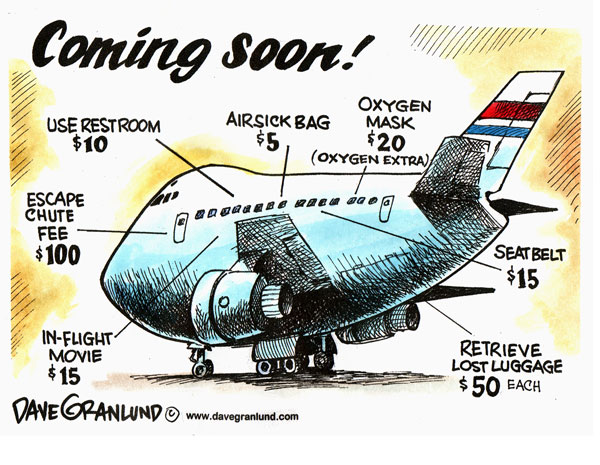
While browsing on LinkedIn, I read this article by Christopher Elliott which talks about the new a la carte approach to air travel – tickets are all that are guaranteed.  Luggage, carry-ons, even water are now added revenue, and gosh isn’t it wonderful? Because this lets customers pick and choose which services they want to pay for.  Which is what EVERYONE wants (anyway, that’s what the airlines would like you to think).

When people pay for a ticket, there are certain things they take for granted as part of the flying experience – such as an opportunity to bring your luggage.  Or drink some water.  Most people would be okay with paying a slightly higher airfare for the illusion that they are getting the experience they expected (see Southwest).air-fees-color-web

So let’s take this back to leadership…employees don’t always know what leadership behaviors they need from their supervisors.  As a result, they are seldom able to tell a manager how they are best led.  Ask any employee what kind of managing style they do best under, and at least 92.3% of them will say, “I hate micromanaging.”  First of all, many employees think being held accountable is micromanaging, and second of all, some employees NEED micromanaging until they learn the job.  So do we still think employees know what they need all the time?

As a leader, you’re responsible for adjusting your style to the needs of your employee – which means you better be able to apply a lot of different kinds of leadership.  And employees expect that of you – it’s part of the social contract of the manager/employee relationship, not a “nice to have”.  Employees will put up with a tougher workplace, longer hours, and provide discretionary effort (the “higher ticket price”) when they know they have a leader who has their back and will step in with the right approach when necessary.

If you suspect you’re an A la Carte Leader and want to change, try some of the following:

  • Schedule regular 1:1s with your employee (even if they don’t want it!)
  • Establish a level of trust by LISTENING (novel concept, I know)
  • Study different leadership models and styles to increase your toolbox (e.g., Situational Leadership, The Leadership Challenge, Strengths Based Leadership, etc.)
  • Accept that you are there to make your employees successful and provide the support they need

Employees don’t always know what they want exactly when they need it, but they DO know when their leader isn’t providing what they need.  Rather than thinking of yourself as an add-on, remember that you are part of the entire employment experience – employees expect and need your support.  And if you fail to give it to them, they WILL move on.

“The first responsibility of a leader is to define reality. The last is to say thank you. In between, the leader is a servant.” 
–Max De Pree

You are how you act (a cautionary tale)

See thou character. Give thy thoughts no tongue,
Nor any unproportioned thought his act.
Be thou familiar, but by no means vulgar.

– Polonius to Laertes, Hamlet

I hate to be yet another post about Richard Sherman and all that, but try as I might, I just can’t shake some feelings of disappointment over the whole affair.  For those of you who have been without internet, here’s what everyone has been talking about.

Sherman’s reaction touched off a firestorm of reaction.  The debate seems to have settled into two camps – those who think Sherman is a thug, and those who think the media is being unfair.

Give every man thy ear, but few thy voice;
Take each man’s censure, but reserve thy judgment.

When I saw it, I was pretty annoyed – he was asked a question about his team, and chose to use this moment to trumpet himself (not his team) and make a personal attack on Michael Crabtree, his opponent.   I don’t think he’s a thug or any of the other words used to describe him – I think he’s a guy with low impulse control who needs to have a little more professionalism.  The outburst (and subsequent follow up comments) lacked humility, a quality other greats in the game show in victory and defeat.whois

But do not dull thy palm with entertainment
Of each new-hatch’d, unfledged comrade. Beware
Of entrance to a quarrel, but being in,
Bear’t that the opposed may beware of thee.

But apparently I’m mistaken.  This story was written – telling us that we are lazy and awful because we didn’t bother to get to know the real Richard Sherman, and aren’t we all just shallow.

Guess what? We are how we act. Each of us is responsible for our behavior. Richard Sherman has a pattern of disrespecting his opponents. I’m glad he’s a person who found a better life through his talent, but that doesn’t excuse him for acting like a jerk.  And now kids are making videos re-enacting the rant.  We are supposed to be okay with it because if kids can re-enact it, there obviously wasn’t anything inappropriate done or said.  Other than the lack of sportsmanship.

There are CEOs who are assholes in their day-to-day lives who are loved because they manage their public persona so well (or the serial killer about whom everyone says, “he seemed like such a nice guy”), just as there are people like Sherman who may do wonderful things away from the spotlight, but chooses to act like a jackass when the cameras are on.  And the one we see on TV is the one from whom we make our judgements.  Is it fair?  Maybe not.

And that in way of caution, I must tell you,
You do not understand yourself so clearly

But it happens to each of us every day – our value to a company might be based on a hallway interaction with an EVP, or one meeting with stakeholders, or a chance encounter on IM.  And we don’t always get a chance to hold follow up press conferences or send out tweets to argue our case.  And most of us don’t get to play the “that’s your problem” card.

We all have choices on how we act.  No, we cannot control how people will react to us.  Nor can we control the judgements made about us based on the baggage people carry around with them.  But we can acknowledge that sometimes our actions might be misinterpreted because of the timing or tone, and we can apologize when we act inappropriately.  We can be accountable for how we act, for that is how others see who we are.

Sherman has had a good past couple of years (as well a dodged suspension due to irregularities in the collection process), and he has always had a big mouth.  If he wants to be remembered for his talent and not for his attitude, he would do well to rethink his public persona.  If he wants to be remembered for his intelligence and escape from a difficult childhood, he should act as the person he is.

This above all: to thine ownself be true,
And it must follow, as the night the day,
Thou canst not then be false to any man.

Unless he is the person he acts like.  And that’s all on him.