10 (-ish) things leaders do that make me sad: Part 1

Okay, this is a list that started out as 10 and then settled somewhere in the vicinity of 14 (I have editing issues), so I apologize for the length. Because it’s so long, I’ve broken it into two separate posts.

There are more of them out there, I’m sure – these are the ones that stand out to me because of the widespread impact they have on an organization.

So here, in no particular order, is the first half of my list:

  1. Fail to acknowledge their impact: Seriously – if you’re a leader, you impact your organization. Pure and simple. No ifs, ands or butts. So when a leader tries to pull the “do as I say, not as I do” crap, it just underscores a certain lack of awareness that leaders need to have to be successful. Don’t be surprised if your team throws each other under the bus when you do the same thing.
  2. Lie: This one’s a pretty obvious no-no, so why do leaders keep doing it? Well, according to research – we ALL lie and cheat…at least a little bit. But some people are LIARS (all caps – I know!) – they misrepresent their skills, their team’s skills, the facts, just about everything. When these lying liars lie, it impacts the business’s ability to make good decisions, destroys trust on all levels, and creates a culture that no one feels good in.
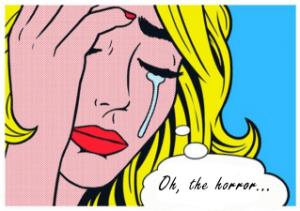
    oh the horror
  3. Avoid conflict: I know. Conflict is icky. People might get upset. Voices might be raised. Eye contact might be made. Here’s the thing – without conflict, there is no debate. With no debate, the wrong decisions might be made because a leader was scared to “rock the boat”. Healthy conflict is ESSENTIAL to innovation and good business. The really annoying bit is that leaders who avoid conflict are often the first ones to say, “I told you so” when something happens that they suspected but didn’t bring up. Boo on them.
  4. Treat “accountability” like a disease: As you know, this is my “thing”. So when I deal with a leader who is unable to embrace accountability, it really puts a little black rain cloud over my head. Lack of accountability comes in many shapes and sizes, but primarily boils down to two big categories – inability to accept accountability for something you did, and inability to hold others accountable for their actions. Both are damaging to the organization. A leader who keeps getting bad outcomes yet doesn’t see how he/she contributed to the situation will forever be blaming outside forces for their issues (unless, of course, it’s a successful outcome – then it’s totally that leader’s skills that did it, the aptly named “self-serving bias”). A leader who doesn’t hold others accountable doesn’t get results, tends to complain about their team a lot, and doesn’t understand why all the A players want to leave.
  5. Talk more than listen: Leaders who listen get amazing results – their employees know they can take anything to their leader and it will be considered. Doesn’t mean it will be implemented, but at least their voice will be heard. Leaders who talk too much are usually GREAT speakers. They are often external processors. All that is well and good, but watch what happens to a team when a leader talks and talks and talks – there’s usually only one voice in meetings, no one is willing to bring things to the leader’s attention, people hesitate when the leader asks for ideas. That’s because people assume the leader’s voice will overrule all others. And that’s not good.
  6. Roll their eyes: Listen, I’m a champion eye-roller. You can hear my eyes rolling from across the country when I think something is ridiculous. And it’s a horrible trait that I’ve worked hard to eliminate. The reality is that eye rolling is the manifestation of contempt – one of the most damaging attitudes. Leaders who roll their eyes are really just treating another person with contempt. They are sending the message that others are inferior to them, that they can’t be bothered to deal with that other person’s issues. It’s often an involuntary movement, but don’t think for a moment the other person didn’t notice.
  7. Gossip: People like gossip. It makes them feel like they are in the “in-crowd” because they have secret information. And even though employees prefer to get their information from their manager, they usually end up getting information through the grapevine, so I get that gossip is a learned habit reinforced by years in the workforce. When leaders gossip, though, it is incredibly damaging. A leader’s words carry weight – speculation and rumor become fact when someone in authority says it. So come on, leaders – show some respect to the absent and stop gossiping.
Want to read more? Continue on to Part 2!

Want to argue my points? Leave a comment.

Everything rustles… (how fear drives your people)

The impact of fear on the workplace typically comes from allegations of a hostile work environment, inappropriate manager behavior, too much stick and not enough carrot, etc. And yes, fear DOES impact the workplace in all those ways. What I want to talk about is the everyday impact fear has on the actions and decisions of managers and employees alike. It’s like death by a thousand cuts – one doesn’t take you down, but a whole lot of them over time is bound to beat you.

The title of this post comes from a quote from Sophocles (seems like a smart guy, so I am okay quoting him):

To him who is in fear everything rustles.

Think about all the rustling going on in your company. There’s a closed door meeting (rustle). The boss isn’t returning my calls (rustle). That person is getting more attention in the staff meeting (rustle). All of this fear is destroying your culture and creating behaviors driven by the wrong thing.  I’ve worked in environments where fear was a seen as a  “motivator” that should be used, and I’ve seen the impact it has on the company – from turnover, to recruiting, to business results, to culture.  It ain’t pretty.

afraidWhen actions are driven by fear rather than thought, you end up with dysfunction.  It’s easier to question motives and suspect a hidden agenda.  A leader’s primary purpose (to make the company successful) is discarded, replaced by a “cover my ass” mentality.  We’ve all seen it – hell, we’ve all probably fallen prey to it at one time or another.  Recognizing fear can be easy – overcoming it is the tricky part.

In his excellent book Your Brain At Work, David Rock uses the SCARF model to help illustrate what drives people either toward or away from a situation, and I like to use it to show how fear becomes the driver in all 5 areas:

  • S stands for status, your relative importance to others.  
    Fear of losing status can cause incredibly awful decision-making, like covering up mistakes, failing to develop their people (they might be better than I am!), forming inappropriate “alliances” amongst their peers, or worse – burying corporate malfeasance.
  • C  stands for certainty, the ability to predict the future.
    This is the reason people tend to run away from change – the fear of the unknown.  Fear driven by a need for certainty is what drives a lot of the gossip and “story-telling” seen in organizations, because people combat lack of certainty by creating a reality that they think they know.  Worse still is when decisions are based on the new reality (and you know it happens every day).
  • A stands for autonomy, which provides a sense of control over events.
    Fear in this area manifests in passive-aggressive behavior – people are afraid they don’t have control so they find a way to get it back, typically by NOT doing something you’ve asked them to do.  Occasionally fear causes people to act first, collaborate second because they fear that their choice in the matter will be taken away from them.
  • R stands for relatedness, or a sense of safety with others (think friend or foe).  
    Trust (or lack thereof) is a major cause of fearful behavior in business – I’m afraid I can’t trust you, so I don’t dare speak up/collaborate/engage in healthy debate/be authentic/you name it.  People are also afraid that they won’t be part of the “in crowd”, that they’ll be on the outside looking in.  This can drive inauthentic relationships, and cause people to act “fake” for the sake of fitting in.
  • F stands for fairness, which (no surprise) relates to the perception of fair exchanges between people.
    Leaders loooooove it when people talk about fairness (darn it, where’s that sarcasm font???).  As it relates to fear, though – a perceived lack of fairness in a situation causes people to fear that they’re in trouble, or they aren’t valued.  This can lead to active disengagement, undermining the success of others, or justifying lying/stealing because “the company owes me”.  They are afraid they aren’t getting “what’s fair.”

So start paying attention to what you’re seeing in your organization and see if fear is driving behaviors you don’t like.  And if fear is the “preferred” method of leadership, use SCARF to help address the issues.  Quiet the rustling in your world.

One last geek quote (but it’s a good one from Dune):

 Fear is the mind-killer. Fear is the little-death that brings total obliteration.

What examples of fear have you seen in your organization?  Share below!

You da man! (whether you like it or not)

Once upon a time (1993), back when Charles Barkley was known better as a professional basketball player and not an analyst with a bad golf swing, he famously declared that athletes shouldn’t be role models.  Nike even made a commercial about it.  And while many people agreed with the underlying point the Round Mound of Rebound was making, the comment left a bad taste in the mouths of the public because the reality is that it doesn’t matter if you WANT to be a role model – sometimes you just are.

It’s the same for leaders.  You may think you were hired for your business acumen, or your ability to set a vision for the company and produce results.   Okay, you’ve got me there – you were hired for those reasons.  But there is another line in your job description that may or may not be explicitly stated.  As Uncle Ben tells Peter Parker, with great power comes great responsibility.  And that responsibility is  to be a role model to your organization.

superherokid

This idea – “the shadow of the leader” –  has been around for a long time, but was first studied in business organizations in Larry Senn’s 1970 doctoral dissertation (and his company Senn Delaney is still rocking the concept).    Remember when you were a kid and you used to dress up like a super hero?  Employees are kind of like that kid – they emulate the people they look up to, or who have control over them.

Here’s another way to think of it:

Think of a family tradition that has been passed down generation after generation.  It might be a phrase that everyone uses, a certain way you cook something, game night, anything. For example, when I make a pizza, I always cut it into squares.  Why?  Because that’s the way my dad always did it.  There is no real reason to cut a pizza into squares – in fact, some would argue it’s very inefficient.  But that’s how pizza was cut in my house, and so that’s how I cut it.

In your organization, you’re the one cutting the pizza into squares.

The leader of an organization casts a shadow that influences the group culture.  This shadow may be weak or powerful, but it always exists.  Whole organizations often take on aspects of the personality of a strong leader (think Apple, Microsoft, Southwest, Virgin, etc.).  It’s not so much that leaders force their style and values on others, but that employees tend to look upwards for clues as to what is important, how to get ahead in the organization, and how to fit in.

This is the power of the shadow in action – the power to shape and influence the character of an organization.  Do you know what kind of shadow you’re casting?

One of the best things about the shadow of the leader is that you have the power to control it – you can take specific actions that will help you cast the shadow you want in order to create the culture you want.  Below are some questions you can answer to help you be the leader you want people to emulate:

  • What are the elements of your shadow, both strengths (things you like) and challenges (things you dislike)?
  • What values, beliefs, and standards are in place within your organization because of these elements? Is that what you want?
  • What behaviors are you seeing in your employees as a result of these elements? Do you like them?
  • What elements of your shadow come from your desire to emulate a leader you had at one time?  Did you mean to make that choice?

Once you’ve answered those questions, you are ready to create an action plan for change, thereby taking control of your shadow.  Complete these sentences to create your action plan:

  • The elements I want to change in my shadow are…
  • It’s important to change this behavior because…
  • I will monitor my behavior by…
  • I will know I’ve been successful when…

If you don’t like the shape of your shadow, change it.  If you don’t like the shadow of the person above you, step out of it and create your own.  Whatever you do, be mindful of your actions – because (despite what Sir Charles might think) people are copying what you do, whether you like it or not.

We don’t choose to be role models, we are chosen.  Our only choice is whether to be a good role model or a bad one.

– Karl Malone (well said, Karl!)