Snark is the New Cool…and that may not be cool

One of the things you may not know about me is that I’m a bit of a musical theater nerd.  What this really means is I tend to be a singing snob.  Yeah…I’m one of those people.  It doesn’t mean I think I can do it better than other singers, I just get annoyed when singing isn’t done correctly. (Note to teachers of young singers – STOP MAKING THEM SING OUT OF THEIR NOSES!!!!!  Thank you.)

So when a live broadcast of The Sound of Music was announced with Carrie Underwood, I wasn’t terribly excited.  Nothing against her voice – I’m just not a country fan and I think sometimes she can be a little wooden in her performance.  And I love Julie Andrews.  Therefore, I chose not to watch.

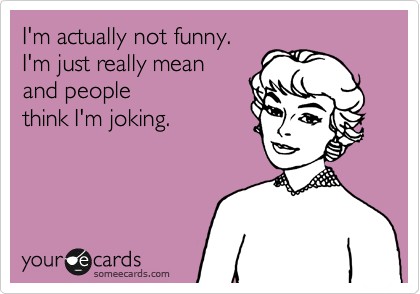
That doesn’t mean I didn’t read a bunch of the comments made on social media on the interwebs.  Seriously, y’all got creative.  And some of you were funny.  And a little mean.
snark1

I was listening to Seth Speaks on my satellite radio (On Broadway channel – enjoy!) and Laura Benanti was a guest (she played the Baroness on the NBC broadcast, and starred as Maria in the Broadway revival…and she is amazing).  She was sharing some backstage stories and such, and Seth asked her what she thought about the comments made against Carrie.  And Laura threw down on the haters.

“Snark,” Laura says, “is the new cool.”   She pointed out that here was a person with the courage to try something she’d never done before…live…in front of 18 million people.  Instead of applauding her for it, and celebrating the fact that a major network took a chance to bring a new, younger audience to Broadway and music, the Twitter-verse used it as a chance to show off how clever it is.

No snark?
This stuck with me.  I love snark.  I enjoy the heck out of reading it, and I tend to engage heavily in the dishing out of said snark, too.  But Laura has a point – snark can get in the way of what you’re really trying to accomplish.  It can shut down people’s willingness to take a chance.  It can break down the feeling of “team”.  A lot of people who give snark can’t take it, so then you get a whiny snarker.  And while snark might be funny or make you look clever, is it adding anything of value to fix the perceived issue?  In short, snark can be extremely damaging.

What to do?
I’m not going to advocate going snark-free.  A little snark is like good satire – it points out that the emperor has no clothes and uses humor and shock to heighten awareness about a situation.  Matt Charney’s Snark Attack blog  is great!  So is Television Without Pity (spare the snark, spoil the network).  That snark IS cool.  And funny.  And thought-provoking. And change driving.

So if you consider yourself a snark aficionado (and who doesn’t, amiright?), use the next 30 days to pay attention to how and when you use it.  If your intent is pure and you’re working towards a greater good, snark away.  And a little snarkiness amongst friends can be fun!  But if you’re employing snark to put someone else down because it makes you feel better about yourself and you think it makes you look clever, stop it. You’re just being an asshole.
Why should I change? He’s the one that sucks. (The importance of self-awareness)

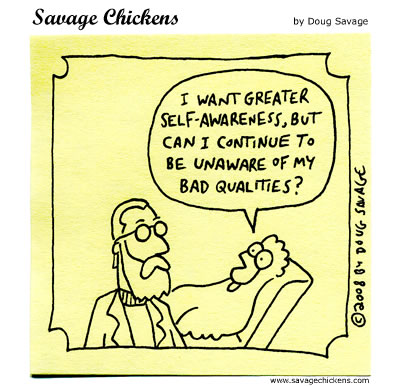
For fans of Office Space, you probably recognized the immortal words of Michael Bolton when discussing the embarrassment of having the same name as that ‘no talent ass-clown’. It’s a great movie (I used to make it mandatory viewing on my team) and a very funny line…and it illustrates perfectly one of the common pitfalls of leaders everywhere – the lack of self-awareness.

We’ve all seen it. Leaders who lament the shortcomings of their people, loudly stating what those people SHOULD be doing. Well, guess what, Mr./Ms. Thang – you’re probably not doing everything right, either. I read somewhere once that we criticize loudest the things in other that we don’t like in ourselves. It’s not a 1:1 correlation (its not like we dislike an embezzler because we also embezzle); rather, it’s a reminder to think about our OWN behavior.

This talent for self-awareness is a vital component of a successful leader. Granted, it’s more fun to point out the shortcomings of others (schadenfreude, anyone?), but far less constructive. It’s the old trap of, “do as I say and not as I do” – and we all know how we’ll that turns out, right?
A few ideas on how to make self-awareness a regular part of your day:

  • Admit you suck at something: I’ve mentioned many times in this blog that the reason why you’re a leader is because you DON’T suck at a lot of stuff.  But you do suck at something (it’s okay, we all do).  Once you’ve admitted that, you’ll be in a better state of mind to practice self-awareness.
  • Get some help: Okay, self-awareness is all about you (hence the whole “self” thing).  And you will eventually be able to self-monitor and make corrections to your behavior on the fly.  But if you’re new to this sort of thinking, it’s a good idea to have a third party help you through observation, providing feedback, or even challenging your assumptions.
  • Accept it’s going to take time: The whole concept of “he’s the one that sucks” is that you don’t want to make the effort to chickenchange yourself because you know it’s going to be difficult; therefore, the OTHER person should undertake that task.  Tough cookies.  You need to take the time and make adjustments to the only thing you can control –   yourself.
  • Check yourself before you wreck yourself: Every day, take some time to think back on the day’s activities and give yourself a grade.  Did you achieve the outcomes you wanted?  Did you achieve them the way you wanted to?  Figure out what you want to do differently tomorrow and give it a go.
  • Think like G.I. Joe: Self-awareness doesn’t come with a how-to guide.  You might realize you’re doing something stupid…and have no idea how to fix it.  This is where G.I. Joe comes in.  Remember – now you know, and knowing is half the battle.  Go, Joe!!!

So there you go.  While Michael Bolton (the cool one, not the saxophone one) had a fairly good argument to refuse to change, you don’t.  Practice a little self-awareness, improve yourself, and you might be surprised how much better everyone else starts getting, too.

*Check out the awesomeness of Doug Savage’s humor at http://www.savagechickens.com/