Free Your Mind (with apologies to En Vogue)

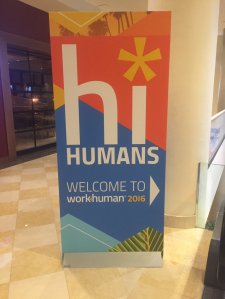
As you know, I’m at the Work Human confernce own in Orlando, FL this week. Lots of good stuff happening here – conversations, candy, donut walls (it’s a thing), and sessions.

The topics on these sessions are aligned with the theme of the conference of finding a new way to work by finding a new way to be. The speakers today have been diverse in their backgrounds and have unique points of view about the research out there around happiness, engagement, and resilience. Not all resonated with me (as I suspected), but I found interesting elements in all that I saw.

envogueSome of my key takeaways from today:

  • You have to free your mind:Biggest takeaway (and most consistent message) is that the brain is easily tricked. Don’t assume success will make you happy. Be happy to lead to success. The self-talk we use primes our brains for success or failure. Amy Cuddy (in a session that surprised me with its relevance) showed us how our ability to expand physically and temporally leads to success.  The brain is a powerful thing – use it to your advantage.
  • The research is still fairly new, and evolving: It’s always a challenge when everyone uses the same research to tell different (yet related) stories. So you hear the same stats quoted in a number of different ways. The good news is that further studies are underway and those who look at happiness and resilience recognize the need to balance it with data and realism. I’m curious to hear more.
  • People are starting to get vocal about their annoyance with generational stereotypes: Yes. People at different stages in life are looking at different things. But deep down, they are all individuals. You could almost hear the collective groan when a sweeping generational statement was made…much like you could hear the cheer when a speaker swatted down those same stereotypes. It’s an interesting time in HR (and business) as we figure out the workforce of the future. I’m seeing a trend towards personalization and away from generalities. And I think that’s a good thing.
  • Personal experience colors interpretation: Now that you’re done thinking, “duh,” hear me out. I mentioned the research is all pretty much the same right now…yet we heard two speakers (Shawn Achor and Caroline Adams Miller) use the same info in VERY different ways. Shawn focuses on happiness and positivity and how starting from a place of optimism leads to success. Caroline uses her own story of overcoming bulimia to make the argument that happiness only comes after hitting rock bottom and facing adversity. Both pretty much agree that success starts with mindset…but such a different tone in those sessions.
  • I want to start EVERYTHING with a Haka Dance: Google it. It’s awesome.
  • The topic isn’t going away: As more research seeks to tie happiness/resilience to engagement, I think you’ll see more and more companies trying to get on the happiness bandwagon. That’s all well and good – but remember, it needs to fit into the culture of your organization. Not everyone will embrace a “meditation room,” but I bet a lot of employees would appreciate a quiet spot to recharge (favorite quote: “Headphones are the new cubicles.” Thanks, Yvette Montero Salvatico!). It will be interesting to see where this leads; I just hope folks remember that it’s a PART of the solution…not the solution itself.

Overall, it was an interesting day that has provoked a lot of discussion around relevance, validity and applicability. And isn’t that what conferences are supposed to do? Make you think?

Hint: Yes. Yes, they are.

There’s one more day of the conference! Follow the Twitter feed on #WorkHuman. 

Learning a new way to work

I’ve always been drawn to challenges. I build, I don’t maintain. I like to push, rock the boat, innovate, break down silos. I’ve worked at organizations that were built that way. I’ve also worked for organizations that weren’t built that way…but needed a kick in the butt anyway.

If I don’t have interesting work to do, I get bored. And when work is interesting, I like to keep working until it’s done. I’m online all the time, I check email all the time, and I never seem to be able to turn off my brain.

Sound familiar?

While it can be a very fun way to work, it’s also a pretty tiring way to work, and leads to high levels of burnout. Those who worked through the 2008 economic downturn know that while headcount was slashed, work expectations never changed. And as the economy recovered a bit, those job were never replaced – businesses figured they could continue working “lean,” thereby helping the bottom line.

But at what cost?

Engagement is still extremely low and don’t appear to be going up any time soon.. And according the Bersin by Deloitte: “Employees are overwhelmed with technology, applications, and a constant flood of information.” Employees are overwhelmed and it shows. While the rise of the gig economy has been overstated, there are more people who are looking to scale back, take a break, or start a new, low-stress career.

We can do better.workhuman

This is why I’m in Orlando, FL this week, attending the WorkHuman conference sponsored by Globoforce. WorkHuman is based on the premise that there has to be a balance between work and life, between happiness and career, and that businesses can create an environment that encourage a healthier approach to work. It’s about helping employees set boundaries and avoid the stress of trying to be “on” all the time.

The conference has sessions on mindfulness, optimism, recognition and will feature CHROs sharing how they are trying to create the “human workplace.”

This is so not how I’ve approached work in the past. I’ve been the one in the back row snorting at the idea of “mindfulness” and “happiness” and other such topics. But resilience is something that resonates with me – and we are starting to learn more about how things like optimism and positivity (mixed with realism) help build resilience.

So I’m here to learn. To hear the research behind these topics and take what makes sense back to my workplace and try to be part of the solution and not the problem.

Not all of what is shared at this conference will resonate with me. I reserve the right to snort from time to time. (After all, I’m the skeptic.) But last year’s conference was pretty darn good and I got a lot out of it. I’m excited to be here.

You’ll see a lot of me on social media the next few days. In fact, there are a lot of great people here to learn new things and share what they’re learning with folks who can’t be here. Track the conference on Twitter under #WorkHuman.

A skeptic’s view of happiness at work

The Intro Bit

If you know me, follow me on social media, or just make up a fake backstory about me (please make me a pirate), you probably realize that while I like to laugh and have fun, I’m not a particularly “up” person.

What I mean by that is I am not a Pollyanna who looks on the bright side of things and always believes things are all going to work out. I tend towards realism with a dose of cynicism. (And a side of eyeroll for good measure.)

So when the whole “happiness” thing started hitting the internet, I was skeptical.  It sounded like just another way of talking about work without having to have any data or research behind it beyond a Cosmo quiz. And deep down, I suspected Pharrell had something to do with it.

Therefore, I did what every good skeptic does. I researched it so I could debunk it.

The Sorta Science-y Bit

Here’s the thing – while some of the “science” out there is a little sketchy (or…a LOT sketchy), there is some really compelling evidence that happiness at work makes a difference to the success of an organization. The iOpener Institute has developed a happiness measure and released some findings in the Wall Street Journal – happy employees stay twice as long, are more likely to help their colleagues, are less likely to be absent, and are more efficient. (For more info, read this white paper.)

Basically, happy employees perceive themselves to be more connected to their organization and are therefore more likely to stay on task and are more likely to choose to be engaged at work than non-happy employees.I_want_to_believe5

The Skeptical Bit

While certain research points to some strong correlation between happiness and connection to business, there is no predictive model between happiness and business performance indicators.

Also, happiness sounds suspiciously like “satisfaction” to me – and you can have satisfied employees who are completely happy to do as little as possible at work. In fact, some research even suggests that job satisfaction has a NEGATIVE impact on productivity. So I’m curious to see more about additional research into this area.

The ‘Here’s How to Make it Work’ Bit

While still preliminary, there’s enough out there to point to definite benefits to supporting happiness at work. As leaders and HR professionals, you are in the perfect position to help employees make the choice to be happy, thereby gaining some positive outcomes for the workplace.  As employees, no matter what your role, you have the power to decide about your own happiness at work.

Some things to keep in mind as you embark on the journey to Work Happyland:

  • Happiness is unique to each person: One of the reasons a predictive model is so hard to find is because “happy” means different things to different people. Watching this video of a tiny horse trotting makes me ridiculously happy. Other people prefer NASCAR. So you have to be willing to adapt to the needs of your team and organization.
  • The pressure to be happy can bum you out: One psychological experiment reported by the Harvard Business Review suggests that the increased expectation of employees to build an “upbeat” workplace can lead to resentment – having the opposite effect on the workplace. Don’t force your people to smile all the time. Create environments where happiness can happen organically.
  • Sometimes, it’s okay to work angry: Some people are more focused, able to detect deception, and negotiate WAY better when they have a little edge. Keep in mind that sometimes happiness can hurt productivity and quality, so don’t be worried if someone isn’t giddy all the time.
  • Help folks set boundaries: We continue to blend work and life more and more – and it’s stressing people out. By making it okay for your employees to leave home at home and work at work, you give them permission to save their best selves for when they need it most.

The research in this area is still emerging, so I am keeping my eyes and ears open as we learn more about happiness at work. I also reserve my right to roll my eyes every now and then if you try to tell me it’s a standalone metric, or if you try to be all obnoxious about it.

On the other hand, my inner skeptic wants to be believe. After all, we spend A LOT of time at work. So why not at least try to make it a happy place to be?


Want to join me in learning more about happiness and other good stuff in the workplace? Come to the WorkHuman 2016 Conference in Orlando, May 9-11, 2016. To register, go to  and use promo code WH16MF300 for $300 off.  THAT should make you happy!