Leadership takes time (Lessons from the Super Bowl)

I know, I know…yet another post about football players and what we can learn from them in moments of great stress. But it’s such a rich topic, people. I mean, really.

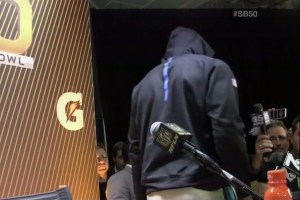
I’ve actually already written some posts about how players respond after a big moment – some do well (Peyton Manning), some not so well (Richard Sherman). So when I saw the post-Super Bowl press conference with Cam Newton (or “presser,” as they say in the biz), I figured I’d leave it alone. There are plenty of people out there who will weigh in on his behavior. Besides, I have work to do.

But then I read some of the comments and tweets from his peers and from sports reporters. Reaction is kind of all over the place, with a majority of people landing in the, “We get you’re upset, but you need to be a leader” camp.

People will contrast Peyton Manning’s performance in post-loss interviews with Cam Newton. They’ll point out that Peyton is always gracious, that he always makes time for the press, that he waits to congratulate his opponents. And to some extent, that’s fair.

But Peyton has been around the league for a long time, not just as a player, but as the son of a quarterback who played for a pretty terrible franchise. He learned over time the importance of humility, of dealing with the press, of using reporters’ first names, and of managing his image. In short, Peyton has learned the lessons of leadership. He did not spring from the forehead of Zeus with perfect leadership behaviors (despite what some would have you believe). He has made mistakes, learned from them, and moved on. cam

Having seen the footage, I do think Cam Newton was pretty unprofessional. He was an outspoken player throughout the year, gregarious and emotive, unashamed of how he celebrates. And he suffered a crushing disappointment – so he shouldn’t have been surprised by the onslaught of questions. If you’re chatty when you’re winning, the press expects you to be chatty when you lose. It shouldn’t be a surprise to him. He’s been called out for his “pouting” (for lack of a better word) in previous years when the team lost. This year, he was much better…because his team hadn’t really lost. As soon as he was faced with adversity, the smile was gone and he his frustration was apparent.

Despite this, I think Cam will be okay.

Cam is young. He did not grow up in a football family. He is an emotional player who hasn’t learned the art of equanimity with the press. That is not, however, everything that he is. He gives footballs to kids. He volunteers at elementary schools. He came back from a horrific car accident that could have killed him to be the NFL MVP.

I guess I just hope that this one moment does not end up defining him as a LEADER. Leadership takes time. Leadership takes repetition. Leadership takes mentoring.

Think about your own leadership growth. Can you really say you’ve never messed up? Multiple times? The only difference between your leadership growth and Can Newton’s is that he’s getting paid a LOT of money…and has the added pressure of learning in public in a 24/7 news cycle.

I think the seeds for Cam Newton are there. And he has support.

When asked about the presser, Peyton Manning had this to say:

“I’ll tell ya’, Cam couldn’t have been nicer to me.He was extremely humble, congratulated me, wished me the best. I told him just congratulations on his outstanding season, and just what a great future he has ahead of him. He’ll be back in that game, I can promise you.

Only time will tell if Peyton is right. But we should give Cam Newton that benefit of time. Rome wasn’t built in a day…and neither is leadership.

Recruiting Animal! This year’s honoree for (the increasingly inaccurately named) ‘Tim Sackett Day’

You might think that all bloggers know each other. That’s not true.

We just act like we do.

Part of that is because we recognize that this world that we live in – particularly the HR blogosphere (yeah, I hate that word, too) – is a unique thing. We have a lot to say about a lot of different topics, yet ultimately, we acknowledge that all of these voices have a role to play and we love it when one of our own has a chance to be exalted by the masses.

And that’s where the annual Tim Sackett Day comes in.

Started in 2011-ish, Tim Sackett Day came about because Tim Sackett was (and is) a blogger and HR guy who couldn’t seem to get any love from the makers of lists.  So the blogger community got together and recognized one of their own.  This has grown into an annual tradition of giving a communal “shout out” to those who have greatness in their hearts, in their heads, and in their blogs.

This year, we recognize Recruiting Animal.  recruitinganimal.PNG

Obviously, the name alone is enough to get him on pretty much any list. I mean…seriously.  That, and the hat.

But ultimately, we recognize Recruiting Animal because he is a true pioneer of social HR. Don’t believe me? Check out the timeline:

  • 2004: Animal creates his very first blog.
  • April 2006:  The Recruiting Animal Blog is born. The format is pretty much the same today as it was back then. Substance over style, baby!
  • March 2007: Not content with the written interaction afforded by the blog, Animal founded the Recruiting Animal Show – the VERY FIRST online call-in show about recruiting. It’s outrageous, funny, thought provoking, in your face, and damn good.  It was at this time that Recruiting Animal joined Twitter. No one really knew what it meant, but Animal was appropriately wary of the belief that Twitter was the promised land for recruiters.
  • 2009: Manifesto video created. Okay, not really a manifesto, but a witty, smart,  realistic look at why social media doesn’t pay but still fricking matters. (The whole thing is worth a watch, but head to the 7:40 minute mark for the meat of it.)
  • The present: The legend continues…

If you are at all interested in HR blogs, then you probably know of Laurie Ruettimann (and if you don’t, you should!). Laurie had this to say about Recruiting Animal:

Animal blazed a trail on social media that allowed people like me (and you) to get on the internet without a lot of risks. And Animal provides you with coverage, whether you know this or not. He’s so outrageous in his big Canadian hat that he makes the things we say and do seem like no big deal…. His heart is as big as Toronto.

I don’t personally know Recruiting Animal. But I know of him. And I know people who think the world of him…and that says a helluva lot.

So (big furry Canadian) hats off to this year’s Tim Sackett Day honoree, Recruiting Animal! Keep doing what you do – we’ll all “get it” one of these days.


If you want to find Recruiting Animal online, you’ve got lots of choices:

Development as partnership (when leaders and employees get it)

Last week, I had the opportunity to both attend and speak at the Illinois state conference for the Society of Human Resource Management (henceforth referred to as ILSHRM, ’cause that’s way too much to type out).

Hundreds of HR professionals descended upon the Holiday Inn and Convention Center in Tinley Park, IL for a couple of days of networking, socializing, eating far too many carbs, and yes…learning.

I love being able to talk to people from around the country about what they do, what they struggle with, and how they are trying to make their workplace – and themselves – better. And these folks are from Illinois, so they’re chatty Midwesterners who are open, honest, and a lot of fun to boot.

Dancing_Cats

What struck me as I talked to the fine folks of ILSHRM is that we all have similar challenges – high state of change, evolving business demands, disengaged employees, managers who don’t always get it, legal shifts, work-life balance, etc. And what impressed me is that despite all the challenges, these people were determined to find a way to fix it. They believed that by advancing their skills, learning from others, and challenging their own thinking, they might be able to take something from ILSHRM back to their workplace, apply it, and make a difference.

Naive? Maybe. Optimistic? Probably.

Impossible? No.

I say it’s not impossible because all those people attending ILSHRM had the support of their organizations and/or their boss.  Maybe it was a “check the box” exercise to prove the company supports development. Who cares – they got to go. Most were there because their boss/leadership had specific problems and trust their HR team to go find a solution that will work for them.

This conference reaffirmed the fact that when leaders and employees are both devoted to development, good things can happen. Heck, I was there because my boss was willing to let me go spread our brand and bring new ideas back. (Thanks, Gail!)

And for the cynics out there, you’re right – some people attend conferences to get their credits to avoid retaking a test, for the carb overload, for a couple of nights away from the kids. But tell that to the fun folks I had lunch with from the Metropolitan Water Reclamation District – all 10+ of them. This was a group determined to get something out of the conference…and have a fun time while they learned. And tell that to the young HR professionals who asked incredibly powerful, insightful questions in all the sessions they attended. They weren’t content to listen and leave – they wanted to explore, to learn from the collective experience from the folks in the room.

The reality is that this only works if everyone involved is willing to MAKE IT WORK. (Tim Gunn shout out!) Developing employees is more than signing up for a class or a conversation about career goals now and then. It’s about employees stating what they need for their development and leaders supporting them in that endeavor.

It takes two to tango.

Leaders, employees, customers and companies all benefit when development is supported. So I challenge each of you – whether you are a manager or individual contributor – to do what you can to partner for development. You’ll get so much more out of it than what you put into it.

I know I do.