Leadership takes time (Lessons from the Super Bowl)

I know, I know…yet another post about football players and what we can learn from them in moments of great stress. But it’s such a rich topic, people. I mean, really.

I’ve actually already written some posts about how players respond after a big moment – some do well (Peyton Manning), some not so well (Richard Sherman). So when I saw the post-Super Bowl press conference with Cam Newton (or “presser,” as they say in the biz), I figured I’d leave it alone. There are plenty of people out there who will weigh in on his behavior. Besides, I have work to do.

But then I read some of the comments and tweets from his peers and from sports reporters. Reaction is kind of all over the place, with a majority of people landing in the, “We get you’re upset, but you need to be a leader” camp.

People will contrast Peyton Manning’s performance in post-loss interviews with Cam Newton. They’ll point out that Peyton is always gracious, that he always makes time for the press, that he waits to congratulate his opponents. And to some extent, that’s fair.

But Peyton has been around the league for a long time, not just as a player, but as the son of a quarterback who played for a pretty terrible franchise. He learned over time the importance of humility, of dealing with the press, of using reporters’ first names, and of managing his image. In short, Peyton has learned the lessons of leadership. He did not spring from the forehead of Zeus with perfect leadership behaviors (despite what some would have you believe). He has made mistakes, learned from them, and moved on. cam
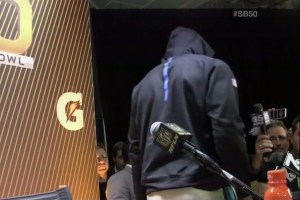
Having seen the footage, I do think Cam Newton was pretty unprofessional. He was an outspoken player throughout the year, gregarious and emotive, unashamed of how he celebrates. And he suffered a crushing disappointment – so he shouldn’t have been surprised by the onslaught of questions. If you’re chatty when you’re winning, the press expects you to be chatty when you lose. It shouldn’t be a surprise to him. He’s been called out for his “pouting” (for lack of a better word) in previous years when the team lost. This year, he was much better…because his team hadn’t really lost. As soon as he was faced with adversity, the smile was gone and he his frustration was apparent.

Despite this, I think Cam will be okay.

Cam is young. He did not grow up in a football family. He is an emotional player who hasn’t learned the art of equanimity with the press. That is not, however, everything that he is. He gives footballs to kids. He volunteers at elementary schools. He came back from a horrific car accident that could have killed him to be the NFL MVP.

I guess I just hope that this one moment does not end up defining him as a LEADER. Leadership takes time. Leadership takes repetition. Leadership takes mentoring.

Think about your own leadership growth. Can you really say you’ve never messed up? Multiple times? The only difference between your leadership growth and Can Newton’s is that he’s getting paid a LOT of money…and has the added pressure of learning in public in a 24/7 news cycle.

I think the seeds for Cam Newton are there. And he has support.

When asked about the presser, Peyton Manning had this to say:

“I’ll tell ya’, Cam couldn’t have been nicer to me.He was extremely humble, congratulated me, wished me the best. I told him just congratulations on his outstanding season, and just what a great future he has ahead of him. He’ll be back in that game, I can promise you.

Only time will tell if Peyton is right. But we should give Cam Newton that benefit of time. Rome wasn’t built in a day…and neither is leadership.

Expanding horizons

This is my plea that everyone – employees and leaders alike – learns how to think outside of themselves.

That they look beyond their personal role to see how they impact the world around them.

That they try to improve the processes they work within.

That they reach out to those they work with to offer support when needed.

That they reach out to those they work with to offer a kick in the butt when needed.

That they step back and think about how the offhanded comment they made in a crowded room might have been interpreted.

Earth_GlobeThat they realize that they made a positive difference in the lives of the people they interact with.
That they see their value in the world and know it spreads beyond those who see them every day.

That they recognize their power to influence…and use their power for good.

That they learn how to say “no” so that others say, “I understand.”

That they win with humility.

That they lose with grace.

That they never lose their love of learning – or that they discover it in the first place.

That they remember that every single person they interact with is going through something in their lives that others don’t know.

That they see the potential of the team, organization, and community that they are a part of – and want to help everyone reach that potential.

That they want to build, not destroy.

That they learn that success comes in many forms.

It is my hope that everyone – employees and leaders alike – realize it’s not all about them.

It’s about us.

How open-minded are you….REALLY?

If I were to ask this question of a random sampling of leaders and employees, how do you think they’d answer?

Most likely, everyone would present themselves as an open-minded, thoughtful human being, unswayed by their bias. (Except for that weird guy from the third floor. But he’s probably a sociopath.)

The reality is that people don’t like to think of themselves as closed-minded, or at the very least, they know better than to admit it. That’s because companies work like hell to hammer home the fact that inclusion, respect, diversity, love, peace, unicorns and rainbows are an integral part of a successful workplace. And it IS important to be inclusive and respectful.

But deep down, we all kind of suck at it.

I don’t mean we’re all assholes and racists or anything. I just mean that we fool ourselves into thinking we’ve got control over our natural biases. And not just the big ones (gender, race, age, etc.) – I’m talking about white-collar, blue-collar, where you went to school, the shoes you wear, what music you listen to…that kind of stuff. Even the most well-intentioned, self-aware person has inherent biases. [For an eye-opening revelation about your own biases, take the Project Implicit test from Harvard. It’s free. And a little spooky.]

All those little biases add up to a pretty significant impact on our decision-making.

Don’t believe me? Look at your hiring practices. Many organizations have some sort of diversity initiative in place – whether it’s monitoring and reporting, or a specific process to ensure a certain candidate pool mix. Hopefully, these programs ARE making a difference for your organization on a macrolevel.

Now look at the teams around you. Look at YOUR team.

Is everyone just a little too…the same?

Do you all like the same things? Have similar backgrounds? Make decisions the same way?

Did you even realize it when you hired them?

BOOM. That’s bias in action, baby.

If you want to be closer to the level of open-mindedness you claim to have, you have to be aware you’re not perfect and be proactive in your approach to make a difference. Here are a few things you can try, either as a leader or an employee:

  • Hiring practices: When hiring, consider taking off names, addresses and school names off the resume. Just look at whether the person meets the required education level and has the right experience. (Bias exists for peers just as much as hiring managers!)
  • Job design: Question whether the education level you’re requiring for a job even makes sense. A college degree does not magically make you a better employee and mean you can do the job. I’m not saying it’s NOT a good thing, but question your implicit assumption it’s required for success.
  • Teams: Challenge your need to like everyone you work with. I mean, it’s nice and all…but a lot of times we like people because they’re just like us. Same can be boring and stifle innovation. Build and/or join a team with people who will challenge your thinking.
  • Silos: Go learn more about the people who do work that is wildly different from yours. If you’re in a corporate office, do some ridealongs with the field folks. If you’re in the field, shadow the corporate people. Understanding of the unknown helps breaks down bias and assumptions.
  • Ideas: What happens who you propose an idea and someone questions it? Do you defend it to the death? Do you think the other person is an idiot because they don’t agree? Do you assume they don’t like it because they don’t have your background? All of the above? To be truly open-minded, you have to be open to the fact that you DON’T know everything…even about the topic you’re supposedly THE expert in. Listen and learn.

These are just a few ideas on how you can set up an environment that encourages open-mindedness through behavior, not intention.

Give one or two of them a shot. After all, you’re open-minded….

Right?