When I was a kid, The Muppet Show was constantly on. Whether it was Roger Moore’s rendition of “Talk to the Animals” while fighting spies with laser guns, or Lynda Carter just being awesome, I loved watching. My most enduring memories of several songs are the version I saw on The Muppet Show – “In the Navy” (Viking pigs singing); “Time in a Bottle” (one of the more poignant versions rendered); “The Gambler” (old ghost gambler guy!); and “Grandma’s Feather Bed” (one of several collaborations with John Denver).
Even better than the guest stars and music were the muppets themselves. Scooter had dreams and a work ethic. Sam the Eagle suffered fools. The Swedish Chef was…well, Swedish. And I’m pretty sure Statler and Waldorf are related to me. When I started to learn more about the craft underlying the creation of The Muppet Show – and later all the movies – I was amazed by the talent and dedication of the people who brought my favorites to life.
Other than Jim Henson (who created the whole thing), the puppeteer who shined brighter than them all for me was Frank Oz. He created Animal, Fozzie Bear (Wakka! Wakka! Wakka!), Sam the Eagle, and others. On Sesame Street, he was responsible for Grover, Cookie Monster, and Bert. And lest we forget…he created Yoda in The Empire Strikes Back – a role for which George Lucas campaigned for an Oscar nomination.
Beyond puppeteering, Frank Oz is an acclaimed director – Little Shop of Horrors, Dirty Rotten Scoundrels, What About Bob?, well…you can look up the rest on IMDB. He even occasionally made a cameo in movies – including that riveting prison clerk scene in Blues Brothers (sacred viewing in my childhood household).
I bring all this up because I want you to really understand what Frank Oz has accomplished throughout his career. This child of puppeteers who grew up to be so instrumental in so many lives.
And now – Frank Oz is on Twitter. And I adore him. 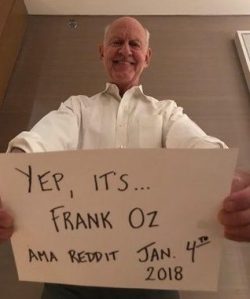
Joining Twitter in December 2017 and using the handle @TheFrankOzJam, Oz has been authentically interacting with people in a way that’s both delightful and stunning. He shares thoughts as he goes about his day. He loves talking with fans, asking them where they’re from and admitting he can’t possibly talk to everyone because he still needs to talk to his wife!
Frank Oz on Twitter is a master class of humility – that most elusive of leadership traits we all claim people need, but often secretly dismiss as weakness when we see it. Since he’s been on Twitter, I’ve been glued to his feed and I think there are some things we can all learned from this man:
- Remember the team: Oz nearly ALWAYS mentions everyone he’s worked with on just about every project. When complimented for his performance as Yoda, his response was it only worked so well because Mark (Hamill) interacted with Yoda like a real person. He throws credit to his collaborators far more than he accepts credit for himself.
- Be honest and open: One of the more honest tweets came from Oz asking everyone which character the public thought he most identified with. After some guesses, he said, “There have really been wonderful guesses. Thanks! Okay. So. I most identify with Grover and Fozzie. Grover because he’s pure, Fozzie because as a kid I really wanted to be in show biz too. I shouldn’t have put Yoda in the mix. He is way deep inside me, but I’m not that wise.” Later he said, “Yes I identified most with Grover and Fozzie, but there are bits of me in all of my characters. Me being boring is Bert, me pure is Grover, me obsessed-Cookie, me neurotic-Piggy, me insecure-Fozzie, me uptight-Sam, me crazed-Animal. I’m a bit like each of them. And so are you.”
- Know that luck is real: He very much acknowledges the opportunities he’s had, and knows how lucky he’s been. “I don’t know how I got here. I was this kid with low self esteem and a bit of talent. But a lot of people have talent and haven’t “made it.” Why did the planets line up for me? Why didn’t other talented people get their Jim Henson as a mentor? I don’t think I’ll ever know why.” When a follower mentioned his obvious “passion,” Oz replied, “No. Not true. I wasn’t passionate. I just had fun with Jim and my fellow performers. And I never struggled to find work. Jim always found it and I just delivered. Others have had to struggle.”
- Don’t forget what work looks like: Frank Oz knows how weird it is that he makes a living through entertainment. He thinks about it a lot. “I’ve always believed the world is lopsided. I get attention & money while others do far more important things to keep our world going: Yes, those who work with their hands, as my father did, but also from teachers to mental health workers. Thank you all for keeping us afloat.” And them he immediately followed it with, “I’m not being humble. What i’ve done in my work life has given value or you wouldn’t be reading this. But what I truly believe is that the lesser known and lesser paid people are the ones holding up the world. So please give kudos to them. I’m doin’ fine here.”
- Believe in the potential of others: “There are hidden artists among us. A really good short order cook is one. Bacon’s on the griddle, bread in toaster, slice bagel, orders shouted, crack eggs, flip bacon, grab toast, hands moving, body in motion. All rhythm, rhythm, rhythm. A beautiful thing to watch. An artist.” Seriously.
- Cherish your elders and those who paved the way: Oz often thinks about the older folks he sees in his travels and encourages us to learn from them. “In my twenties, (mid 1960’s) I bought a video camera with a VERY heavy battery case and huge camera. Before they became too old, I recorded hours of footage of my mom and my dad telling me their life’s stories. They are gone now. But I have their stories. Don’t wait too long.”
If you struggle with how to interact with others, follow Frank Oz on Twitter and study his language use, approach, openness, and humility. He’s the internet hero we didn’t know we needed. He is the balm to all the anger in the world right now. If we could just try to lead with curiosity and listen for understanding, maybe we’d be a step closer to being the people we hope we can be.
I view kindness as a weapon. Not the kindness that is paternal or condescending or platitudinous. I mean the kindness that comes from true empathy; that gently acknowledges another’s travails and so makes her/him feel less alone. For me, there’s no stronger weapon.
Frank Oz, 12/31/2017


 Surviving Leadership