Small talk and the decline of practically everything

There is a lot of chatter out there.

On any given day, millions of ideas are shared via the internet, via Twitter, LinkedIn, articles, this blog, etc. Lots of one liners, jokes, snarky comments; but also inspirational quotes, videos of baby goat yoga, lists of “life hacks” (whatever the hell those really are), etc. In fact, every minute on the internet sees, among other things, a minimum of 2.4 MILLION Google searches, 347,222 tweets on Twitter, and 972,222 Tinder swipes (may you all find love).

This is the age of Big Data [insert dramatic music here].

And yet, most of what is out there is little more than a tasting menu of ideas. It’s a one-way sharing of thoughts, feelings, observations, and/or ego. We dip our toe into the pool of discourse, but we don’t stay too long lest we get dragged into a debate, get attacked by trolls, or – lord forbid – have to participate in an honest-to-god CONVERSATION.

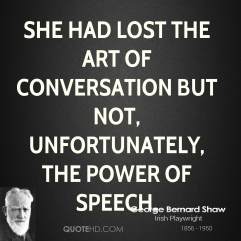
What happened to our ability to sit down and actually talk to people?

In high school and college, people were all about having deep, philosophical conversations about life, death, and everything in between. Yeah, they got pretty annoying sometimes, but it was good practice in identifying where you stood in the world. You were able to frame your argument, consider counterpoints, and share your own counterarguments. It was a great way to apply debate skills and decide what you may or may not believe in.

Granted…I did not have Twitter or Facebook when I was in college. We barely had the internet. #Iamnotold #dammit

Today, communication is built to be quick, witty, and shallow. I actually resisted Twitter for a LONG time because I do not believe 140 characters is enough room to communicate meaningfully. I now accept it for what it is, but still throw it the side-eye now and then because I think it’s part of the problem.

People don’t really talk anymore.

I am as guilty of this as anyone. As an affirmed introvert, I LOVE the fact that I can do so much “communicating” online, in writing, without actually have to see someone face to face. I hate talking on the phone voluntarily. I avoid networking events like the plague. Give me a chance to interact virtually and I will take it every single time. And it probably makes me less effective as a coworker/boss/friend/human being.

It’s easy to just stop typing when you’re not happy with the way a conversation is going. You can just block someone if they get a little too obnoxious. Or you just throw a hashtag out there (#micdrop) and act like you won.

Real world conversations take vulnerability. They take concentration. They take commitment.

I’m going to try to do better at this. I’m going to try and have better conversations with the people I actually see in real life.

This doesn’t mean I won’t be quick, witty, and shallow on the internet. Are you kidding?! That’s way too much fun. I’m just going to…try harder. I hope you do, too.

What’s the worst that could happen?

Your zipper is down

May you always have someone in your life who will tell you your zipper is down.

May you have a friend who lets you know there’s cilantro stuck between your teeth.

May you have a significant other who tells you when you are overreacting.

May you have an archenemy who makes you smarter.

May that same archenemy be willing to team up with you against a common foe as needed.

May you have a boss who is brave enough to tell you to stop it, you’re making an idiot of yourself. 

May you have a best friend who gets it when you just text “Blergh.”

May you have a pet who loves you unconditionally…but totally leaves the room when you start yelling at the TV, because who’s got time for that?

May you have a health care provider who reminds you to take care of yourself.

May you have a teacher in your life whom you remember for the best of reasons.

May you have parents whose phone calls you sort of avoid because seriously, you don’t need to talk to me EVERY 3 hours, do you?

May you have all these things and more because it means you’re not alone. It means there are people out there who care enough to point out your faults. There is someone out there who wants to make sure you’re on the right path.

And if you have that, it means you have an obligation to be that person to someone else.

Because everyone needs at least one person who cares enough to tell you that your zipper is down.

“I love me” – a lesson for leaders

At a recent work function, an employee was recognized for her tenure with the organization.

She was introduced, presented with her plaque, and applauded for her service. And then she gave a small speech.

The speech was very much her personality – heartfelt, spontaneous, funny, endearing. But one part stood out over all others.

She began the section by thanking those who helped her in her career. She acknowledged all the support and mentoring she received from those around her. She then talked about all she was able to accomplish, comparing herself to a butterfly. And then she paused, realized how much she was going on and on about herself, giggled, and said, “I love me.”

The crowd laughed. They loved it. It was so “her.”

She laughed along a little bit, then got serious and said, “It took me a long time to be able to say that.”


Imagine being brave enough to stand in front of a room of your peers – and your leadership team – and say those words.

How would your organization react? I mean, really….what would the people in the room say if this happened at your organization?

Would they be supportive? Would they applaud? Or would they politely clap while giving each other knowing glances that this is clearly a “career limiting move”?

For all our humanity in the workplace, we actually kind of suck at dealing with heartfelt emotion. When someone expresses gratitude earnestly in public, it makes us uncomfortable. Why is that? Have we really decided that people AREN’T people that we should pretend we have no emotions? I hate drama as much as the next person, but I also recognize that people bring different parts of their lives to work. Some folks look forward to work as a place to leave the chaos of their life behind. Some people enjoy work for the relationships they’ve developed. Some people overshare (we didn’t need to see videos of your knee surgery, but thanks!). Some people never share at all (it seems like there’s that one person who no one really knows, and it turns out they have something like 12 kids and were in a movie once).

The point is, we as leaders have done a poor job setting a good example about what is an is not okay in the workplace in terms of emotions. Someone probably cried in a VPs office once and it freaked him/her out, and the next thing you know, all the “how to succeed in business” articles started defining professionalism as “no emotion.” That message of “stoicism = strength = success” has been perpetuated for years.

But then came Emotional Intelligence and suddenly we’re all supposed to care about our feelings, and worse than that…THE FEELINGS OF OTHERS. Good lord. We are not equipped for that – especially leaders. We’ve worked hard to HIDE emotions, and promote those who do the same. So what happened? Some leaders went WAY too far the other way, and were all about sharing and caring and wearing their emotions on their sleeves. Which, frankly, makes a LOT of people uncomfortable. And again, emotion became something to make fun of.

We need to find balance, people. We need to find a way for people to BE people without BEING all over the other people who don’t like to BE in public. Leaders have a chance to connect with their people, and help their people connect with other people – in a completely appropriate and professionally supportive way. No, we don’t have to be in each others’ weddings – but recognize some people might. We don’t have to go out to happy hour with our coworkers – but there are a lot of people who do. The best way to promote balance is to watch and learn from people who are successful, but are also unafraid to show emotion. They cry, they vent, they laugh uncontrollably at cat videos. But they still get shit done and they still command respect from those around them.

Back to our story….


After the employee being honored finished her speech, she received a standing ovation. And it reinforced everything that’s good about being yourself at work. About acknowledging the mistakes you made during your career. About being grateful to those who helped you along the way. About the pain of growing up. And about the satisfaction of kicking butt at your job for a long time.

This is a person who had leaders who believed in her. Who pushed her when it looked like she needed pushing. Who encouraged her when she needed encouraging. Who supported her humor, her intelligence, her sass, and her abilities. In short, this is a person who had leaders who allowed her to discover who she was – someone who could finally say, “I love me.”

Leaders – if you can have ONE employee be able to say that, then you have done your job. You have helped someone realize their potential. You enabled instead of dictated. You got the hell out of the way and watched someone flourish because of what was inside them.

Here endeth the lesson.