Fight the good fight

Let’s face it – no matter what our aspirations, most of us leaders will never ascend beyond middle management. That’s because unless we are a CEO of a company without a board (or we are ALSO the board chair), we all answer to somebody.

This perpetual state of “rock, meet hard place” means that leaders are constantly being asked to implement ideas, policies, projects, and other shenanigans they absolutely do not agree with. And even more, they know their employees will not agree with them, either.

The challenge is always knowing when to fight and when to support. In general, the rule of thumb has always been “fight up, complain across, support down.” Which…mostly works. It’s important that leaders know how to pick their battles and when to gain and spend political capital.

On the other hand…

There are times when your team really needs to see that you’re fighting for them. They need to believe you, their leader, has their back when they aren’t around to see it. They need to see that you are human, that you recognize when a policy from the higher ups seems contrary to the organization’s stated values, and that you are willing to stick your neck out for something that’s important.

Leaders, you won’t win on these. Most of the time the decision has already been made and you’re basically just fighting a whirlwind. You’ll be told you have your marching orders and that it’s happening with or without you, so it might has well be with you.

How you decide to react to that statement is up to you.

What I can tell you is that your team notices when you fight for them and with them. They know most of these issues are a losing battle. They know you’re putting your neck on the line. And because of that, they will be in that battle with you.

That means you have to be smart. That means you fight when it matters, not when you’re feeling petty. That means you explain why you’re fighting – so make sure the reason is worthy.

Being a leader means finding a balance in that gray area of supporting the organization’s mission and purpose and railing against anything that seems to be against the mission and purpose. Being a leader means knowing you will fight many times, and you will lose.

But being a leader also means showing your employees that with power comes responsibility, and being a manager sometimes means pushing back on authority now and then when the issue is important. It shows your employee you support them…and you expect them to also push back when the issue is important. Because informed dissent breeds innovation, and permission to dissent respectfully builds trust.

Yes, leaders. You will lose the occasional battle. But you just might win the war.

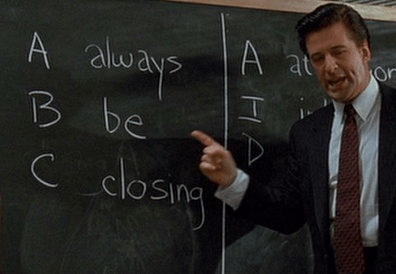
Always Be Curious (with apologies to Glengarry Glen Ross)

As you probably know, I have a day job. Yes, I actually work in human resources. For a real company and everything!

But I’m also fortunate enough to have the opportunity to speak at a handful of conferences and other events throughout the year. I enjoy doing this – it’s a great chance for me to visit other states and talk to fellow HR professionals about the struggles they’re facing and to share my experiences in the hopes we all walk away with a fresh perspective and some new ideas to try.

Well, that’s the idea, anyway.

The reality is that not everyone attends a conference with the intent to learn. Some are there just for the recertification credits. Some are there to hang out with their HR friends and hit the expo floor. Some are there to finally get a few days away from the kids so they can watch some RHONJ in peace, dammit! It’s not necessarily what the conference planners intended, but honestly, they’re pretty happy if people pay, show up, give the keynotes some attention, and fill out the feedback forms.

Speakers have a love/hate relationship with feedback forms. We do want to hear from our audience – we want to get better, we want to know what was meaningful to you, we want to hear that we’ve changed your life because you finally understand the new overtime regulations. (Okay, that last one was a bit tongue in cheek.) But seriously…we want some sort of validation that the time we spent building the presentation, practicing, traveling to the conference, and delivering the content was useful for someone. And most comments are very kind. You get the random comment about room temperature (sorry, we can’t control that) or the fact that someone doesn’t like the color of your dress (which is why I usually wear pants), but for the most part, it’s good feedback.

For the most part.

Inevitably, no matter what presentation I deliver or at what conference, there is at least ONE person who writes the comment: “I didn’t learn anything new.”

Really? Not a single thing? At all?

Listen, as a speaker, I’m usually a tough audience. Speakers end up seeing a lot of different sessions with different types of presenters, so you can get a little jaded. I admit it. But I walk into every session with the intent of taking away at least ONE thing I’ve learned from that person. Hell, if nothing else, I learned their name and what they do for a living.

But not this person. This person just says, “I didn’t learn anything new.”

This depresses me. Not because I worked hard to do research to include a lot of value-added data (which I always do), or because I shared my experiences in other orgs in hopes it helps (which I also do). It depresses me because a comment like that indicates that this person is not curious. They walk into every situation assuming they know everything and that there is nothing that anyone could possibly teach them.

Who wants to live life like that?

BE CURIOUS. Be open to new ideas and new experiences. Be open to new data. Be open to the fact that your carefully crafted world view might not be 100% accurate.

I’m not asking you to agree with everything you hear. In fact, I want you to question it, challenge it. That shows me you are thinking about it and are curious about how it ties into what you’re currently doing. It shows me you’ve internalized the idea and are considering it and may decide to reject it. At least you cared enough to hate it instead of dismissing it as “nothing new.”

So this is my challenge to you from now until the end of the year. Instead of dismissing something outright, think about it. Question it. Be curious about it. You might actually learn something new.

God forbid.

If I were king of the forest: in praise of managerial courage

I’m one of those people who lacks a strong natural filter.

I know – shocking, right?

I mean, I can have a filter – a damn good one. I’m very good at spinning a story to make it seem like it’s a good idea, or at the very least, not a horrible one. I’ve worked in tech startups, for crying out loud. I had to write press releases to make a letter of intent sound amazing even though we didn’t really have a product that worked. And I’ve work in Human Resources, for crying out loud. Do you know how many times I’ve had to “sell” a new policy or change in benefits? I can filter, dammit. It just takes effort.

king-of-the-forest
With a woof and a woof and a royal growl – woof.


So why am I talking about filters when I so clearly stated in the headline that I’d be talking about managerial courage? Because I think that filters sometimes overtake our willingness to be bold. We are so concerned with not ruffling feathers or rocking the boat or saying the wrong thing or looking a little silly that we turn the filter up to 11 and refuse to speak up and let things happen that shouldn’t. [I used ‘and’ a lot in that sentence. Oops.]

Leaders should exhibit managerial courage if they want to be successful. I’ve got reasons:

  • Innovation doesn’t come from being meek: Change happens because someone stands on a desk – metaphorically or otherwise – and yells they are MAD AS HELL AND AREN’T GOING TO TAKE IT ANYMORE. Courage means sometimes you have to do something unpopular to move forward.
  • Feisty managers can instill pride in a team: Employees know when bullshit is going down. They might not have the best spin detectors in the world, but they know enough to be able to tell when a bad idea is implemented. Managers who speak up appropriately against the craziness in their world show their teams that not every leader accepts the crap that rolls downhill. (You’ll notice I said ‘appropriately’ – that’s important.) Teams like a manager who stands up for what’s “right” – whatever that looks like.
  • Speaking out can foster healthy conflict: Not enough organizations know how to fight. Too many people seem to think debate = anger = personal attack. Can we stop thinking this? Seriously. Managerial courage requires leaders to accept the momentary discomfort of conflict and start an exchange of ideas, which leads to better decisions because people have learned to talked about the issue and not each other. Healthy conflict – good. Artificial harmony – bad.
  • Safe is boring: Ever heard the line Fortune favors the bold? No? Well, now you have. If you have ambition to move up in an organization or want to gain influence with your stakeholders, you’ll need to speak up. It creates opportunities for you to be viewed as a thinker – as someone who thinks big and isn’t afraid to share their big ideas. I don’t mean that you should naysay everything. Then you’re just an asshole. I mean you should accept a little risk in order to gain a bigger reward.
  • You learn how to fail: Not every episode of managerial courage will end with you draped in glory. In fact, you’ll most likely fail more often than not – especially early on. Each time you will refine your timing, target your message, and fine tune your approach. The powers that be will start listening, and even if you don’t change their minds this time, you’re depositing influence for a later discussion. It’s kind of like when a star player argues a foul call or a called strike. They know they won’t reverse the call…but it just might get the ref to lean towards their point of view the next time.

Being a leader is exhausting. You often feel like you’re fighting an uphill battle and all you get is blame and you never get the recognition. You’re responsible for a team of people who may or may not trust you, and may or may not care to be engaged at work. Oh, and if you’re like most people, you’re a “working leader” – meaning you have a whole bunch of deliverables due, too.  I think that’s why so many leaders shut down and decide to go along to get along – they just don’t have the energy to fight anymore.

Well, I say – fight, dammit. Step up to the plate and display your courage. You’ll energize yourself. You’ll energize your team. You’ll energize your organization.

Success is not final; failure is not fatal: it is the courage to continue that counts.
– Winston Churchill