So, you’re a crappy employee. Now what?

Okay, maybe you’re not really a crappy employee.  Maybe you’re just a misunderstood genius.  A tortured artist whose brilliance is unappreciated by the rest of us.

Right.

Or maybe you really are an employee who just isn’t very good at your job.

Hey, it happens. Sometimes responsibilities change and you don’t have the necessary skills.  Sometimes you take a stretch job and you’re in over your head. Sometimes you get a new boss you just don’t get along with.  Sometimes you just run out of gas.

Whatever it is, you probably know you’re not doing your best, and it bothers you. A lot.

Nobody likes being bad at their job. And contrary to popular belief, most employees know when they are struggling.  We don’t always admit it…but deep down, we know.
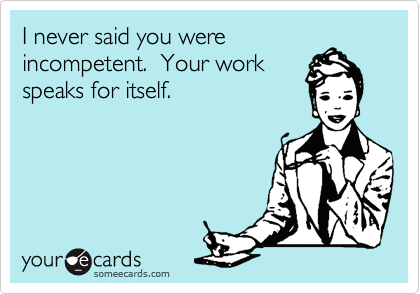
never_said_incompetent

The real question is – what do you want to do about it? Well, you have a few choices:

  • Decide if you want to stay in your current job: Maybe you like your job.  Maybe you don’t like your current job but need it.  Or maybe you really hate it and have the freedom to walk away.  Figure out the answer to that question and act on it.
  • If you want to leave, leave: Don’t be one of those people who quits but keeps coming in every day. It hurts your reputation, hurts your teammates, and never turns out well.  If you’ve decided to leave, do it sooner rather than later. But leave like a grown up, okay? No mic drops needed.
  • If you want to stay, fight for it: Acknowledge that you are not performing up to expectations. Get some help.  Ask for for honest, specific feedback from your manager, stakeholders, teammates – anyone who can give you some suggestions on how to turn things around. And don’t settle for “just do better.”  Ain’t nobody can act on that advice.
  • Own it: Maybe someone else was the spark for your troubles at work, but you’re the one who controls your actions. Admit you own your performance and the outcomes.  It’s the only way you will be able to make the necessary changes.
  • Get your head on straight: If you’re having trouble at work, you’re probably not the happiest person right now. It’s easy to work yourself into a downward spiral with negative self-talk and a crappy attitude. Take some time to reflect on how you got to where you are. Confide in a friend, a group of friends, a therapist, your dog – whoever you need in order to help you work on your outlook.
  • Keep checking in: It didn’t take you a day to turn into a crappy employee, so give yourself some time and keep the dialogue with your manager open.  Course correct as needed and keep moving in the right direction.

Whatever you decide to deal with your current situation, don’t forget to celebrate the wins. When you’re in a tough situation, you can forget how awesome success can feel. Whether you quit a job you hate or decide to take control of your current performance – you deserve a little pat on the back. It takes courage to take action when you feel beat up.

You might be a crappy employee now, but there’s no excuse to STAY a crappy employee.

You can do it. I believe in you. After all…you’re a misunderstood genius.

Just like the rest of us.


Failure is good as long as it doesn’t become a habit.
~ Michael Eisner

 

Control Yourself (or face the Wrath of Dilfer)

It’s funny how Trent Dilfer keeps saying things that relate to being a person in the modern workplace.

And people say sports analogies are overused. (They are, but stick with me here.)

In his post-game analysis of the “game” between Green Bay and Chicago, Trent Dilfer referenced the fact that an athlete can’t control who they play, when they play, or the conditions in which they play.  But they CAN control three things:

  • Their attitude
  • Their effort
  • Their energy

After dropping this knowledge bomb, Trent went on to rip into the Bears.

Regardless of your feelings about football, the Packers, the Bears, or even Trent Dilfer, the point he made is incredibly applicable to each of us working in the corporate jungle.

control

We don’t always have full control of with whom we work, the environment in which we work, the traffic in which we drive, the customers we serve, or the load of craziness that gets dumped on our desk every single day.

We do, however, have control over how we respond to it.

How you choose to control what you can control is up to you.  The point is…CONTROL it.  You won’t always be successful, but at least you won’t have any excuses.  Don’t set yourself up for embarrassment.  (I mean, 6 TDs in the first half, guys?? For shame, Bears.)

So my challenge to each of us as we make the final push towards the holidays and year end is to make our New Year’s Resolutions early.

I will check my attitude at regular intervals throughout the day, and ensure I’m controlling it and not the other way around.

I will put forth the appropriate effort in my work. If I’m working too hard on unimportant things, I will fix it.  If I’m not working hard enough on important things, I will figure out why…and I will fix it.

I will take care of myself to ensure I have the energy for both work and home, and I will prioritize my energy for the things that matter most.

Stay focused.  Keep control.  Do your best. Own the outcomes.

And don’t give Trent Dilfer a reason to make this face.

TD_frown


To Burn or Not to Burn? (a question of bridges)

Early on in my career, I had one of those proud/not-so-proud moments (depending on how you look at it) while working for a small company as an “office manager” – you know, that all-inclusive title that pretty much means you have no authority but all the blame.  I dropped an F-bomb on the owner’s wife.  [It’s a long story, but basically she accused me of not caring enough about the job. Because I didn’t respond to her request in 3 seconds.  But I digress.]

I believe the exact phrase I used was, “F*** you and f*** this job.”  I grabbed my phone and my purse and made my dramatic exit.

After walking away from the building, the reality of what happened hit me and I called my husband and said, “I think I just quit my job.”  The thing was, I couldn’t afford to quit my job.  So…I turned around and went back to the office to figure it out.   So much for leaving in a blaze of glory.

Luckily, the owner’s wife apologized first, then I apologized, and we made it work until I moved on to complete my student teaching.  Despite the time that has past, I’ve never forgotten that moment, thinking back to it with a certain wistfulness every time I’ve moved on from a company.  But I have never reenacted that moment because I know there would be consequences.

man lighting fuse

Before you decide to lay waste to the past and leave in a dramatic fashion (like these extreme quitters), decide if it’s worth it by answering these questions:

  • Will I need a reference from anyone at this company?
    Obviously you would only select “friendly” references.  But any recruiter worth their salt will do what they can to find backdoor references – folks NOT on your friendly list – because they want the real scoop.  Those are the people you need to be thinking about.
  • Did I gain a significant amount of experience at this company that I will need to be able to refer to in the future?
    A job you had for a month or two might be okay to leave off the ol’ resume.  But what if you were there for 2 years?  Or 5 years? Or 15?  You’re going to need to be able to use that experience to sell your skills to a future employer.
  • Is it possible I may want to return to this company?
    Sean Connery claimed he would NEVER play James Bond again…and then came back to make, you guessed it, Never Say Never Again.  I get tough work environments, burn out, impossible bosses, etc.  The reality is that people move on, circumstances change, and time lends perspective.  Don’t risk future opportunity to for short-term satisfaction.
  • How small is my industry’s world?
    This is particularly important if you have a niche skill set – IT, legal, and yes, even instructional design, can fall into this arena.  Word of your behavior will get out.  And with social media, the range will be even further than you think.  If there’s a chance your exit may reflect poorly on you if told to a potential future employer, it’s a BAD idea to burn that bridge.
  • Am I an adult?
    Seriously, are you?  A true professional tries to address the issues at hand, and if that doesn’t work, he or she leaves like an adult human being rather than a 2-year-old or viral video wannabe.  Yes, it’s really entertaining to watch the videos of extreme quitters, and we all live vicariously through their efforts.  But what did it really change in those companies?  And where are those people today?  A few people did turn their moment of fame into a career, but most probably traded a moment of triumph for a professional lifetime of explaining away that YouTube clip.

There are times when burning bridges might make sense (companies engaging in illegal activities come to mind).  The point is, only you can make that choice – so make it a good one.

If you decide it’s totally worth it – go for it!  And please, film it so we can enjoy it, too.

Do you have story of a burned bridge to share?  Are there times when it DOES make sense to burn a bridge?  Let me know in the comments!