We are capable of so much _________________


[Note to readers: This isn’t a “leadership” post, per se. I mean, leaders should read it from the perspective of leading others, but really, it’s a post about people.]


We’ve been rewatching From the Earth to the Moon in spurts. My husband and I are unabashed space race nerds – we watch all the documentaries, we love The Right Stuff, and I swear, I would have tried to be an astronaut if it were for the fact that the mere idea of weightlessness makes me want to barf. (Seriously…I can’t even read in a car. It’s a real pain.)

When I watch these shows, I’m struck by how freaking AMAZING it is that human beings did this. I mean…we sent people TO THE MOON. And they came back! In 1969! That’s just crazy. What’s even more amazing is all the steps that had to go right for us to be able to get to that moment with Neil Armstrong and Buzz Aldrin. Someone had to think through all the little steps it would take to launch a rocket safely, then put a person in it, then put two people in it, then dock in space, then design a LEM, then design the space suits, etc. It’s mind-blowing…and nevermind that they did this in only 8 years. EIGHT!

The moment humans walked on the surface of the moon was truly a uniting moment for our species. Footage from around the world showed it didn’t matter what country you were from, or what you believed in – people recognized the sheer magnitude of what we had been able to accomplish. Not only did it validate all that we had worked for up to that moment; it gave us hope for the potential of all that we could achieve.superhero-kids-day-e1431462427802

I bring this up because we need to be reminded of the potential of who we are. We are living in a time of unimaginable connectedness. On the one hand, it gives us the opportunity to connect with and learn from people all over the world. On the other hand, it means people can spew forth any thought that comes into their heads and put it on the internet.  So as you can see, we end up having to take the good with the bad. Unfortunately, the bad is so. damn. loud.

So let’s take this opportunity to remember – we don’t inherently suck as a species. We create so many things for the benefit of others. We can come together as a society and revel in our potential. (I mean, are you watching the Olympics? The refugee team – inspiring!) For every terrible story of someone taking advantage of people, of violence, of terror, there are more stories of heroism, of charity, of bravery…of love.

I am a realist. I know that what makes us capable of so much progress is the same thing that makes us capable of so much horror. I know that sometimes we start down a path with the best of intentions, and somewhere along that path we lose our way. But not always. Sometimes we stumble upon a discovery that can change the world. Sometimes we create something simple but joyous. And sometimes we just keep on keepin’ on.

As you go about your life in the coming weeks, help those around you find the good potential inherent in what we do. Encourage people to seek out stories of triumph, not anger. Keep your mind open to the possible.

We are capable of so much __________.

How do you want to complete that sentence?

This is beyond religion or creed or nation. We would not be here if humanity were inherently evil. We’d have eaten ourselves alive long ago.

So when you spot violence, or bigotry, or intolerance or fear or just garden-variety misogyny, hatred or ignorance, just look it in the eye and think, ‘The good outnumber you, and we always will.’

~ Patton Oswalt
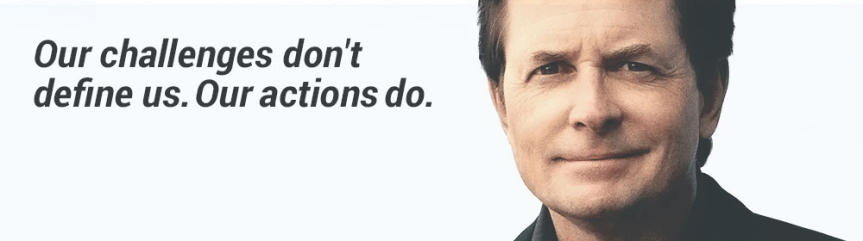
What does inspiration look like? A Canadian actor, apparently

The last day of a conference is always a little rough. You’ve seen a lot of sessions and they all start to blur together. At some point you hear, “yada yada yada” and think it’s insight.

And then you see a keynote that stops the conference cold and hits everyone on a gut level.

That keynote was Michael J. Fox.

In case you have been living under a rock, Michael J. Fox was THE guy for awhile – Back to the Future, Family Ties, Spin City. What we didn’t know is that in 1991, at the age of 29, he was diagnosed with Parkinson’s Disease and told he would only have about 10 years left to work.

Ten years.

Can you imagine how limiting that must have been? Most of us would have ranted and raved, felt sorry for ourselves, been paralyzed by fear, or some other “end of world” reaction I assume we’ve all imagined at one time or another.

Michael J. Fox went out and starred in Spin City. He continued to act. He wrote 3 best-selling books.

He lives every single day. And he is happy.

On the last day of the Work Human conference in Orlando, there was a lot of anticipation to see him speak. Recent reports were that his disease was progressing quickly. Would he be okay onstage? Would he speak at all?

Lucky for us, he did speak. You could tell the disease had progressed. His speech was a little slurred, you saw the tremors. But you also saw the glint in his eye, the quick wit, the humor – the PERSON. He never shied away from talking about Parkinson’s and how it impacted his life and the lives of those around him. He talked about the challenges of hearing his time to work was limited. He shared the frustrations of not having early detection for Parkinson’s (by the time he had the tremor that led him to the doctor, 80% of his dopamine-producing cells were already dead).

But most of all, he shared the joy he finds in life.

MainHeroSpaceBanner-v1915-v2

He shared it by the way he talked about his family – his parents, his wife, his 4 children. He shared it in the way he focused on what he CAN do, not what he can’t. There were people who cried throughout his entire talk because despite the fact you could see the disease had affected him physically, you saw he chose to see the disease progression as a gift – it gave him focus, honesty and clarity.

I can’t possibly capture the impact Michael J. Fox had on the audience. Nor can I capture all the incredible quotes. Here is a taste of what the crowd experienced:

  • On his father: “My father was in the military. When you had a problem, he was the first person you wanted to call and the last person you wanted to talk to.”
  • On hearing the doctor tell him he had 10 years left to work: “It was after 10 years that I finally got good. Parkinson’s stripped away all the tricks and forced me to be honest.”
  • On his disease: “I accept things. That doesn’t mean I’m resigned to them, but I can accept them them as they are and move on.”
  • On caregivers of those living with disabilities: “There are no rules for people with a disease or disability – let them define their own life and what they can do.”
  • On his foundation: “We are the leading private funder of Parkinson’s research.”
  • On delaying disclosing his diagnosis: “How can the audience laugh at me if they know I’m sick?”
  • On the future: “You can’t project what’s going to happen in the future. You just have to see how it goes.”

I’ve always cringed when someone comes up to me and says, “Happiness is a choice!” Mostly because it’s accompanied by a big giant smile and is usually preceded by a statement akin to, “It looks like someone has a case of the Mondays.” But when Michael J. Fox says he made the choice to not let this define him and to fill his days with life, I totally believe it.

This keynote made the conference for me. It’s one thing for people to tell you to choose happiness.

It’s another thing entirely to see someone who did it.

This is what inspiration looks like. A 54-year-old Canadian who loves to walk outside and feel the dew on his feet and spend time with his family.

Who knew?


If you’re interested in learning more about the Michael J. Fox Foundation or if you want to donate to fund research, visit https://www.michaeljfox.org/

Free Your Mind (with apologies to En Vogue)

As you know, I’m at the Work Human confernce own in Orlando, FL this week. Lots of good stuff happening here – conversations, candy, donut walls (it’s a thing), and sessions.

The topics on these sessions are aligned with the theme of the conference of finding a new way to work by finding a new way to be. The speakers today have been diverse in their backgrounds and have unique points of view about the research out there around happiness, engagement, and resilience. Not all resonated with me (as I suspected), but I found interesting elements in all that I saw.

envogueSome of my key takeaways from today:

  • You have to free your mind:Biggest takeaway (and most consistent message) is that the brain is easily tricked. Don’t assume success will make you happy. Be happy to lead to success. The self-talk we use primes our brains for success or failure. Amy Cuddy (in a session that surprised me with its relevance) showed us how our ability to expand physically and temporally leads to success.  The brain is a powerful thing – use it to your advantage.
  • The research is still fairly new, and evolving: It’s always a challenge when everyone uses the same research to tell different (yet related) stories. So you hear the same stats quoted in a number of different ways. The good news is that further studies are underway and those who look at happiness and resilience recognize the need to balance it with data and realism. I’m curious to hear more.
  • People are starting to get vocal about their annoyance with generational stereotypes: Yes. People at different stages in life are looking at different things. But deep down, they are all individuals. You could almost hear the collective groan when a sweeping generational statement was made…much like you could hear the cheer when a speaker swatted down those same stereotypes. It’s an interesting time in HR (and business) as we figure out the workforce of the future. I’m seeing a trend towards personalization and away from generalities. And I think that’s a good thing.
  • Personal experience colors interpretation: Now that you’re done thinking, “duh,” hear me out. I mentioned the research is all pretty much the same right now…yet we heard two speakers (Shawn Achor and Caroline Adams Miller) use the same info in VERY different ways. Shawn focuses on happiness and positivity and how starting from a place of optimism leads to success. Caroline uses her own story of overcoming bulimia to make the argument that happiness only comes after hitting rock bottom and facing adversity. Both pretty much agree that success starts with mindset…but such a different tone in those sessions.
  • I want to start EVERYTHING with a Haka Dance: Google it. It’s awesome.
  • The topic isn’t going away: As more research seeks to tie happiness/resilience to engagement, I think you’ll see more and more companies trying to get on the happiness bandwagon. That’s all well and good – but remember, it needs to fit into the culture of your organization. Not everyone will embrace a “meditation room,” but I bet a lot of employees would appreciate a quiet spot to recharge (favorite quote: “Headphones are the new cubicles.” Thanks, Yvette Montero Salvatico!). It will be interesting to see where this leads; I just hope folks remember that it’s a PART of the solution…not the solution itself.

Overall, it was an interesting day that has provoked a lot of discussion around relevance, validity and applicability. And isn’t that what conferences are supposed to do? Make you think?

Hint: Yes. Yes, they are.

There’s one more day of the conference! Follow the Twitter feed on #WorkHuman.