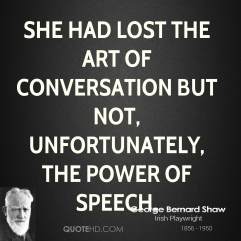
Small talk and the decline of practically everything

There is a lot of chatter out there.

On any given day, millions of ideas are shared via the internet, via Twitter, LinkedIn, articles, this blog, etc. Lots of one liners, jokes, snarky comments; but also inspirational quotes, videos of baby goat yoga, lists of “life hacks” (whatever the hell those really are), etc. In fact, every minute on the internet sees, among other things, a minimum of 2.4 MILLION Google searches, 347,222 tweets on Twitter, and 972,222 Tinder swipes (may you all find love).

This is the age of Big Data [insert dramatic music here].

And yet, most of what is out there is little more than a tasting menu of ideas. It’s a one-way sharing of thoughts, feelings, observations, and/or ego. We dip our toe into the pool of discourse, but we don’t stay too long lest we get dragged into a debate, get attacked by trolls, or – lord forbid – have to participate in an honest-to-god CONVERSATION.

What happened to our ability to sit down and actually talk to people?

In high school and college, people were all about having deep, philosophical conversations about life, death, and everything in between. Yeah, they got pretty annoying sometimes, but it was good practice in identifying where you stood in the world. You were able to frame your argument, consider counterpoints, and share your own counterarguments. It was a great way to apply debate skills and decide what you may or may not believe in.

Granted…I did not have Twitter or Facebook when I was in college. We barely had the internet. #Iamnotold #dammit

Today, communication is built to be quick, witty, and shallow. I actually resisted Twitter for a LONG time because I do not believe 140 characters is enough room to communicate meaningfully. I now accept it for what it is, but still throw it the side-eye now and then because I think it’s part of the problem.

People don’t really talk anymore.

I am as guilty of this as anyone. As an affirmed introvert, I LOVE the fact that I can do so much “communicating” online, in writing, without actually have to see someone face to face. I hate talking on the phone voluntarily. I avoid networking events like the plague. Give me a chance to interact virtually and I will take it every single time. And it probably makes me less effective as a coworker/boss/friend/human being.

It’s easy to just stop typing when you’re not happy with the way a conversation is going. You can just block someone if they get a little too obnoxious. Or you just throw a hashtag out there (#micdrop) and act like you won.

Real world conversations take vulnerability. They take concentration. They take commitment.

I’m going to try to do better at this. I’m going to try and have better conversations with the people I actually see in real life.

This doesn’t mean I won’t be quick, witty, and shallow on the internet. Are you kidding?! That’s way too much fun. I’m just going to…try harder. I hope you do, too.

What’s the worst that could happen?

Can you change your industry if you don’t consult?

It happened again. One of those The 25 Most Influential Whatevers Changing the Industry lists. The ones that inevitably have the same core group of names you see on every other list in the same industry. And the ones that seem to consist solely of consultants.

I’m not saying those people don’t deserve to be on those lists. The folks who make those lists have clearly gotten their message to a wider audience and are typically looked to as an expert in their field. And they work hard to earn that recognition.

What I am saying is that you almost never see an in-house person on those lists, what might be referred to as a “practitioner.” Oh, you see folks who own their own businesses and do it well, so it’s not like they aren’t working their butts off in “corporate America,” but they still tend to be on the outside looking in.

There are a lot of reasons why this might be the case, none of them nefarious; it’s just the nature of the work you do as a practitioner. First, let’s look at why consultants tend to make lists more often:

  • Consultants depend on getting their name, brand and messaging out there on a regular basis to build their business. You have a day job, the basic need of getting your name out there for a paycheck isn’t as strong.
  • Consultants are a third-party voice, and as such they get the “fresh eyes” credibility boost. Remember when you were new at your company and everyone thought you were brilliant? It’s the same effect sometimes for consultants.
  • Consultants know that they need to stay current to stay credible, so they do their homework on the latest and greatest stuff that’s going on. Also, a lot of them tend to be invited to speak at conferences, which means they see the most recent products and research…and it raises their visibility in the field.

So that begs the question – can you be recognized as an industry trailblazer when you’re working a 9-5?

Pigeons. In holes. Get it?


The short answer is yes…it just takes a lot more work.

First, figure out WHY you want to change your industry. Is it for personal glory? Or do you really think there’s got to be a better way to do it? If it’s personal glory….well, feel free to promote yourself out there and see how long you last. But if you really think there is a better way to do work within your industry, there are a few things you might consider doing on your way to trailblazer status:

  • Be a Mad Scientist: Your current organization is a great testing ground for new ways to do things within your industry. Think of it as your own little laboratory. When you get some interesting results, start sharing it with people in your industry.
  • GET ON SOCIAL MEDIA: I know, I know…EVERYONE is on social media. You know why? Because it’s a great place to network with other people who do your job, too! You can talk to people, ask them how they’re handling certain issues, share your expertise. And you don’t have to go to awkward after-work happy hours to meet them, either. It’s like an introvert’s dream.
  • Put yourself out there: This is sort of related to the social media one, but has a broader focus. If you want to impact your industry, you need to see more of your industry. Go to conferences (if you can). Volunteer locally if there is an industry membership group nearby. Reach out to similar organizations and see if you could visit to learn a little more about what they do. Don’t bury yourself in your bubble and assume you’re a rock star because you have figured out your company’s system. You need to find out about other systems before you can help change the industry.
  • Publish your findings – successes and failures: Publishing might seem kind of formal, but depending on your industry, it could be the way to go. Or, you know, you could start a blog. Or maybe apply to speak at some of those industry conferences you’ve heard so much about. Sharing what you’re doing with people outside of your organization is the best way to get feedback on what you’re doing AND to help influence what is going on in the industry.

Does that sound like a lot of work? It can be. You’ve got a day job, and a lot of this may need to happen at lunch breaks, evenings and weekends. No one said change was easy, but if you really want to impact your industry, you may need to burn the midnight oil every once in awhile.

Oh, and one last thing you might think about as you embark on this quest….

  • Be okay with making YOUR company better: Sometimes it’s enough to make a difference at your own place of business. Not every change will be industry-changing – often, it’s enough to know you’ve made work better for the people around you. And really…isn’t that the best kind of change?

Fight the good fight

Let’s face it – no matter what our aspirations, most of us leaders will never ascend beyond middle management. That’s because unless we are a CEO of a company without a board (or we are ALSO the board chair), we all answer to somebody.

This perpetual state of “rock, meet hard place” means that leaders are constantly being asked to implement ideas, policies, projects, and other shenanigans they absolutely do not agree with. And even more, they know their employees will not agree with them, either.

The challenge is always knowing when to fight and when to support. In general, the rule of thumb has always been “fight up, complain across, support down.” Which…mostly works. It’s important that leaders know how to pick their battles and when to gain and spend political capital.

On the other hand…

There are times when your team really needs to see that you’re fighting for them. They need to believe you, their leader, has their back when they aren’t around to see it. They need to see that you are human, that you recognize when a policy from the higher ups seems contrary to the organization’s stated values, and that you are willing to stick your neck out for something that’s important.

Leaders, you won’t win on these. Most of the time the decision has already been made and you’re basically just fighting a whirlwind. You’ll be told you have your marching orders and that it’s happening with or without you, so it might has well be with you.

How you decide to react to that statement is up to you.

What I can tell you is that your team notices when you fight for them and with them. They know most of these issues are a losing battle. They know you’re putting your neck on the line. And because of that, they will be in that battle with you.

That means you have to be smart. That means you fight when it matters, not when you’re feeling petty. That means you explain why you’re fighting – so make sure the reason is worthy.

Being a leader means finding a balance in that gray area of supporting the organization’s mission and purpose and railing against anything that seems to be against the mission and purpose. Being a leader means knowing you will fight many times, and you will lose.

But being a leader also means showing your employees that with power comes responsibility, and being a manager sometimes means pushing back on authority now and then when the issue is important. It shows your employee you support them…and you expect them to also push back when the issue is important. Because informed dissent breeds innovation, and permission to dissent respectfully builds trust.

Yes, leaders. You will lose the occasional battle. But you just might win the war.