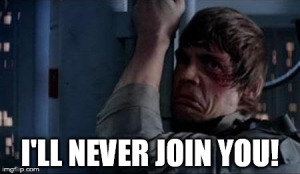
Not a joiner? Join the club*

*Author’s Note: See what I did there? 

There’s been a lot written about the challenges of being an introvert in a workplace that tends to value the behaviors of extroverts (see: Susan Cain). From open floor plan workspaces to “collaborative” work styles (e.g., we all sit in a room and stare at the same document until magic somehow occurs), to a belief that you must speak up in meetings or you’re not adding value – the preferred work style of introverts seems contrary to how corporate America seems to want to operate.

Despite this clash of styles, introverts are doing (mostly) okay. Exhausted and fussy at times, but mostly okay. We’ve been figuring out how to adapt to, and influence, our work environments to find a way to not only exist but thrive. We have also made headway in busting the myth that introverts are anti-social heathens who hate people. (That’s only a few of us.) Most introverts actually like people…but individually, and for short periods of time. Or through social media, because this means we can meter the intensity of our interaction to match our energy. Which is nice. Slowly but surely, we’ve started to change the perception that you have to be “outgoing” to be a good leader.

Then out of the blue…someone asks you to join their “group.”

Maybe it’s a bowling league. Maybe it’s a work committee. Or maybe someone tries to throw you into a generalized reference to a “them” when telling a story.

If you just read that and felt your heartbeat climb and your anxiety increase, chances are you are NOT a joiner.

It’s okay…I’m one of you. (Which really is kind of funny when you think about it, because now we’re a group but we don’t really WANT to be a group, and now we hate ourselves for being part of a group. Ugh.)

I know I started this post talking about introverts, but I want to point out that extroverts can be “anti-join,” too. I think anyone who hates being labeled or put into a box (particularly by others) aren’t really a “joiner.” Because introverts recharge individually, though, maybe they’re more prone to not wanting to join the club. (I have no research to support this, but it seems like research doesn’t change people’s minds anyway, so let’s pretend I told a really emotional story and got you on my side on this one.) (And yes, I’m aware of the irony that I just used research to prove that research won’t change your mind.)

Anyway, back to not wanting to be a joiner.

The problem with not being a joiner at work is that it somehow puts a mark on you. People who don’t want to join the club are often labelled as difficult, or maybe they “aren’t a culture fit,” which is often code for “not like us.”  Unfortunately, that mark can be tough to shake. Most people want so desperately to belong, so it’s hard to understand why someone wouldn’t want to belong in a very public, assimilated way.

And that’s where the challenge lies – never try to tell a non-joiner they HAVE to join. They will become stubborn, angry, and most likely will act directly opposite from what you’re trying to get the group to buy into. (At least that’s what my mom says I do. I think she’s lying out of spite.) They will feel put upon, and more importantly, they will feel even more like an outsider because you have put their otherness on display. And now they will never join you.

This is a damn shame, too, because here’s the thing – non-joiners actually do join things. They just tend to be much more selective and only join things that really speak to them – causes, activities, awesome snacks at club meetings. Don’t think of them as non-joiners. Think of them as the Discerning Joiner.

Discerning Joiners recognize they only have so much time and tolerance for meetings, get togethers, busy work, etc. They focus instead on things that they care about. And when they decide to join that “club,” the Discerning Joiner is a juggernaut. They will devote time, energy, attention, resources – anything they need to do in order to make sure their decision makes a difference for someone.

You WANT Discerning Joiners – you just don’t realize it yet. They tend to be the people who can make a real difference in society. They see something they don’t like and refuse to “join the club.” Instead, they make a conscious decision to evaluate the situation and do something to turn people’s heads and make them uncomfortable. It could be something as simple as sitting in someone else’s “spot” in a meeting to break up the monotony. Or it could be something as public as kneeling. Whatever action they take, though, they take intentionally. Don’t discount the power of that. Harness it. Encourage it. See what you can do to create an environment that allows that to happen positively.

And if you ARE a Discerning Joiner, stay strong. Stay principled. Don’t feel pressured to join the crowd. Join when it makes sense. Feel comfortable in being an individual, too.

USE YOUR POWERS FOR GOOD.

Even if you do it alone.


I am no bird; and no net ensnares me; I am a free human being with an independent will.
– Charlotte Bronte


Don’t you dare forget…a session with Kat Cole

[This post first appeared on the SHRM Blog on June 19, 2017]

Today saw the beginning of #SHRM17 in New Orleans, where 18,000 HR pros have descended upon the city for learning, fun, and reconnecting with old friends.

The shenanigans kicked off early in the morning with pre-conference workshops, but the sessions began in earnest after lunch, with concurrent sessions and SmartStage speakers. But the main event REALLY kicks off late in the afternoon, with the appearance of Juana Hart and our first keynote of the conference.

You have probably heard of Kat Cole – she worked at Hooters and learned the operations side of the business when the cook disappeared. Her hard work and inherent business sense led to her recommendation to be sent to Australia to launch restaurants there.  She became a Vice President at 26, and then moved over to Cinnabon to become President of the company at the age of 33. Her story is remarkable. She is remarkable.

Ms. Cole’s keynote was impressive – no slides, no teleprompter, just a woman telling her story and the lessons learned along the way. There were so many inspiring tales in the keynote. I have no doubt my fellow SHRM bloggers will cover many of them. There was one in particular, however, that stood out to me.

She had just finished sharing a major mistake she made early on at Cinnabon, and shared how that mistake led to lasting success. And then, she talked about how her mom keeps her grounded. Every day on her birthday, Ms. Cole’s mother sends her a card with the following reminder: Don’t you dare forget where you came from, but don’t ever let it solely define you.

This hit me on a personal level. Everyone carries the memories of where they come from with the through life. These experiences shape who we are and how we approach adversity. Some choose to overcome them and never look back. Others wallow in those experiences, using them as an excuse to stay stuck. Ms. Cole’s message from her mother is striking because it illustrates the power of remembering what got you through adversity, and then using it to move forward.

When we refuse to look back at who we were in the past, we fail to acknowledge the lessons we learned on that path. We don’t honor the person who made it through the wilderness. We pretend it didn’t exist. But that’s not really the case, is it? That person is always looking over our shoulder, whispering in our ear, holding us back or pushing us forward. It would be disingenuous to believe we aren’t still holding on to a part of the past, even as we look towards the future.

So why focus so much on this aspect – especially when it comes within the context of Human Resources? There are two reasons – one external, the other internal.

First, the external – we need to remember that each of the employees and leaders we work with are bringing their pasts to work. We have an opportunity to be that voice that says, “Yes, you ARE that person who dealt with a not-so-great past. But that doesn’t have to be who you are forever.” We can help these people move forward by reminding them of their strengths and working with leadership to recognize when humility and courage come together to make real change.

Second, the internal – HR needs to listen to that advice. For too long, we have wallowed in the belief that we have no influence. That no one will let us do anything. That we have fought like hell to get where we are today and it just doesn’t seem like it’s that far at all. And yet…look at how far we have come. We are no longer “personnel.” We have the ear of our CEOs. We may still struggle at times, but CHRO is a position that actually EXISTS in business – and it didn’t always. We have struggled and we will continue to struggle…but we have so much potential.

So my advice to you, #SHRM17 HR professionals – don’t forget where you came from….but DON’T YOU DARE let that solely define you.

Be more. Do more. Dare more.

Small talk and the decline of practically everything

There is a lot of chatter out there.

On any given day, millions of ideas are shared via the internet, via Twitter, LinkedIn, articles, this blog, etc. Lots of one liners, jokes, snarky comments; but also inspirational quotes, videos of baby goat yoga, lists of “life hacks” (whatever the hell those really are), etc. In fact, every minute on the internet sees, among other things, a minimum of 2.4 MILLION Google searches, 347,222 tweets on Twitter, and 972,222 Tinder swipes (may you all find love).

This is the age of Big Data [insert dramatic music here].

And yet, most of what is out there is little more than a tasting menu of ideas. It’s a one-way sharing of thoughts, feelings, observations, and/or ego. We dip our toe into the pool of discourse, but we don’t stay too long lest we get dragged into a debate, get attacked by trolls, or – lord forbid – have to participate in an honest-to-god CONVERSATION.

What happened to our ability to sit down and actually talk to people?

In high school and college, people were all about having deep, philosophical conversations about life, death, and everything in between. Yeah, they got pretty annoying sometimes, but it was good practice in identifying where you stood in the world. You were able to frame your argument, consider counterpoints, and share your own counterarguments. It was a great way to apply debate skills and decide what you may or may not believe in.

Granted…I did not have Twitter or Facebook when I was in college. We barely had the internet. #Iamnotold #dammit

Today, communication is built to be quick, witty, and shallow. I actually resisted Twitter for a LONG time because I do not believe 140 characters is enough room to communicate meaningfully. I now accept it for what it is, but still throw it the side-eye now and then because I think it’s part of the problem.

People don’t really talk anymore.

I am as guilty of this as anyone. As an affirmed introvert, I LOVE the fact that I can do so much “communicating” online, in writing, without actually have to see someone face to face. I hate talking on the phone voluntarily. I avoid networking events like the plague. Give me a chance to interact virtually and I will take it every single time. And it probably makes me less effective as a coworker/boss/friend/human being.

It’s easy to just stop typing when you’re not happy with the way a conversation is going. You can just block someone if they get a little too obnoxious. Or you just throw a hashtag out there (#micdrop) and act like you won.

Real world conversations take vulnerability. They take concentration. They take commitment.

I’m going to try to do better at this. I’m going to try and have better conversations with the people I actually see in real life.

This doesn’t mean I won’t be quick, witty, and shallow on the internet. Are you kidding?! That’s way too much fun. I’m just going to…try harder. I hope you do, too.

What’s the worst that could happen?