The world IS wide enough

I am an unabashed Broadway nerd. I’m not the most knowledgeable, and I have some very controversial views on Cats (Spoiler Alert: I can’t stand it.), but what I lack in knowledge, I more than make up for my love of certain shows. And one of my greatest loves is Hamilton. (Going out on a limb there, I know.)

The show overflows with themes, just pick one – love, ambition, politics, the disconnect between men who cried freedom but not really for all. In relistening to the soundtrack recently, another theme really stood out to me – the idea that there is enough room for more than one success story.

Too many of us think the only way for one person to rise is for another person to fall. That the key to protecting what you have gained is to ensure no one else has that same chance. This can be especially true among groups who have historically struggled to gain power – women, minorities, LGBTQ, the poor, the undereducated, the disadvantaged. 

I watch the dialogue happening in our country today and I’m struck by this theme returning again and again. And it troubles me because it seems we are approaching success like a zero-sum game, which is bad for society at large. Fair isn’t equal…but do we really think a zero-sum game is fair?

We see this play out on a smaller scale in our workplaces. We make some strides in diversion, but fall down with inclusion. We talk about “culture fit” without acknowledging it could easily be code for “look, think, and BE like me.” We subconsciously (and sometimes consciously) place a limit on how many of the “other” are allowed to be successful, and we create a system that ensures the few “other” who do succeed participate in keeping the new status quo to protect what little gains they’ve achieved.

How did we get here? And more importantly, how do we move on from here?

Maybe it’s as simple as realizing the world IS wide enough; that success is NOT a zero-sum game; that, in fact, when we support each other and help each other succeed, we raise ALL ships. We need to celebrate the honestly gained success of others, not knock them down. We need to stop comparing ourselves to an impossible standard we see online because so much of it is a lie anyway. We need to set a path that makes sense for us, and then support others who are seeking their own path.

At the recent WorkHuman conference, Former First Lady Michelle Obama and Steve Pemberton spoke about the Maasai tribe’s custom of asking not “how are you?” but “how are the children?” In their culture, if the children are well, then everyone is well. This resonated with me (and not because I like children – I’m not exactly maternal). It resonated because it’s another way of saying, “The world is wide enough.” Give every child a chance to succeed, and they will continue to expand the borders of our world as we know it.

There is so much room for success in this world. There is so much potential to be realized.

How will you help others expand their world?

Now I’m the villain in your history
I was too young and blind to see…
I should’ve known
I should’ve known
The world was wide enough for both Hamilton and me

– Aaron Burr, Hamilton: The Musical

Fight the good fight

Let’s face it – no matter what our aspirations, most of us leaders will never ascend beyond middle management. That’s because unless we are a CEO of a company without a board (or we are ALSO the board chair), we all answer to somebody.

This perpetual state of “rock, meet hard place” means that leaders are constantly being asked to implement ideas, policies, projects, and other shenanigans they absolutely do not agree with. And even more, they know their employees will not agree with them, either.

The challenge is always knowing when to fight and when to support. In general, the rule of thumb has always been “fight up, complain across, support down.” Which…mostly works. It’s important that leaders know how to pick their battles and when to gain and spend political capital.

On the other hand…

There are times when your team really needs to see that you’re fighting for them. They need to believe you, their leader, has their back when they aren’t around to see it. They need to see that you are human, that you recognize when a policy from the higher ups seems contrary to the organization’s stated values, and that you are willing to stick your neck out for something that’s important.

Leaders, you won’t win on these. Most of the time the decision has already been made and you’re basically just fighting a whirlwind. You’ll be told you have your marching orders and that it’s happening with or without you, so it might has well be with you.

How you decide to react to that statement is up to you.

What I can tell you is that your team notices when you fight for them and with them. They know most of these issues are a losing battle. They know you’re putting your neck on the line. And because of that, they will be in that battle with you.

That means you have to be smart. That means you fight when it matters, not when you’re feeling petty. That means you explain why you’re fighting – so make sure the reason is worthy.

Being a leader means finding a balance in that gray area of supporting the organization’s mission and purpose and railing against anything that seems to be against the mission and purpose. Being a leader means knowing you will fight many times, and you will lose.

But being a leader also means showing your employees that with power comes responsibility, and being a manager sometimes means pushing back on authority now and then when the issue is important. It shows your employee you support them…and you expect them to also push back when the issue is important. Because informed dissent breeds innovation, and permission to dissent respectfully builds trust.

Yes, leaders. You will lose the occasional battle. But you just might win the war.

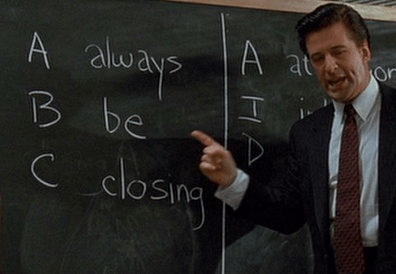
Always Be Curious (with apologies to Glengarry Glen Ross)

As you probably know, I have a day job. Yes, I actually work in human resources. For a real company and everything!

But I’m also fortunate enough to have the opportunity to speak at a handful of conferences and other events throughout the year. I enjoy doing this – it’s a great chance for me to visit other states and talk to fellow HR professionals about the struggles they’re facing and to share my experiences in the hopes we all walk away with a fresh perspective and some new ideas to try.

Well, that’s the idea, anyway.

The reality is that not everyone attends a conference with the intent to learn. Some are there just for the recertification credits. Some are there to hang out with their HR friends and hit the expo floor. Some are there to finally get a few days away from the kids so they can watch some RHONJ in peace, dammit! It’s not necessarily what the conference planners intended, but honestly, they’re pretty happy if people pay, show up, give the keynotes some attention, and fill out the feedback forms.

Speakers have a love/hate relationship with feedback forms. We do want to hear from our audience – we want to get better, we want to know what was meaningful to you, we want to hear that we’ve changed your life because you finally understand the new overtime regulations. (Okay, that last one was a bit tongue in cheek.) But seriously…we want some sort of validation that the time we spent building the presentation, practicing, traveling to the conference, and delivering the content was useful for someone. And most comments are very kind. You get the random comment about room temperature (sorry, we can’t control that) or the fact that someone doesn’t like the color of your dress (which is why I usually wear pants), but for the most part, it’s good feedback.

For the most part.

Inevitably, no matter what presentation I deliver or at what conference, there is at least ONE person who writes the comment: “I didn’t learn anything new.”

Really? Not a single thing? At all?

Listen, as a speaker, I’m usually a tough audience. Speakers end up seeing a lot of different sessions with different types of presenters, so you can get a little jaded. I admit it. But I walk into every session with the intent of taking away at least ONE thing I’ve learned from that person. Hell, if nothing else, I learned their name and what they do for a living.

But not this person. This person just says, “I didn’t learn anything new.”

This depresses me. Not because I worked hard to do research to include a lot of value-added data (which I always do), or because I shared my experiences in other orgs in hopes it helps (which I also do). It depresses me because a comment like that indicates that this person is not curious. They walk into every situation assuming they know everything and that there is nothing that anyone could possibly teach them.

Who wants to live life like that?

BE CURIOUS. Be open to new ideas and new experiences. Be open to new data. Be open to the fact that your carefully crafted world view might not be 100% accurate.

I’m not asking you to agree with everything you hear. In fact, I want you to question it, challenge it. That shows me you are thinking about it and are curious about how it ties into what you’re currently doing. It shows me you’ve internalized the idea and are considering it and may decide to reject it. At least you cared enough to hate it instead of dismissing it as “nothing new.”

So this is my challenge to you from now until the end of the year. Instead of dismissing something outright, think about it. Question it. Be curious about it. You might actually learn something new.

God forbid.