Connecting the dots (and by dots, I mean people)

Note: This week I am at the annual National SHRM Convention in Las Vegas, NV. And in case you’re wondering if it it’s hot in Las Vegas in July, the answer is HELL YES. The heat…my god, man, THE HEAT.

As we enter the final day of this national gathering of HR folks, the attendees will be thinking about what they really got out of this experience.

  • Were the sessions worth it? Many of them were. Hopefully you chose wisely!
  • Were the keynotes good? Mika Brzezinski was. Her message about knowing your value resonated. And even if you disagreed with her, she made you think about WHY you disagreed.]
  • Were the boxed lunches good? No. 
  • Was the Expo Hall helpful? Depends on your goals. May you connect with many good vendors!
  • Did you have fun at Jennifer Hudson? No one called me for bail money, so you must have balanced it right!

What strikes me about this week as I talk to fellow attendees is how much they talk about different people they’ve met. About the woman working in Iowa as an HR Department of One and how much she has in common with the man in California facing the same challenges. About the folks on the shuttle bus chatting about their day, laughing knowingly about a session as if they were old friends. About the online friends who have been connected for a couple of years who finally got a chance to meet face to face.

I attend SHRM not just because I want to see the sessions, or keynotes, or go to Vegas. (Wait…what?)connect-the-dots

I attend SHRM because I want to connect with the online community who has welcomed me, supported me, mocked me (I’m looking at you, Stollack), and embraced me as one of their own. I am not here in any sort of official blogging/social media capacity and yet I’ve been able to hang with these folks, participate in fantastic conversations, and share my opinions with this fascinating, smart group of people.

Last night at dinner, Jason Lauritsen (yes, I’m name dropping) stopped for a moment and reflected on the growth of this little online family, and how SHRM has become a type of family reunion – a chance to reconnect on a human level with people who have been scattered around the nation.

Jason’s right. SHRM really is about the connections we make. But what’s more important are the connections we SUSTAIN.

My challenge to you as you go back to your homes and to your lives (or to the casinos) is to ensure you sustain the connections you make in life. Help connect people to those who can help each other. And plan ways to keep those connections fresh through face-to-face meetings.

The simple truth is that for all the process and product our companies deal with, it’s the PEOPLE that matter.

Connect. Sustain. Refresh.

It’s that simple.
Ninjas in our midst: in praise of undercover leaders (dispatch from #SHRM15)

Note: This week I am at the Annual National SHRM Convention in Las Vegas, NV. And in case you’re wondering if it it’s hot in Las Vegas in July, the answer is HELL YES. The heat…my god, man, THE HEAT.

Not everyone likes to go to conferences.

There are a lot of people. Vendors looks desperate. There are too many sessions that seem to look the same, and if you have to get on one more shuttle bus, you may burst into tears.

Now multiply that by about 15,000.  Because that’s how many HR professionals have descended upon Las Vegas for the annual SHRM National Convention.

They come for a variety of reasons – some come to get their recertification credits, some to see specific speakers, some to raid the Expo Hall, and yes…some come just because they want a company-sponsored trip to Vegas. (Don’t judge – you’re just mad you didn’t think of it.)

I would argue, however, that the vast majority come to reconnect with others who share their experience, skills, and intereninja2sts. They come because they want to meet the people they’ve connected with over the years. They come because they want to learn from others.

And they come because so many of these HR professionals are LEADERS.

No, they don’t have the fancy title. In fact, many of them don’t even think of themselves as leaders. They are HR folks doing the best they can to help their organizations be successful. And in the process, they prove their leadership.

These folks ask good questions in sessions. They stay behind to challenge the speaker on points made during a session. They engage with their peers on the Expo Floor or while waiting for the shuttle. They ask how the conference is going when riding the elevator down to the lobby each morning. They challenge the thinking of those around them, aren’t afraid to call something bullshit when it is exactly that, yet they don’t tear down – they help build.

This wouldn’t surprise the people who know them, because back in the office, these same HR professionals nudge and influence, support and coerce the employees and leaders working in their organizations. They keep the trains running AND challenge the status quo – all without calling attention to themselves. It’s about the outcomes, silly.

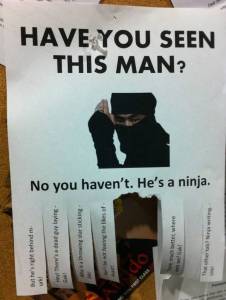
They are leadership ninjas. You don’t even realize they were there – but you feel their effects long after they’re gone. (And some of them are partial to black. No idea why.)

Are you noticing the “ninjas” in your organization? Are you willing to recognize leadership based on actions, not words? Are you able to empower based on behaviors, not title?

Don’t underestimate the power of these covert leaders…because I guarantee there are others in the organization who notice their influence and rely on their leadership capabilities.

When these HR professionals return to their organizations, eager to share what they experienced and itching to try some new things, give them some grace. Leaders DO. Leaders ACT. Leaders TRY. The worst thing you can do is look at them like they’ve grown a second head because these people want to implement something new.

So be quiet. Stand back.

You may be surprised what a ninja can do.

Ride into the Danger Zone (stepping out and taking a risk)

This week I am attending the WorkHuman 2015 Conference in Orlando, Florida. The goal of this conference is to help companies find ways to create a community of support and positivity that brings greater meaning to everyone’s work lives.  I’ll share what I learn here and on Twitter (@mkfaulkner43 #WorkHuman). 


If you’re going to make a mistake, make a mistake of passion.
–  Dr. Montgomery, jazz teacher

If I had a pick a word for Day One of WorkHuman, I would say it’s Balance.

Day Two, I would pick Risk. As in, take more of them.

I like this word. In fact, I LOVE this word. Risk. It’s a good one and it reminds all of us that innovation and greatness doesn’t come from sitting on our ass waiting for someone to tell us the best way to do things. We have to go for it.

All the keynote speakers so far today – Rob Lowe (yes, he IS that pretty in real life) and Nilofer Merchant (FOLLOW HER) – pushed the idea of stretching your comfort zone, taking big risks, not being afraid to fail, to BE WEIRD.

We are so hard-wired to stay in our boxes, follow the rules, conform. It’s time we embrace the fact that danger is a necessary ingredient to realizing our full potential.

We all work with and for people who never look outside of the four walls of their particular business, who believe the experience they have and the way they have always done things is exactly the right and best way to do it.

And you know what? It might be. For them. In that system. In that industry.

But for the rest of us? We need to be bold. We need to show courage. We need to stop thinking and start doing.

As employees, this means sharing our ideas and making proposals that we think are smart. Yes – there is a very real chance that it will get shot down the first, second, tenth time. But if you don’t believe in your idea enough to keep reworking it, getting more data, and trying again, why do you think anyone else would believe in it? The approval of others isn’t the only measure as to whether or not you have a good idea. Just because they don’t see it and get it, doesn’t mean it doesn’t exist.

danger_zone_-_kenny_loggins_2

As leaders, it means stopping our incessant need to “protect” – to protect what we have, to protect what our teams have, to protect some perceived notion of security. Leaders are EXACTLY in the right position to rock the boat – and rock it a lot – in order to move their business forward. Leaders have the influence, the knowledge, and the audience to be able to take real risk and make a difference. Leaders will set the example that risk-taking – and potential failure – is okay, encouraged, and ultimately, valued because of the impact it can have on the organization.

It doesn’t mean you get to be stupid about it.

It means you believe in the validity of an idea so much that you want it to succeed.

It means you believe in yourself enough that you know you are someone worth taking a risk for.

Risk taking is contagious. It breaks the status quo and challenges our assumptions about what we do, how we do it, and most importantly, why we do it. Risk taking made Rob Lowe a star and made Nilofer Merchant a successful businesswoman and author. They embraced their drive, embraced their beliefs, embraced a dream. And that’s why they’re standing on a stage telling the rest of us how to take risks – because they’ve already done it.

Embrace the danger. Move the business forward. Move yourself forward.

Take a risk.


Only those who will risk going too far can possibly find out how far one can go.
– T. S. Eliot