Two months of crazy for one night of awesome (the benefits of getting “involved”)

Last night, we held the first DisruptHR event in Denver, CO.

I had attended the very first DisruptHR in Cincinnati, OH because Jennifer McClure and Steve Browne said I should.  Chris Ostoich, founder of BlackbookHR, corralled Jennifer and Steve to help him organize the event because they all believe that HR needs to move itself forward in its thinking and its approach.

Hell yeah.

When I got back to Colorado, I said, “We need this here.”  So I reached out to Shawna Simcik and Meredith Masse at Innovative Career Consulting, and we were off to the races.  They were all in – because they agreed that it’s time we start thinking about talent and processes in a whole new way.

After a lot of meetings, emails, cat-herding and coffee, we did it.  We looked at our creation.  And it was good.

I’m writing about this not because I think you need to know about DisruptHR (which you do) or should check out BlackbookHR and Innovative Career Consulting (which you should).  I’m writing about it because this was a true step forward in my personal development.  I’m not a traditional people person. I’m not the one who thinks conferences are super amazing.  I’m usually the Idea Rat with this type of stuff – thinking “somebody really should do a conference”.

victory_cat

I decided to get involved because I think this idea is important, dammit.  We need to get out there and challenge our leaders and our HR brethren to be forward thinking.  And since I’m a bit of a control freak, I decided to get involved by being a co-organizer, which meant getting out of the shadows (deep down, I might be a “puppet master”) and being front and center.

If you are toying with the idea “getting involved”, here are some things I learned and gained because of the experience. This way you can make an informed decision.

Lessons learned:

  • Focus your intent: Whatever the “event” might be (a conference, a meeting, a task force, a book club), make sure you know exactly what it stands for and what your goals are.  We went in knowing that we wanted to start to change people’s minds about HR.  We also know we wanted our sponsors to have access to like-minded folks and to build networks.  So we shaped the event (from marketing, to registration, to tone) with those outcomes in mind.
  • Find the right partners: I would NEVER have been able to pull this off without the right people to help me.  I sensed that Meredith and ICC had a similar “disruptive” approach to HR and talent, which is why I approached them to be a sponsor/co-organizer.  And they ran with it.  Their enthusiasm, support, and tenacity to make this work…just invaluable. And we all brought different skills to the table, which meant the event would be well-rounded and appeal to more than just one person.
  • Get AMAZING speakers: If you are planning a speaking event, you need speakers.  And boy did we have them.  They were enthusiastic, brave, knowledgable, funny, talented…seriously.  They were off the hook.  Thank you to – Kathleen Brenk, Daniel Horsey, Matt Rowe, Brian Fretwell, Melissa Case, Kristin Van Horn, Sean Shepard, Tanja Hinterstoisser, Ph.D., Jo McGuire, Damian J Guerin, CCP, SPHR, and Shawna Simcik.  Find these people.  Connect with these people.
  • Book an awesome venue: If you are planning a networking event with speakers, the venue needs to work! Think about the acoustics, the space, the flow, the seating, the parking…everything.  Equally important is a venue that understands what you’re trying to accomplish and will work with you to convey the right tone.  We had Casselman’s – and they were great to work with.  They suggested a mix of seating and setup that encouraged the networking we were looking for.  And they made sure our speakers could be heard.  Big win.
  • Choose the right topics: You’ve heard “content is king.”  The topics you choose for your event need to serve the intent of the event, as well as be entertaining and thought-provoking.  We worked closely with our potential speakers to find topics that would advance the thinking of HR and get people thinking about their processes in a new way.  Okay…actually, our speakers came up with them.  But we picked ’em.  So there.

Unexpected bonuses:

  • New friends and connections: The DisruptHR group has bonded.  We have been through some serious shit and came out the other side with a new group of friends.  The speakers are connecting left and right, we may have encouraged a couple to join Twitter (I’m looking at you, Jo!), and we have all gained new resources to help us think of new ideas and approaches.  It’s hard to make new meaningful connections.  We did it.
  • Chance to shift mindset: Seriously – how often can you say you have a chance to start a thought revolution?  The whole event aligns with my “brand” as a forward-thinker who likes to shake people out of their day-to-day…and I think we won a few converts.  I want to keep this going.
  • Sense of accomplishment: This whole event was SO outside of my comfort zone – between the planning, the networking, the “group work” (people who know me know that challenge), the marketing, the hosting, the speaking – there were a lot of firsts for me.  I was EXHAUSTED when it was over…and I was incredibly proud at not just what WE did, but what I did.  Challenges are good, so I am going to continue challenging myself and others.

This post may not seem like it’s about traditional leadership.  There isn’t anything about feedback, or dignity, or engagement, or anything like that.  It’s about continually pushing yourself and others to try something new, do something scary, and find a level of success that wasn’t guaranteed or possibly believed.

Huh.  Maybe it was about leadership.  How ’bout that.


Quick note:  Shout out to Stephanie Sigler – the first boss I had who really challenged me to be a leader and stop being a brat.  🙂 Thanks for being there last night!
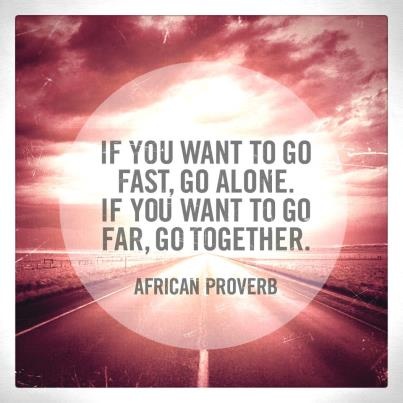
I get by with a little help from my friends

Do you have a safety net?   Do you have a network of friends who can help you through tough times?  Do you have a group of folks who can talk straight to you and tell you when you’re being an idiot?

If you don’t, you need one.

Leaders have a tendency to try and do everything on their own.  As a result, they often suck at delegating, struggle to communicate their vision compellingly…and aren’t too good about reaching out for help when they need it. And of all people, leaders (especially CEOs) need to avoid isolation – it can negatively impact the business.

support_picture

Regardless of your level of leadership, you can benefit from having your own personal support team.  I know this from personal experience:

  • Venting: Life is not always cupcakes and unicorns, which means you’re going to need to be able to complain and rage from time to time.  Your support group will listen and not judge…well, not much.
  • Accountability: A good support group calls you on your crap. They can also help you clarify and achieve your goals.  It’s good to have people around who can keep you on track.  They can also suggest actions to take to help get you to the finish line.
  • Sanity Check: This is similar to “accountability” but it’s a little more focused than that.  Your support team is there to throw out the red flag when they see you about to do something incredibly stupid.  It’s great to have that voice of reason when things go crazy.
  • Wisdom: As much as you think you know everything, you don’t.  Your support team can use their collective knowledge to help you break through your issues and move forward. So find some smart people for your posse!
  • Laughter: When you pick your support team, make sure you pick ones who have the same sense of humor as you.  And aren’t afraid to say inappropriate things.  And who know REALLY good jokes.

Just remember: you don’t have to go through this alone. Find your team and conquer the world!

PS – Shout out to #TeamFaulkner!  You know who you are.  And you are awesome.

Do you have a support network? What do you use it for?  Share in the comments!

NASA is freakin’ awesome (why science geeks are leading the way for engagement)

The other night, after being woken up by a particularly loud dog turning over in her crate, the TV was turned on and I ended up watching an hour long program on NASA’s Curiosity mission to Mars.  It was awesome, and if you are not in awe of the things that human beings can do when focused on a common cause, shame on you.  I’ve been a space nerd from a very early age.  The Right Stuff is still one of my favorite movies. I really wanted to be an astrophysicist (then I hit ‘Intro to Complex Variables’.  Oof.) and I watch documentaries all the time (hence the Science Channel on at 3:00am).  I love that stuff.

As I lay there, not sleeping like I should have been, I was struck by how geeked (shout out to Steve Browne!) everyone was about the work they were doing.  And I couldn’t help think that any corporation would be lucky to have such an engaged workforce, and how any workforce would love to be that excited about going to work every day.  The NASA geeks obviously love that stuff, too.

I know NASA has come under fire in the past for their culture of cover up that resulted in deaths (Challenger, Columbia) and other leadership blunders.  I’ll address that side of the culture in the future. But for those people working on the Curiosity mission, the culture gave them exactly what they needed in order to love their jobs AND be successful.curiosity

What is it that got these NASA people so jazzed (other than the obvious fact that they are working on AWESOME SPACE STUFF)?  Here are a few things that I think contribute to the high level of NASA employee engagement that corporations can learn from:

  • People get to apply their skills and interests towards really cool work: Engagement surveys keep telling us that people want to be able to put their strengths to work on interesting projects.  You’ve probably said once or twice in your career, “I just want to make a difference.”  Well, these people are doing that – they get to use all their training and years of gazing up at the stars to help explore a distant planet.
  • Everyone is working toward the same massively difficult, but inspiring, goal: NASA is all about throwing down the gauntlet.  It started with Kennedy’s assertion that we would get to the moon by the end of the decade in the ’60s, to Apollo 13’s shifted mission to bring the astronauts home, to landing the most ambitious rover safely on Mars to conduct science experiments.  This singular focus drives all decisions and actions, keeping the teams focused on the common target.
  • Everyone’s role is well-defined: As you can imagine, a project like Curiosity has a LOT of different teams working on specific aspects of the mission.  There’s the experiment team, the landing team, the communications team, the power team, the SAM (sample analysis) team, etc.  Each person knows what their specific goals are, what the expectations are, the timeline required, and the potential impact of failure.
  • Everyone understands how their role contributes to the overall mission: I didn’t hear anyone say, “I don’t know why I do what I do – I just take orders.”  These are people who are driven to succeed because they know the rest of the mission is relying on their success.  They are given the big picture to provide context and truly believe they are a part of something greater than themselves.
  • They prepared…and prepared…and prepared…and were ready for anything: The level of testing and simulations the teams underwent before launch, during the journey to Mars, and right before landing meant the team felt they were able to handle any contingency.  Leadership understood the importance of gelling as a team, practicing skills until mastery, and throwing in trouble scenarios so the team could learn how to handle them in a low risk environment.  This level of practice lent skills and cohesion that resulted in a successful rover landing…even though the method used to land the rover had never been used before.
  • The work captures the hearts as well as the minds: One of the project’s scientists told the story of when he was a kid and the first Voyager photos from Mars were published in the ’70s.  He said, “That’s the day I became a planetary scientist.”  He basically is working on the project he dreamed about when he was little. The ability to emotionally connect with one’s  work is powerful. Simon Sinek’s excellent TED talk and book Start With Why discusses the need to understand who you are as a company and then let all things flowing from there.  The scientists working on Curiosity knew why they were there, and the long hours and stress were truly a labor of love.
  • They celebrate their wins: Just watch the reaction of the team once Curiosity safely touched down on the surface of Mars.

True, most of us will never get a chance to work on a project like landing a rover on another planet so far away that it takes 14 minutes for radio signals to reach it.  But when you think about it, none of the things that make those NASA geeks so excited are really out of reach for companies.  It’s about letting your people use their strengths to move the company forward on ambitious goals that everyone understands and connects to.  Each person knows what their role is and why it’s important.  They can be emotionally committed to the work.  And everyone can celebrate their wins and learn from their mistakes.

It doesn’t take a rocket scientist to figure that out.