So, you’re a crappy employee. Now what?

Okay, maybe you’re not really a crappy employee.  Maybe you’re just a misunderstood genius.  A tortured artist whose brilliance is unappreciated by the rest of us.

Right.

Or maybe you really are an employee who just isn’t very good at your job.

Hey, it happens. Sometimes responsibilities change and you don’t have the necessary skills.  Sometimes you take a stretch job and you’re in over your head. Sometimes you get a new boss you just don’t get along with.  Sometimes you just run out of gas.

Whatever it is, you probably know you’re not doing your best, and it bothers you. A lot.

Nobody likes being bad at their job. And contrary to popular belief, most employees know when they are struggling.  We don’t always admit it…but deep down, we know.
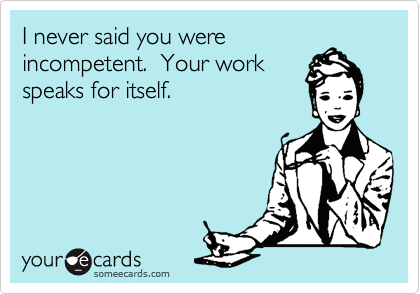
never_said_incompetent

The real question is – what do you want to do about it? Well, you have a few choices:

  • Decide if you want to stay in your current job: Maybe you like your job.  Maybe you don’t like your current job but need it.  Or maybe you really hate it and have the freedom to walk away.  Figure out the answer to that question and act on it.
  • If you want to leave, leave: Don’t be one of those people who quits but keeps coming in every day. It hurts your reputation, hurts your teammates, and never turns out well.  If you’ve decided to leave, do it sooner rather than later. But leave like a grown up, okay? No mic drops needed.
  • If you want to stay, fight for it: Acknowledge that you are not performing up to expectations. Get some help.  Ask for for honest, specific feedback from your manager, stakeholders, teammates – anyone who can give you some suggestions on how to turn things around. And don’t settle for “just do better.”  Ain’t nobody can act on that advice.
  • Own it: Maybe someone else was the spark for your troubles at work, but you’re the one who controls your actions. Admit you own your performance and the outcomes.  It’s the only way you will be able to make the necessary changes.
  • Get your head on straight: If you’re having trouble at work, you’re probably not the happiest person right now. It’s easy to work yourself into a downward spiral with negative self-talk and a crappy attitude. Take some time to reflect on how you got to where you are. Confide in a friend, a group of friends, a therapist, your dog – whoever you need in order to help you work on your outlook.
  • Keep checking in: It didn’t take you a day to turn into a crappy employee, so give yourself some time and keep the dialogue with your manager open.  Course correct as needed and keep moving in the right direction.

Whatever you decide to deal with your current situation, don’t forget to celebrate the wins. When you’re in a tough situation, you can forget how awesome success can feel. Whether you quit a job you hate or decide to take control of your current performance – you deserve a little pat on the back. It takes courage to take action when you feel beat up.

You might be a crappy employee now, but there’s no excuse to STAY a crappy employee.

You can do it. I believe in you. After all…you’re a misunderstood genius.

Just like the rest of us.


Failure is good as long as it doesn’t become a habit.
~ Michael Eisner

 

Best friend at work? Just have my back.

The Gallup 12 is a well-known set of questions used to gauge employee engagement. Many of the questions are tied to whether an employee understands how he/she contributes to the organization’s goals, has a chance to do what he/she does best, and whether or not someone has expressed interest in his/her development. You know, the usual.

But there’s one question on the 12 that tends to throw people for a loop – #10 – I have a best friend at work. Best friend? Who the heck cares if you have a best friend at work? You’re there to work, not join a knitting club.  Right?  Turns out it’s not quite that simple.

keyboard and two persons on white background

When you start to look into the question (for an excellent overview on the Gallup 12, read 12: The Elements of Great Managing), the reality is that employees are not looking to find their lifelong BFF at work.  What they are looking for is the “go to” work friend – someone they can talk with when things get crazy, share their frustrations and victories with, or even as simple as someone with whom they can go to lunch.

This person is your “work wife”, “work husband”…this person is your safety net.  In terms of employee engagement, this person is an “anchor” – just like a manager, the job itself, the culture…something that keeps you in the game, motivating you to give discretionary effort to your work.

What if it wasn’t a friend that you really want?  What if you just want someone to have your back when things go south?

Let’s face it – work just sucks sometimes. Deadlines shift, approvals rescinded, coworkers annoy. We need to vent.  We need to take risks. We need to rock the boat. We need to know we can go complain to someone who won’t “report you” or feel the need to act in an official capacity. That’s what Question #10 is all about – knowing that you can take a chance and someone will be there to support you.

The great thing about Question #10 is that it is position agnostic – it doesn’t matter if you are a manager, an individual contributor, entry level or executive.  Each of us has the potential to have each other’s back. So instead of being a jerk, or making a joke, or rolling your eyes – just listen.  Offer support.  Have someone’s back.

You might be surprised by the difference you can make.

Failure is ALWAYS an option

There are those who would say “Failure is not an option.”

There are those who believe if you can go 60 seconds without making a mistake, you can go another 60 seconds, and then another, and then another…and therefore you should never make a mistake because all you need to do is string together a lifetime of 60 seconds of mistake-proof life.

There are those who berate their people for failing. Who chastise them in public, in private, or both.

FailureAnd to those people I say – you’re wrong.

Failure IS an option.  In fact, it is a necessity.

Without failure, we wouldn’t know what doesn’t work as we strive towards innovation.

Without failure, we wouldn’t appreciate the sweetness of success.

Without embracing our own failures, we teach our children that failure is unacceptable. And we wonder why children are either type-A stress balls or failure-avoiding underachievers.

Without learning from our failures, we are doomed to repeat them.

Learning HOW to fail is as important in learning how to win. In fact, it’s probably even more important because if you’re taking risks and living a big life, you will fail far more often than you will succeed.

So yes – failure is an option. So is success.  So is mediocrity. So is a life lived in quiet desperation.

Now ask yourself:

Are you brave enough to fail?