It’s never too late to try something new

In January this year, we took my mom (whom I refer to as Mumsie Poo) to Las Vegas as part of her Christmas present. (It was a really fun trip. You should all take my mom to Las Vegas.)

Mumsie Poo has been a firm believer that she does NOT need a smart phone, that she can get along with a flip phone just fine, thank you very much. I clandestinely took a picture of her on the rental car shuttle as she was 9-key texting a message to my aunt.

mom1

To get the full experience, imagine the beeping turned up to high. And feel free to imagine the talking to herself as she tries to figure out why she hit the wrong key and how to delete it. (To be fair…she is pretty fast on that 9-key.)

Recently, her flip phone started acting weird and it was time to get her a new phone. Shockingly, it’s really hard to get a flip phone these days (weird, right?) and we thought it was time my mom embraced the technology of today, which she agreed to. Mostly because we wouldn’t buy her another flip phone. (Seriously. The beeping….)

So we took her to the local AT&T store and got her set up on an iPhone SE.  Our sales rep, Nichelle, did a PHENOMENAL job of walking her through the process of getting her phone set up, making sure my mom typed everything in so she could learn the interface, recognizing when the keyboard was frustrating and getting a stylus for my mom (yes, we bought it) and transferring Mom’s contacts into her new phone.

This is Mumsie Poo at the store, figuring out her new phone (note the rockin’ hot pink stylus):

IMG_4905

Since this picture was taken, my mom has gone to the Apple store to learn how to set up her wireless network on her phone and took a free class on how to use all the features. All on her own with no prompting from us. She also inadvertently called me 4 times and left 2 voicemails of people talking in the class, but that’s not the point.

The point is that this woman, who swore she would NEVER have a smart phone, has embraced it and is proactively learning how to make the most of the features.

I think too many of us think we can’t possibly try something new because it would be too hard to learn a different way. We think our HRIS system is just fine because it would be too hard to learn a new navigation system. We think our management style will do because it’s too hard to change who we interact with our employees. We think we don’t have to change the way we behave at work because “that’s just the way we are.”

Well, poppycock.

I don’t care where you are in your life or your career. There’s always time to learn how to do something differently. There’s always time to embrace the advances of our civilization. There’s always time to reconsider our long held beliefs.

This week, thousands of HR professionals descend on Washington, DC for the annual SHRM conference. They will attend sessions, visit the Expo floor, and talk to their peers across the world. Some are here to learn, many are here to get recertification credits, and some are here because it’s a chance to go to DC.

Whatever the reason for being here, I implore all attendees to approach the experience with an open, curious mind.

Be like Mumsie Poo. Whether you step willingly into something new, or you’re pulled kicking and screaming into the unknown, learn to embrace it. See it as an opportunity, not a curse. If you don’t like it, that’s okay. At least you tried something new, and you just may have learned something.

And how cool is that?


[Note: My mom doesn’t know I put her in a blog post with her picture. She says she reads my blog, so if so….Hi, Mom!!!]


Learning a new way to work

I’ve always been drawn to challenges. I build, I don’t maintain. I like to push, rock the boat, innovate, break down silos. I’ve worked at organizations that were built that way. I’ve also worked for organizations that weren’t built that way…but needed a kick in the butt anyway.

If I don’t have interesting work to do, I get bored. And when work is interesting, I like to keep working until it’s done. I’m online all the time, I check email all the time, and I never seem to be able to turn off my brain.

Sound familiar?

While it can be a very fun way to work, it’s also a pretty tiring way to work, and leads to high levels of burnout. Those who worked through the 2008 economic downturn know that while headcount was slashed, work expectations never changed. And as the economy recovered a bit, those job were never replaced – businesses figured they could continue working “lean,” thereby helping the bottom line.

But at what cost?

Engagement is still extremely low and don’t appear to be going up any time soon.. And according the Bersin by Deloitte: “Employees are overwhelmed with technology, applications, and a constant flood of information.” Employees are overwhelmed and it shows. While the rise of the gig economy has been overstated, there are more people who are looking to scale back, take a break, or start a new, low-stress career.

We can do better.workhuman

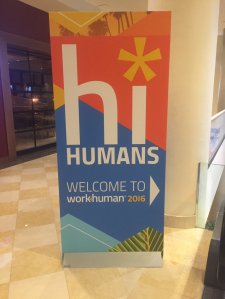
This is why I’m in Orlando, FL this week, attending the WorkHuman conference sponsored by Globoforce. WorkHuman is based on the premise that there has to be a balance between work and life, between happiness and career, and that businesses can create an environment that encourage a healthier approach to work. It’s about helping employees set boundaries and avoid the stress of trying to be “on” all the time.

The conference has sessions on mindfulness, optimism, recognition and will feature CHROs sharing how they are trying to create the “human workplace.”

This is so not how I’ve approached work in the past. I’ve been the one in the back row snorting at the idea of “mindfulness” and “happiness” and other such topics. But resilience is something that resonates with me – and we are starting to learn more about how things like optimism and positivity (mixed with realism) help build resilience.

So I’m here to learn. To hear the research behind these topics and take what makes sense back to my workplace and try to be part of the solution and not the problem.

Not all of what is shared at this conference will resonate with me. I reserve the right to snort from time to time. (After all, I’m the skeptic.) But last year’s conference was pretty darn good and I got a lot out of it. I’m excited to be here.

You’ll see a lot of me on social media the next few days. In fact, there are a lot of great people here to learn new things and share what they’re learning with folks who can’t be here. Track the conference on Twitter under #WorkHuman.

We’re failing our people

The Society for Human Resource Management – or SHRM – recently released some very interesting surveys around employee engagement and talent acquisition. Both reports have some very interesting information, so I highly suggest you download and give them a read.

As a leader and an HR professional, there were a few stats that stood out for me:

  • 88% of US employees reported overall satisfaction with their current jobs
  • 45% of US employees reported they were likely or very likely to look for a job outside their current organization within the next 12 months
  • 32% is the average turnover rate in the first 6 months for new employees
  • 26% of jobs are filled from internal candidates

Now, I’ve been known to find patterns and connections that are tenuous at best (don’t call me a conspiracy theorist…it’s really more of a hobby). But when I see these stats together, I’m inclined to make some leaps of logic, such as:

  • People are “satisfied” but would happily jump ship because they think there’s something better out there (read: “it’s all about the benjamins”)
  • 3/4 of our jobs have to be filled externally because we didn’t plan ahead
  • We’re doing a pretty crappy job of selecting the right people and/or onboarding them properly

In short, we seem to be failing our people as leaders. the-office-quotes-12-main

Yes – I’m pointing the finger at leaders right now. We’re the ones making the decisions. We create comp structures that incent employees to leave within two years (or is it three years) or lose earning power. We make lazy hiring decisions – either waiting too long to make a decision and thus lose the best candidate, or we settle for someone who isn’t really qualified because we just need a warm body.

And why are we making those lazy hiring decisions? Because we haven’t invested in employee development for a long time. The recession of 2007/2008 (and beyond) helped us justify cutting costs for developing our people – even though we know it would improve their performance, commitment and our bench strength. Oh, and it would also improve our managers, who impact our employees’ day-to-day lives. But hey…we really needed to save that $300,000 at the time. Right?

And so, we are playing catch up. Our workforce is facing a retirement wave. Yes, it was delayed by a down economy as people stayed in the workforce longer, but now people are leaving to enjoy their hard-earned retirement. So we have to hire external people to fill the leadership or more senior roles we should have been developing internally. And yes – a healthy mix of internal to external hires is preferable. But do you think it’s 25% to 75%? Really? Because our current employees see this happening and decide that there is no future for them at their current company…so they start looking.

We can make it better.

We can look at our employees’ development and decide to invest in them.

We can build Total Rewards programs that actually reward people. AND keep up with market increases. You don’t want to build base salary? Fine. Offer incentives/bonuses/whatever you want to call them. Build in some flexibility, too.

We can have conversations with our employees about their career goals, and then try to help them reach those goals. Will they always be at the current company? No. But that employee will remember you did that for them and share that story. And now you have an employer brand to be proud of.

You’ve all seen this old chestnut:

CFO asks CEO: What happens if we spend money training our people and then they leave?

CEO: What happens if we don’t and they stay?

Now replace “training” with “developing” or “investing in” or “caring about” our people. And realize that the CEO in this quote doesn’t need to worry.

The reality is, they won’t stay. They’ll find an organization that values them enough to invest in their future. And they’ll leave angry and bitter rather than inspired and grateful. And they won’t be our problem any more. And the cycle will repeat.

This is your call to action. This is your chance as a leader to use your voice and your influence to change the system. Show the business you mean business. Show your people you care.

Turn failure into success.