Get To vs. Have To: The employee’s dilemma

I’m writing this on a Sunday evening while watching playoff hockey waiting for Game of Thrones to start and trying to figure out why our dog has become endlessly fascinated by a piece of paper on an end table. In short, it’s a lovely evening and I’m happy that I get to do this.

I bring this up because as the weekend winds down, people are lamenting the fact that they “have to” go to work tomorrow. (Don’t believe me? Check your Facebook/Twitter/Instagram feeds.) And thus we are confronted by the dichotomy all employees deal with at work – what they “get to do” vs. what they “have to do.”

“Have to” is all the work employees tend to complain about – answering emails, attending recurring meetings, data entry, making phones calls, paying invoices…all the tasks that fulfill the basic functions of their job descriptions.

“Get to” is the work that employees say they want – stretch goals, new projects, visibility, variety, excitement…all the things that a new and different from the day-to-day. swivel chair

In short, “have to” is the work we get paid for, “get to” is the work that engages us.

What’s interesting is how quickly the “get to” turns into “have to” for so many employees. What was once new and exciting gets absorbed into the background as just another thing you work on in your job.

This phenomenon is known as the hedonic treadmill (or hedonic adaptation, if you must be specific) and refers to our singular ability to return to a relative level of happiness (or unhappiness) following a positive or negative event in our lives. Basically, if you’re a happy person, you’ll still be a happy person even after undergoing a setback. But if you’re a negative person, you’ll still be a negative person even if you win the lottery.

Let’s apply this to work. If you (generally) like your job, the “have to” doesn’t bring you down too much. The “get to” is a nice perk, but you don’t really need it because you’re already in a good place.  Chances are, you’re probably more engaged (or at least satisfied – NOT THE SAME THING) than the average person. If you (generally) chafe against your job, the “get to” won’t be enough to change your tune.

So if you are more of a Grumpy Cat than an Oprah (The Secret), how do you maximize the “get to” moments at work?

  • Keep your eye on the prize: Work will feel less “have to” if you find ways to help you reach your long term goals. Working an office day job but really want to be an agent? Look at your internal relationship building as honing your networking skills.
  • Take control of your “have to”: Be efficient and work your way through your “have to” list every day so it doesn’t weigh on you. Talk to your boss about restructuring your “have to” if you’re approaching burnout. One of the reasons “have to” brings us down is because we don’t have control over it. Try to get some.
  • Think of the “get to” as a reward, not a right: Remember, “get to” is development and growth. It’s not something that you should take for granted or sit back and wait for it to come to you. Be proactive and ask for the “get to”. Now it’s something you’ve earned, which can extend your happiness about the “get to.”
  • Check your attitude: Granted, people will land somewhere on the spectrum between Pippi Longstocking and Chicken Little, and it’s okay to know who you are. But if you find yourself unable to appreciate the “get to” in your life, find out why. Maybe you need more sleep, maybe you need some perspective, maybe you need therapy. Whatever it is, figure it out.

The reality is that the “have to” work will never ever go away. The trick is to find enough “get to” work to keep it interesting.

And try to have a good week, everyone!



Savvy, not sell-out (navigating office politics)

genuine-stampThroughout my career – in HR and otherwise – I have encountered numerous people who insisted that they don’t believe in office politics.

Well, to paraphrase Neil deGrasse Tyson, it doesn’t matter whether or not you believe in office politics. They still exist. And if you want to be successful in your job, regardless of level, you are going to have to figure out how to deal with them.

The number one thing people need to remember when dealing with office politics is that you CAN still be “you” while adjusting your style to fit the situation. I’ve talked to employees and leaders alike who claim they would be a fake if they were anything else but fully authentic.  Here’s the thing – there’s “authentic” and AUTHENTIC. The first kind involves flexibility with staying aligned with your values, and successful professionals typically practice that.  The second kind involves a loud, in-your-face, I-gotta-be-me approach that people who use psych profiles (think DiSC) to justify being pushy. (“I’m a D, dammit!! I’m supposed to be that way!”)

In order to be successful in business, you are going to have to figure out how to navigate the politics of any organization’s culture. I use the word “politics” deliberately, as the players each have an agenda they are trying to advance. Some of these agendas are altruistic, some completely selfish – but they all compete even if they ostensibly strive to meet the same goals.  That’s why you are going to have to learn to play this game.

So how do you play without losing yourself in the fray? By knowing how to be savvy without being a sellout, and without being your overly AUTHENTIC self. Check out these scenarios:

  • Boss suggests a course of action that you don’t think is going to work:
    • Overly AUTHENTIC response: That’s a terrible idea that won’t work.  Let me tell you why.
    • Sell-out response: You’re the boss.  We’ll make that happen.
    • Savvy response: That’s definitely an option. Have we thought about X, Y, Z?
  • Executives begin arguing with each other about small details in your business proposal:
    • Overly AUTHENTIC response: Are we really going to spend time talking about this now?
    • Sell-out response: Sure, we can do that. You guys just tell us what you want and we’ll do it.
    • Savvy response: It sounds like we have some details to work out. Do we have an agreement in the general direction and we can talk about the small details off-line? Or maybe, Would it be helpful to see the full proposal before delving into the details? Maybe your questions will be answered.
  • Coworker becomes overly aggressive/belligerent in a meeting:
    • Overly AUTHENTIC response: Oh, you did NOT just say that to me!!! (typically accompanied by a waving finger)
    • Sell-out response: Hey, hey…we can do whatever you want to do. Let’s just all try to get along
    • Savvy response: I can see that you’re upset, and that’s not my intention. What are your concerns?

Notice a trend in these responses? The savvy response is all about finding a solution without losing ground. It’s about focusing on the issue and not on the person (either you OR the other party). You can adjust the Savvy Response to be in your voice, and in fact, you should.  The more it sounds like you, the more likely the others in the room will listen and less you’ll feel like you’re selling out to the pressures in the situation.

So the next time you’re in a politically-charged situation, be prepared to translate your overly AUTHENTIC response into one that will ensure you’re heard and one that moves towards a solution.  And you don’t even have to sell your soul to do it.

 Authenticity requires a certain measure of vulnerability, transparency, and integrity.
~ Janet Louise Stephenson

The truth will set you free…but first it will piss you off.
~ Unknown

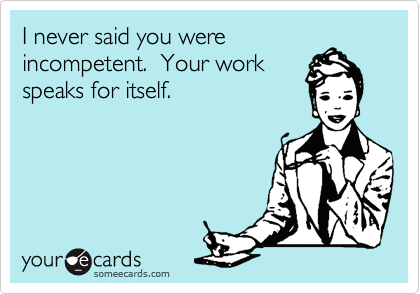
So, you’re a crappy employee. Now what?

Okay, maybe you’re not really a crappy employee.  Maybe you’re just a misunderstood genius.  A tortured artist whose brilliance is unappreciated by the rest of us.

Right.

Or maybe you really are an employee who just isn’t very good at your job.

Hey, it happens. Sometimes responsibilities change and you don’t have the necessary skills.  Sometimes you take a stretch job and you’re in over your head. Sometimes you get a new boss you just don’t get along with.  Sometimes you just run out of gas.

Whatever it is, you probably know you’re not doing your best, and it bothers you. A lot.

Nobody likes being bad at their job. And contrary to popular belief, most employees know when they are struggling.  We don’t always admit it…but deep down, we know.

never_said_incompetent

The real question is – what do you want to do about it? Well, you have a few choices:

  • Decide if you want to stay in your current job: Maybe you like your job.  Maybe you don’t like your current job but need it.  Or maybe you really hate it and have the freedom to walk away.  Figure out the answer to that question and act on it.
  • If you want to leave, leave: Don’t be one of those people who quits but keeps coming in every day. It hurts your reputation, hurts your teammates, and never turns out well.  If you’ve decided to leave, do it sooner rather than later. But leave like a grown up, okay? No mic drops needed.
  • If you want to stay, fight for it: Acknowledge that you are not performing up to expectations. Get some help.  Ask for for honest, specific feedback from your manager, stakeholders, teammates – anyone who can give you some suggestions on how to turn things around. And don’t settle for “just do better.”  Ain’t nobody can act on that advice.
  • Own it: Maybe someone else was the spark for your troubles at work, but you’re the one who controls your actions. Admit you own your performance and the outcomes.  It’s the only way you will be able to make the necessary changes.
  • Get your head on straight: If you’re having trouble at work, you’re probably not the happiest person right now. It’s easy to work yourself into a downward spiral with negative self-talk and a crappy attitude. Take some time to reflect on how you got to where you are. Confide in a friend, a group of friends, a therapist, your dog – whoever you need in order to help you work on your outlook.
  • Keep checking in: It didn’t take you a day to turn into a crappy employee, so give yourself some time and keep the dialogue with your manager open.  Course correct as needed and keep moving in the right direction.

Whatever you decide to deal with your current situation, don’t forget to celebrate the wins. When you’re in a tough situation, you can forget how awesome success can feel. Whether you quit a job you hate or decide to take control of your current performance – you deserve a little pat on the back. It takes courage to take action when you feel beat up.

You might be a crappy employee now, but there’s no excuse to STAY a crappy employee.

You can do it. I believe in you. After all…you’re a misunderstood genius.

Just like the rest of us.


Failure is good as long as it doesn’t become a habit.
~ Michael Eisner