Expanding horizons

This is my plea that everyone – employees and leaders alike – learns how to think outside of themselves.

That they look beyond their personal role to see how they impact the world around them.

That they try to improve the processes they work within.

That they reach out to those they work with to offer support when needed.

That they reach out to those they work with to offer a kick in the butt when needed.

That they step back and think about how the offhanded comment they made in a crowded room might have been interpreted.

Earth_GlobeThat they realize that they made a positive difference in the lives of the people they interact with.

That they see their value in the world and know it spreads beyond those who see them every day.

That they recognize their power to influence…and use their power for good.

That they learn how to say “no” so that others say, “I understand.”

That they win with humility.

That they lose with grace.

That they never lose their love of learning – or that they discover it in the first place.

That they remember that every single person they interact with is going through something in their lives that others don’t know.

That they see the potential of the team, organization, and community that they are a part of – and want to help everyone reach that potential.

That they want to build, not destroy.

That they learn that success comes in many forms.

It is my hope that everyone – employees and leaders alike – realize it’s not all about them.

It’s about us.

When things go wrong, will your people do right?

Today was the kind of day that business travelers tell horror stories about.

I’m speaking at two conference this week (MNSHRM and WISHRM), and today was the first day of a week of travel. It was supposed to be easy. I had just gotten my TSA Pre-Check, so security wasn’t a problem. And I was flying Southwest Airlines with a good boarding position (A 31 – not too shabby).

How hard could it be?

My husband dropped me off at the airport one hour and forty minutes before my flight was scheduled to take off. I figured I’d drop off the bag, breeze through security and grab a little breakfast.

And then I encountered this:

line_southwest

A line to end all lines. And it was even worse inside.

Turns out, Southwest had a massive computer system outage today. They couldn’t print boarding passes from many of the service desks. They couldn’t print baggage claim tickets.

They had to do EVERYTHING by hand – check in, boarding, manifest clearing – everything.

And you know what? They did it with a smile.

The skycaps worked quickly. They had their process down and did what they could to keep the mood light. (I got through that ridiculous line in 35 minutes.)

The boarding gate agent was funny and handled the craziness with some humor.

The flight crew acknowledge the challenges, kept the passengers informed, and did what they could to ensure everyone on the flight made it – even when security was backed up (seriously…get TSA pre-check).

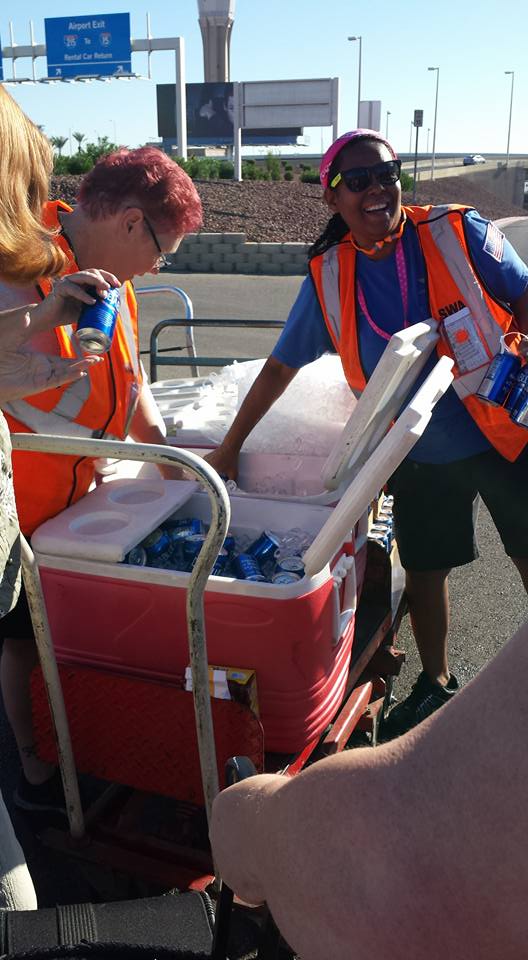
It wasn’t just in my hometown where the employees did what they could to make the best of a terrible situation. Check out these employees in Las Vegas, handing out cold drinks to folks stuck in the hot sun:

SW_2

Was everyone happy? Of course not. It was stressful for everyone involved. Not everyone saw exemplary service from Southwest employees, but overall, they have handled the ongoing problems pretty well.

In the event of this kind of crisis, how would YOUR employees perform? And what can you do to best ensure you’re ready to respond?

  1. Have a plan: The Southwest employees weren’t using sticky notes to process baggage. They had printed tags designed for manual checking. The gate agent had a protocol to process mobile and paper passes without computer access. If you don’t have a Plan B for your business process, you’ll have even more problems.
  2. Hire the right people: Southwest is very explicit about their culture and expectations for their employees – but they also make a pledge to do right by their people. (The “To Our Employees” clause…) By taking time to find the right people to carry out your organization’s work, you increase the likelihood that they will be able to respond to a challenge the way you want them to.
  3. Balance process with humanity: I can’t imagine the level of complexity Southwest faced with this system outage. Between the sheer number of passengers, Homeland Security requirements, and airport regulations, they could have chosen to approach this with a very command-and-control approach. Instead, I saw employees empowered to make decisions. I read examples of employees given the freedom to hand out cold drinks. I saw a flight crew take time to alleviate a passenger’s concern about a connecting flight when we took off late. Are you willing to let go in times of pressure and put the trust in your people to do the right thing?

They say that adversity does not build character, it reveals it.

What character will your people reveal?

[Disclaimer: I’m sure a LOT of people had a horrible travel day today, and many of them are annoyed and frustrated still. My experience may not be the same as others. If you had a bad start to your day, I really hope it got better!]

Development as partnership (when leaders and employees get it)

Last week, I had the opportunity to both attend and speak at the Illinois state conference for the Society of Human Resource Management (henceforth referred to as ILSHRM, ’cause that’s way too much to type out).

Hundreds of HR professionals descended upon the Holiday Inn and Convention Center in Tinley Park, IL for a couple of days of networking, socializing, eating far too many carbs, and yes…learning.

I love being able to talk to people from around the country about what they do, what they struggle with, and how they are trying to make their workplace – and themselves – better. And these folks are from Illinois, so they’re chatty Midwesterners who are open, honest, and a lot of fun to boot.

Dancing_Cats

What struck me as I talked to the fine folks of ILSHRM is that we all have similar challenges – high state of change, evolving business demands, disengaged employees, managers who don’t always get it, legal shifts, work-life balance, etc. And what impressed me is that despite all the challenges, these people were determined to find a way to fix it. They believed that by advancing their skills, learning from others, and challenging their own thinking, they might be able to take something from ILSHRM back to their workplace, apply it, and make a difference.

Naive? Maybe. Optimistic? Probably.

Impossible? No.

I say it’s not impossible because all those people attending ILSHRM had the support of their organizations and/or their boss.  Maybe it was a “check the box” exercise to prove the company supports development. Who cares – they got to go. Most were there because their boss/leadership had specific problems and trust their HR team to go find a solution that will work for them.

This conference reaffirmed the fact that when leaders and employees are both devoted to development, good things can happen. Heck, I was there because my boss was willing to let me go spread our brand and bring new ideas back. (Thanks, Gail!)

And for the cynics out there, you’re right – some people attend conferences to get their credits to avoid retaking a test, for the carb overload, for a couple of nights away from the kids. But tell that to the fun folks I had lunch with from the Metropolitan Water Reclamation District – all 10+ of them. This was a group determined to get something out of the conference…and have a fun time while they learned. And tell that to the young HR professionals who asked incredibly powerful, insightful questions in all the sessions they attended. They weren’t content to listen and leave – they wanted to explore, to learn from the collective experience from the folks in the room.

The reality is that this only works if everyone involved is willing to MAKE IT WORK. (Tim Gunn shout out!) Developing employees is more than signing up for a class or a conversation about career goals now and then. It’s about employees stating what they need for their development and leaders supporting them in that endeavor.

It takes two to tango.

Leaders, employees, customers and companies all benefit when development is supported. So I challenge each of you – whether you are a manager or individual contributor – to do what you can to partner for development. You’ll get so much more out of it than what you put into it.

I know I do.